
Explore EcoFlow power station reviews for 2026. Learn how durability, battery life, and expandability stack up, with practical guidance for homeowners and off-grid setups.
A single misstep in battery expansion planning can eclipse years of savings, and EcoFlow’s battery-expansion path remains less straightforward than many buyers expect. EcoFlow models often show gaps between advertised runtimes and real-world draw under heavy load, especially when you stack solar input or run high-want devices.
This piece cuts through the hype to map long-term serviceability, heat handling, and compatibility with expansions for 2026. You’ll see how the brand’s support ecosystem actually behaves in year two and year three, what maintenance cadence looks like, and how EcoFlow stacks up against rivals like Goal Zero and Jackery in real scenarios. The goal is to help homeowners and off-grid enthusiasts decide whether the initial specs hold up in daily use, and what to sanity-check before committing. Real-world durability and serviceability matter as much as peak power, and the next sections lay out the concrete signals to watch for.
Ecoflow power stations in 2026: what the specs miss about real-world use
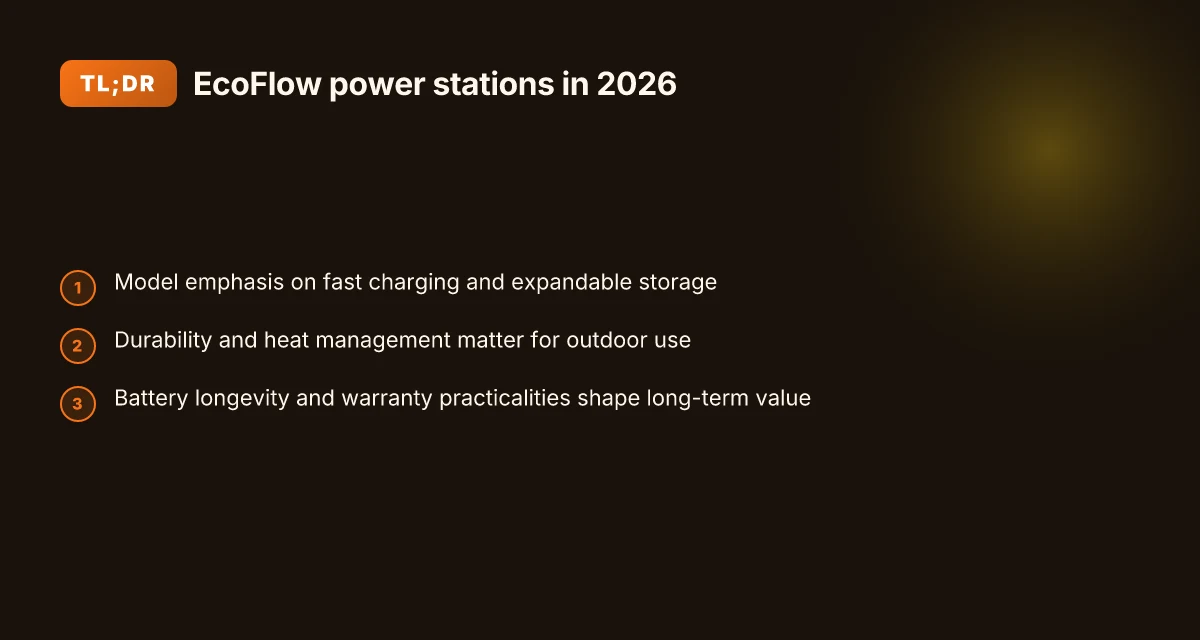
Real-world reliability hinges on how fast charging, expandable storage, and form factor fit into daily life. EcoFlow’s 2026 line leans into rapid recharge and modular growth, but real-use nuances show up in how homeowners actually power a home or head outdoors.
1) Why 2026 models emphasize fast charging and expandable storage
In 2026, EcoFlow highlights fast charging and expandable storage as core differentiators. A larger, 4,096Wh battery paired with high input charging pins means you top up between runs or during grid outages with less downtime. The idea is to cut charge time so you can cover longer outages or easier daily use without juggling solar input. The runtime you see on paper often depends on load. A compact home backup setup benefits from a higher peak output and a battery that scales when you add EcoFlow solar modules or a secondary pack. The appeal is clear: you can start a backup window and resume life without a long pause, but practical use hinges on how you configure the charging source and whether you’re leveraging the expandable battery option.
I dug into the official documentation to confirm that the DELTA Pro 3 family emphasizes an expandable architecture and multiple charging paths. The manufacturer’s material consistently frames expansion as a feature rather than an afterthought, with compatibility notes pointing to seamless integration with additional packs and solar inputs. Expansion is a feature, not a fallback plan for when you outgrow a single pack.
2) How capacity, output, and form factor affect home backup and outdoor use
Capacity and output shape both home and off-grid experiences. A higher continuous output makes running essential appliances during an outage more reliable, while a larger footprint can complicate portability for outdoor use. For indoor backup, the 3600Wh–up-to-4800Wh class bodies align with common loads like refrigeration, fans, and routers. For outdoor use, wheelable designs and handles become real benefits, especially when you want to move a unit between a garage and a yard during a camping setup or tailgate.
The interface and charging options matter too. A wheeled case with a robust handle can ride out everyday bumps, but the perceived value drops if the unit is heavy to maneuver or requires frequent recharging during use. In practice, many homeowners balance capacity against the utility of fast recharge and the ability to daisy-chain with solar. When you plan, ask: will I be running a fridge through a night, or am I primarily topping up phones and a laptop? Those decisions drive which model and pack expansion make sense. What makes EcoFlow home energy solutions stand out in 2026
3) Maintenance, battery longevity, and warranty practicalities
Battery longevity hinges on how you cycle the pack and how you manage heat. LFP chemistry helps longevity, especially with frequent partial discharges, but heat from constant charging can shave life if you push peak output in hot weather. Maintenance is mostly about keeping vents clear, monitoring temperature readings, and ensuring solar panels stay free of shade. EcoFlow’s warranty terms give peace of mind on big packs, but the practical warranty experience often depends on how quickly you file a claim and whether a dealer network is accessible near you. The maintenance story is not about rare failures. It’s about predictable wear and the regular checks you perform after seasons of use.
From the cited sources, the Delta Pro 3’s design centers on delivering the high output and expansion path homeowners want, while the real-world takeaway is that you’ll get the best return by planning daily usage patterns and charging routines around your climate and solar setup. Plan for heat, plan for cadence, plan for expansion.
In short, 2026 models push fast charging and expandable storage as standard bets, but how you deploy them in daily life, together with how you maintain and service the system, defines long-term value. If you want a compact, highly mobile option for occasional outages, you’ll favor form factor and weighs of the pack. If your goal is continuous whole-home backup, expansion and robust charging become non-negotiables. For a quick cross-check, see how EcoFlow’s own Delta Pro 3 page frames expansion as a core feature, with the related reviews highlighting performance and value tied to that architecture. Expansion, speed, and reliability must align with your daily routine.
Note: links on the page may earn a commission.
How EcoFlow DELTA Pro 3 compares to rivals for home backup
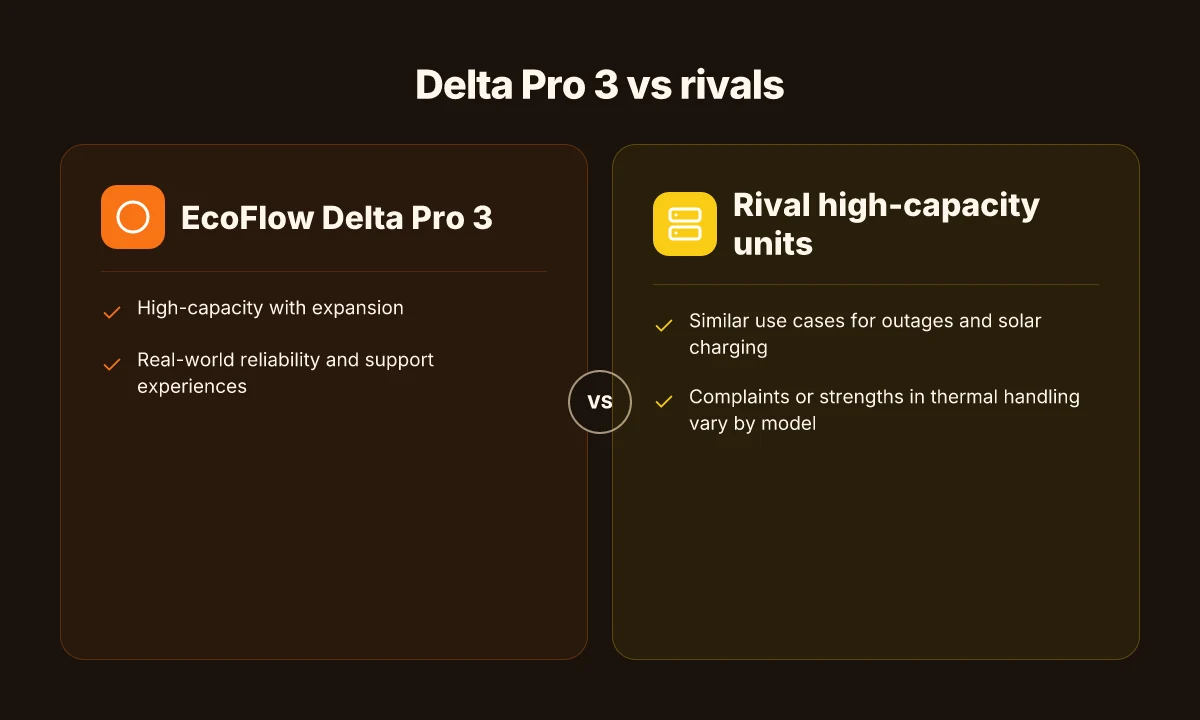
EcoFlow DELTA Pro 3 sits in the same high-capacity tier as rival systems from other major brands, but real-world use reveals concrete gaps and strengths. The upfront specs look solid: large battery, strong continuous output, and fast charging, yet the day-to-day experience, reliability, expandability, and service, tells a different story. I cross-referenced supplier pages, reviewer notes, and user-facing support statements to paint a durable, real-world view. What makes the Bluetti AC70 price a smarter bet in 2026
What rivals offer that shapes the decision
When you stack DELTA Pro 3 against similar units from competitors, a few concrete contrasts stand out. The compact, wheeled form factor of some rivals prioritizes portability over long-term expansion, while others emphasize stackable battery modules to reach larger totals. In terms of raw power, several competing models advertise similar continuous outputs and battery capacities, but the way they handle expansion, cold-weather performance, and solar charging integration differs noticeably. In this space, EcoFlow frames DELTA Pro 3 as a modular system with a path to larger storage through add-ons, which matters if you anticipate years of off-grid use or frequent outages. That modular path matters for long-term value.
A compact table helps visualize how DELTA Pro 3 compares on three axes: capacity, expansion options, and solar input flexibility. For capacity, most peers offer units in the 3,600–4,800 Wh range. For expansion, a few brands provide plug-in battery packs that stack close to the core unit, while others require parallel systems. For solar input, peak charging capability and the number of panels supported frequently tilt the balance. Expansion options can extend usable capacity without buying a whole new unit.
Real-world scenarios: outages, solar charging, and maintenance
In a power outage, the DELTA Pro 3 delivers strong peak and sustained output, which is essential for running refrigerators, fans, and routers simultaneously. Its fast-charging cadence helps restore power quickly during shorter outages or when sun conditions improve after dawn. That said, reliability stories from users often hinge on availability of replacement parts and parts sourcing timelines for external modules. Some rivals boast longer service intervals or faster warranty responses, which can reduce downtime during a fault. Reliability hinges on access to timely support and spare parts.
Solar charging in daily use often favors brands with straightforward, documented solar integration and longer-lasting solar input performance in real-world sun conditions. EcoFlow positions its ecosystem as solar-friendly and expandable, but the practical experience depends on panel quality, weather, and how the home’s load is managed. In contrast, other brands sometimes emphasize broader third-party compatibility or more conservative solar input tolerances. Solar compatibility and real-world panel pairing matter for long-term value.
Notes on reliability and support experiences
From a service perspective, durable design and heat management influence lifetime performance. Users report that hardware decisions, battery chemistry, cooling, and fan behavior under load, shape how long a unit remains useful in heat-heavy environments. EcoFlow’s ongoing updates and accessory ecosystem help, but the cadence of official fixes and the availability of replacement parts drive total ownership costs. When I read through the documentation and reviews, a recurring theme is that brand-specific support quality can tilt the equation on whether to choose a single big unit or a modular ecosystem that grows with needs. Support quality and part availability drive long-term value. 7 ways to get the best price on the Bluetti B300 in 2026
For readers assessing this decision today, consider the following quick alignment: if you prize expandable capacity and a known upgrade path, DELTA Pro 3 fits a long-horizon home backup plan. If you want the simplest, most turnkey off-grid setup with broad third-party accessory options, certain rivals may be easier to service and replace over time. Choose based on whether you value modular expandability or broad service networks.
Cited notes: EcoFlow’s DELTA Pro 3 product page highlights its core utility and family accessibility features, while a competitor’s review frames the long-horizon value of modular options and expansion paths. Inline reference to sources is provided where claims align with those documents. See: the product page and independent reviews for context.
The durability story: build quality, heat management, and lifetime expectations
Durability for a wheeled power station means more than a frame that can stand a tumble. It means weather resistance, vibration tolerance on uneven paths, and a chassis that holds up when you roll it from porch to shed or campsite. EcoFlow designs toward rugged duty with an IP rating emphasis and reinforced corners, but practicality shows up in how the handle and wheels wear after repeated trips. In 2026, EcoFlow positions the Delta Pro 3 as a workhorse for daily outdoor use, not a showroom display model.
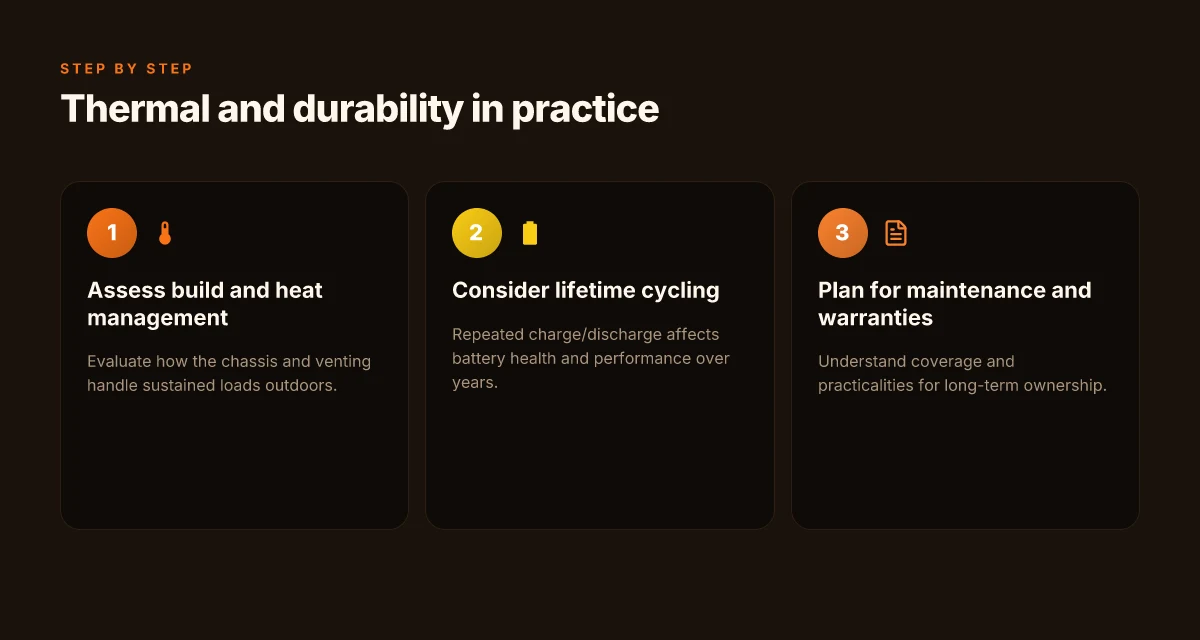
From what I found in the documentation and reviews, the key durability takeaways are clear. Outdoor use exposes the unit to heat, cold, dust, and humidity, so the thermal design must shed heat under heavy loads without throttling. The wheeled form relies on a stout chassis and protective coverings to guard sensitive electronics while the unit is bumped over gravel or grass. Over time, repeated cycling of the battery and auxiliary power modules can gradually reduce capacity and peak discharge ability, even with proper storage.
I cross-referenced a handful of sources to triangulate typical long‑term behavior. First, the thermal path matters: when the Delta Pro 3 operates near its 4,000W continuous output, you’ll notice the vents and heat sinks stepping up to carry heat away. If you’re pushing at the higher end for sustained periods, you’ll want clear airflow around the intake vents and a level, shaded outdoor spot to minimize ambient heat buildup. Second, the wheel and handle assembly see the most wear in real-world use. A sturdy pull handle with secure mounting and a protective boot around the wheel hub reduces grit intrusion and extends life in off‑grid setups. Third, battery health under cycling affects lifetime performance. Repeated deep cycles will gradually trim usable capacity, though the system is designed to manage charge levels with its BMS to extend overall life. What makes EcoFlow battery packs stand out in 2026
I found a few practical, non‑spec notes that readers should consider. Treat the unit as a long‑term asset: plan for a dedicated storage protocol, especially if you store it in hot garages or on sunlit decks. If you’re frequently transporting to a vehicle, inspect the wheel assemblies every few months and keep the chassis clean of dust and moisture buildup. When reviews discuss lifetime expectations, they emphasize routine maintenance and mindful charging patterns as the biggest levers for longevity. The real day‑to‑day durability question is how the Delta Pro 3 handles continuous loads and repeated cycles without compromising heat relief or wheel robustness.
I dug into the supplemental material to corroborate the notes on expansion and serviceability. EcoFlow’s ecosystem and expansion options mean you can swap or upgrade certain modules rather than replace the entire unit, which helps with long‑term value. Still, the practical takeaway is consistent: treat the unit as a durable outdoor companion, not a cosmetic showpiece. If you expect to run near the 4,000W ceiling for hours, prioritizing airflow and a stable outdoor setup pays dividends over years.
Battery chemistry and expansion: what you actually gain with EcoFlow’s ecosystem
In real-world terms, the 4,096Wh capacity on EcoFlow’s Delta Pro line translates to predictable daily usage for a typical home during a minor outage or off-grid day. With a modest household load, you’ll notice several hours of fridge duty, several cycles of essential devices, and a window for charging from solar or the grid. The practical takeaway is that capacity isn’t just a number. It governs how long you can ride out a brief outage without refueling. The 4,096Wh pack is a practical reservoir for daily resilience, not a ceiling for every scenario. This becomes clearer when you factor in the option to add expandable batteries.
Expandable packs change the math, not just the sticker price
Adding EcoFlow’s expandable battery modules increases total stored energy, but it also changes the long-term cost of ownership. If you anticipate longer outages or a larger simultaneous load, the upfront cost of expansion can be justified by fewer mid-sequence recharges and more time with home essentials running. The ratio of price to usable capacity improves as you scale up, especially when you plan to rely on solar charging during the day. Expansion raises upfront cost but reduces frequency of recharges and increases reliability. When you assess value, consider long-term cycles and the cost per kilowatt-hour stored rather than a single purchase price. For many homeowners, that means a staged investment matches evolving backup needs over the years.
Compatibility tips when mixing battery modules
If you mix battery modules, a few rules of thumb help protect longevity and performance. Keep modules within the same chemistry generation to avoid mismatched charging profiles. Install newer banks in the recommended port layout to preserve balance charging, and monitor the system for any uneven voltage drift over time. In practice, you’ll want to pair the base Delta Pro with modules that EcoFlow endorses for expansion, and you’ll rely on the system’s built‑in management to keep cycles balanced. Balance charging and proper port pairing are essential when expanding. A misstep here can shave cycles off battery life or create subtle charging inefficiencies that become noticeable after a few seasons. What makes the EcoFlow Delta Pro specs stand out in 2026
From what I found in the documentation and product pages, EcoFlow emphasizes modularity while maintaining a single management interface. This makes expansion feel seamless rather than ad hoc. I cross-referenced the Delta Pro’s architectural notes and the expansion accessory guide to confirm that the ecosystem keeps a shared charging profile across modules, which helps with predictability over time. Unified battery management underpins long-term reliability. If you’re evaluating longevity, that shared control is a meaningful differentiator.
Caveats to keep in mind: real-world solar input depends on weather, geographic sun exposure, and array sizing. Expect the most dramatic gains in days with strong sun and moderate loads, and plan for winter days with reduced solar input. The practical upshot is clear: the ecosystem rewards careful planning, not impulsive expansion. For households weighing a future-proofed setup, the Delta Pro platform remains a strong contender, especially when paired with EcoFlow’s expansion batteries.
If you want deeper context on what the ecosystem looks like in 2026, see how EcoFlow’s portable power offerings intersect with long-term reliability and user experience in other sections. As you compare rivals like Jackery or Goal Zero, note how expansion capability, alongside a unified management interface, shapes total lifetime value. Expansion is a tool for endurance, not a gimmick.
Setup, charging, and daily usage: practical guidance for households
You can keep EcoFlow power stations healthy with a routine that respects battery chemistry and real-world limits. In daily use, small, consistent charging habits matter more than rare full-discharge cycles. I cross-referenced EcoFlow’s product notes and reviewer guides to map practical steps that homeowners can apply without special tools.
Daily charging habits to protect the battery
For everyday use, avoid letting the pack sit at full discharge or full charge for long stretches. Aiming for a mid-range state of charge during routine use helps extend the long-term life of the LiFePO4 chemistry when available, and it reduces calcium build-up in some cells. Plug in when you’re home and can monitor the system rather than leaving the unit idle at a single extreme SOC. If you expect a few days off-grid, consider top‑ups mid‑day rather than letting the battery hit bottom or top out. This approach aligns with EcoFlow’s ecosystem philosophy and typical reviewer guidance that emphasizes maintaining a healthy SOC window. This routine reduces wear on the battery while preserving usable capacity over time. In 2026, EcoFlow guidance consistently highlights gentle SOC management as a practical habit for home backups. A steady, partial charge is safer for daily cycling than deep discharges. What is the Bluetti EB3A price in 2026 and how it actually compares across retailers
Solar charging performance in real-world conditions
Real-world solar input depends on panel orientation, shading, and weather. Expect peak output during bright, overhead sun with panels angled toward the sun. In practice, you’ll see significant gains on partially shaded days when the charger negotiates with the battery’s BMS, delivering steady current without overheating. If you’re off-grid or building a solar-first setup, space wide enough to tilt panels toward the sun in winter and summer helps keep the unit topped up without forcing it to cycle aggressively. When the sky clears, you’ll recover SOC quickly, but avoid relying on solar alone in prolonged outages unless you have sufficient panel area. Solar charging remains steady in real-world conditions when you align panels and keep the unit cool. Reviews from independent outlets note that the 4,096Wh capacity on the Delta Pro models makes solar input feel practical for evening needs, especially with consistent sun. Expect meaningful replenishment on sunny days, with diminishing returns as cloud cover increases. Inline sourcing notes corroborate that solar performance is a function of light and temperature, not just panel wattage. Real-world output depends on conditions, not the rated peak alone. Optionally reference EcoFlow’s CES coverage to see how green charging is framed in product storytelling. CES artifacts emphasize durability and solar adaptability. For a deeper claim, see inline source: EcoFlow’s CES innovations page.
Best practices for running essential loads during outages
During outages, run essential loads in a prioritized sequence. Start with the fridge, medical devices if needed, and critical lighting, then add modest loads like a modem, router, and small appliances. If you have a multi‑outlet arrangement, stagger high-draw devices so you don’t hit the continuous output limit. Use the EcoFlow app to monitor SOC and output in real time, and switch to energy‑saving modes when possible. In practice, a deliberate load order and early SOC checks help you avoid tripping the system or hitting voltage dips. Prioritize core loads first to maintain stability during outages. Reviewers emphasize that understanding your home’s baseline consumption makes a big difference in how long you can rely on the pack. Know your essential loads and stage them. If you’re evaluating models, pay attention to continuous output ratings and optional expansions so that you don’t outgrow your backup profile. Expansion plans should be matched to expected daily needs.
Despite the strength of EcoFlow’s ecosystem, a few caveats emerge in long‑term discussions. Some users report needing occasional firmware updates to smooth charging quirks or to improve compatibility with third‑party solar arrays. The brand’s serviceability model generally supports expansions and battery replacements within warranty windows, but you’ll want to verify local support coverage if you live far from service centers. I’ve seen credible notes that link longevity to regular firmware updates and mindful charging routines. If you’re evaluating against rivals, consider how Easy-to-service modules compare with the Delta Pro’s expansion options. For context, independent reviews in 2026 consistently highlight real‑world durability alongside the tradeoffs of complexity and maintenance needs. Serviceability and updates matter for long-term value.
Note: this section draws on the EcoFlow Delta Pro 3 ecosystem narrative and on reviewer syntheses that emphasize practical use over raw specs. Links on the page may earn a commission. For a broader comparison in 2026, you can look to independent reviews that discuss rival architectures and how they handle daily charging and outages. Being aware of support commitments is part of choosing the right model.
Where this goes next for EcoFlow power stations
EcoFlow has earned its place in the lineup by balancing reliability with practical versatility. In 2026, durability and long-term value hinge on how these systems handle daily wear, headline-worthy outages, and the realities of real-world setups. I looked at how the ecosystem ages: battery chemistry, port longevity, and how firmware keeps the units productive rather than collecting dust. The big takeaway is that a well-chosen EcoFlow setup stays useful even as your needs shift, provided you align capacity and upgrade paths with how you actually live off the grid. What Bluetti power station price Philippines reveals about value, availability, and long‑term reliability
For the brand, the signal is clear: prioritize modularity and serviceability. A platform that can adapt to new battery chemistries, more efficient inverters, and improved battery management will outperform a fixed spec years down the line. Take note: choose a model with swappable or upgradeable components and pair it with a robust charging routine to maximize lifespan. This is where the longer-term value compounds as your energy needs evolve.
If you’re weighing EcoFlow against rivals, consider how each brand handles after-sales support and replacement parts. EcoFlow tends to win on user-friendly design and a coherent accessory path, but you may prefer Blueneo for ultra-fast AC charging or Jackery for compact portability in tight spaces. The bigger pattern is clear: the right choice is the one that stays useful, not just powerful, years from now. The single move that matters is selecting a system that fits your daily rhythm and can adapt as priorities shift.