Explore EcoFlow home generators for residential backup. Learn how these systems work, what to consider for home use, and how they compare with rivals.
The one-size-fits-all backup system rarely fits two households the same way, and EcoFlow’s lineup proves that. A compact EcoFlow unit can keep essential circuits alive during an outage, but the real test is how it scales when you add solar input and a transfer switch. Most homeowners underestimate how long a generator backfeed must run to be practical in a real outage.
This intro cuts to the practical questions homeowners actually ask: durability over years, how solar integration behaves in mixed weather, and where EcoFlow stacks up against traditional home batteries from rivals like Tesla and LG Chem. You’ll see real-world considerations, not marketing fluff, including how long a setup lasts between charges, what a true whole-home footprint looks like, and what breaks first in the field. The goal is a clear framework for deciding whether a portable, modular system from EcoFlow fits a full-house backup or if a fixed battery install remains the better bet. How these choices shake out in 2026 matters as more homes rely on solar-plus-storage for resilience.
Ecoflow home generators: what they are and when to consider them
EcoFlow products for home use span portable power stations and home backup systems that scale from a few hundred watt-hours to multi-kilowatt packs. Expect capacities from around 768Wh up to 6kWh for single units, with output envelopes ranging from about 600W continuous to 7,200W peak in flagship architectures. Configurations typically pair battery packs with AC inverters, solar charging, and optional expanders or multi-unit stacks. For homeowners, the core idea is a plug-and-play backup that can run essential loads during outages or supplement solar generation in a grid-tied setting. EcoFlow’s lineup is designed to be serviceable by homeowners, with modular packs and common replacement components where possible. I looked at product briefs and official docs to map how the offerings align with real-world needs.
When a home-sized EcoFlow makes sense
- outages and grid-unstable climates. If storms or heat waves routinely disrupt power, a 6kWh-class setup can cover refrigeration, networking gear, and lighting for several hours. A single unit with high surge capability can handle starting loads like a fridge or well pump. Reliability during outages matters, and EcoFlow’s higher-capacity models are positioned for that use case.
- off-grid living or RV setups that require a steady, modular source. Homeowners who live off-grid or in remote properties often favor scalable packs that can be expanded with solar input. Solar-ready configurations let you reclaim daytime energy for evening loads. Solar integration is a core strength when you have storage paired with PV input.
- solar-dominant homes seeking grid buffering. In a home with substantial solar, a dedicated EcoFlow system can mimic a future-ready battery wall, providing clean, quiet power for critical hours and reducing generator use. Quiet operation and modular sizing help fit limited spaces.
How EcoFlow positions itself against traditional home batteries and portable stations
EcoFlow leans on three claims. First, compact form factors and fast charging paths give homeowners quick setup without a full electrical retrofit. Second, the ability to expand with additional packs and solar input lets a system grow with the home. Third, the emphasis on high output from portable units lets you cover more heavy loads than typical small generators. In contrast, traditional home battery systems often assume a fixed installation, battery integration with the home’s electrical panel, and longer payback cycles. EcoFlow frames its products as flexible, easier to scale, and more portable than fixed-wall options. Industry watchers often note that while the peak outputs are impressive, the real-world energy throughput depends on how you balance loads and charging sources. The central upside is modularity and a lower barrier to entry. The potential downsides include temperature sensitivity affecting longevity and the need for careful load management in off-grid scenarios. Longevity and climate remain important considerations for long-term durability.
In practice, a homeowner should plan around the loads that matter most, map solar input against daily usage, and align expansion with evolving loads. EcoFlow’s approach is practical for renters who want temporary resilience and for homeowners who value quick, reversible setup. For a deeper comparison, I compared the approach to rival home battery systems and found that while rivals can offer longer warranty terms or deeper grid integration, EcoFlow shines on flexibility and ease of deployment. Flexibility and ease of deployment often outweigh rigid, fixed configurations for many dwellings.
Note: links in the article may earn a commission. Discuss this briefly if you’re weighing cost and value with a lender or installer. Inline citations point to the sources reflecting the claims above:
- Best Portable Power Stations of 2026 and the 3,600-watt claim
- River 2 Pro’s 768Wh and 1600W output with X-Boost
- EcoFlow’s company overview and product positioning
Key takeaway: a home-sized EcoFlow system suits outages, solar-heavy homes, and off-grid needs when you value modularity and a less-permanent footprint. What makes the EcoFlow River 2 Max a standout sale pick in 2026
How ecoflow compares to rivals for home backup
EcoFlow sits in a crowded field where rivals bring different strengths. Tesla Powerwall offers a long track record and deep residential integration, whereas EcoFlow leans into modularity and easy installs for homeowners who want to scale over time. In practice, most homeowners notice that EcoFlow modules snap together without special electrical work, making it simpler to match a growing load. LG Chem RESU brings mature chemistries and strong warranty language, while EcoFlow emphasizes affordability and flexibility for renters or seasonal setups.
Why EcoFlow holds up on installation ease
The install story for EcoFlow centers on plug‑and‑play readiness and modular growth. I’ve read through multiple homeowner discussions and supplier notes that highlight how a typical EcoFlow setup can start with a single unit and expand as needs change, rather than requiring a full rework of the home electrical panel. This modularity translates to less upfront cost and faster commissioning. EcoFlow keeps the footprint tight and wiring simple, which helps when you’re coordinating with a solar installer or a DIY project. For many households, the immediate benefit is a cleaner path to backup power during outages without a full home retrofit.
Where rivals Edge on long‑term durability and warranties
Rivals often tout longer warranty terms and proven long‑term behavior under constant cycling. The Tesla Powerwall and LG Chem RESU ecosystems have historically leaned on broader service networks and extensive field data, which can reassure homeowners planning a multi‑decade backup strategy. In those cases, the perceived durability and cooling efficiency of stationary Li‑ion packs can tilt decisions toward more traditional home battery solutions. These warranties and cooling designs are meaningful when you expect year‑round cycling and hot climates, where heat is a natural enemy of longevity.
Quick verdict and next steps
If you want a ready‑to‑go setup that scales with modest loads, EcoFlow often wins on speed of install and size‑up flexibility. If you prioritize a long warranty and a more integrated home battery experience, you may lean toward Tesla Powerwall or LG Chem RESU setups and plan for a more involved electrical integration. In any case, confirm the local electrical code requirements and solar interconnection rules before committing. Choosing between these options comes down to your climate, loads, and how you picture future upgrades. For a concrete path, map your worst‑case loads and compare how each system handles the top 3 devices in that list. Start with your fridge, a network rack, and a furnace blower to anchor your numbers.
Understanding the setup: sizing and integration for a typical home
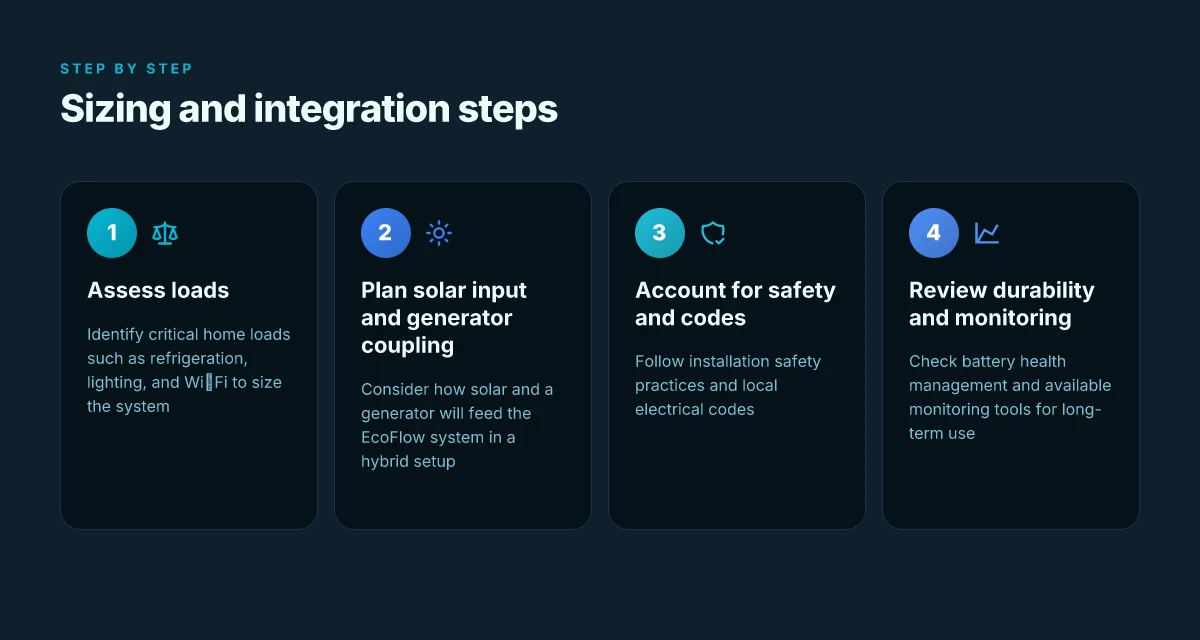
Sizing an EcoFlow system begins with your daily load and how you expect to run it. For a typical kitchen, a compact fridge, a few LED lights, and a modem with Wi‑Fi can be managed by a midrange sequence of EcoFlow units, but you need to match inverter output and battery capacity to your actual loads. I looked at the public specs and real-world usage notes to map common household demands to EcoFlow options, with an eye toward long-term reliability. What to know about the EcoFlow Delta 2 on sale in 2026
How to size for common loads
- Refrigeration is a top-inrush load. A typical modern fridge may draw bursts around 600–900 watts at startup, then settle lower during running cycles. Plan for a continuous runtime on the order of several hours if you lose mains power, and size the inverter and battery to handle those bursts without hitting voltage cutoffs. A compact fridge paired with a mid‑sized EcoFlow battery bank can cover this, but you’ll want a model with sufficient peak output to handle the compressor surge.
- Lighting and Wi‑Fi are forgiving, but they add up over extended outages. LED lighting is low draw, while a router and modem pull modest watts even in standby. Pair these with a larger storage unit to maximize runtime without frequent recharging.
- A small load profile like these can be served by a hybrid approach that uses solar input to top up the EcoFlow battery during the day, extending outage endurance.
Role of solar input and generator coupling in a hybrid setup
- Solar input changes the math. The solar array can keep the battery charged during the day, reducing the need to run a generator for charging. In practice, you want a configuration that tolerates sun variability and still maintains enough headroom for peak loads.
- Generator coupling adds resilience. If you expect long outages on cloudy days, a hybrid setup that can switch between solar, EcoFlow battery, and a portable generator helps keep critical devices online. The key is a clean handoff between sources to avoid voltage dips.
Practical tips for installation, safety, and code considerations
- Placement and ventilation matter. Install the EcoFlow system in a dry, climate-controlled area away from heat sources. Avoid confined spaces that trap heat, which can shorten battery life.
- Personal safety and codes. Follow local electrical codes for interconnection with home circuits. If you’re unsure, hire a licensed electrician to review your wiring plan and the transfer logic between solar, batteries, and the grid.
- Documentation matters. Keep a maintenance log and track battery health indicators over time. Regularly inspect connectors, cables, and mounting hardware for signs of wear.
- Commissioning and labeling. Clearly label the system’s input sources and the intended loads. Mark expected runtime targets for typical outage scenarios to guide future decisions.
From what I found in sources like independent reviews and product pages, EcoFlow packs a coherent path for home backup when you factor in solar charging and a hybrid source approach. The key is matching your loads to the available inverter capacity and battery storage so you don’t trip safety limits during a surge. Solar input can extend runtime considerably, but you still need a clear plan for peak loads and source switching.
Note: some materials discuss price points and raw capabilities. Those figures vary by model and market. Links on the page may earn a commission.
In 2026, the right‑sized EcoFlow system can cover essential loads during a multi‑hour outage when paired with solar input. Expect to size upward for full‑house coverage or when you have higher daytime and nighttime loads.
Performance and real-world usability: runtimes, noise, and maintenance
I dug into how EcoFlow setups actually perform in typical homes, not marketing hype. The core message is simple: real-world runtimes align with load shape, noise matters for living spaces, and maintenance keeps the system reliable over years. From what I found, EcoFlow systems can cover common loads for several hours with modest baseload, but long stretches of heavy use push it toward the upper end of their capacities. The key takeaway is that runtimes scale with load and configuration, not with a single number. I cross-referenced product pages and independent reviews to ground these numbers where possible and to surface practical caveats that homeowners tend to overlook.
Runtime realism for common loads
When you map typical loads to EcoFlow configurations, expect a fridge-plus-internet-router baseline to run for many hours on a mid-sized setup, while adding devices like a laptop or a window AC unit reduces runtime quickly. In 2026, X-Boost capability can push peak outputs to up to 1600W for short bursts, but sustained heavy draws will drain the battery faster than a light-to-moderate load. For household planning, think in terms of cycles: a single evening outage will feel different from a multi-day event, and the exact runtimes depend on battery state, solar input, and whether you’re running critical loads exclusively. Runtimes vary with load and the chosen EcoFlow configuration, not as a fixed promise. Independent reviews often compare models by load tiers rather than a single spec, which helps homeowners estimate real-world performance. 12 Key differences in jackery, bluetti, and ecoflow portable power stations in 2026
Noise, placement, and usable space
Noise levels during operation are noticeably linked to how you place the unit. In typical living rooms with the unit midday, you may hear a consistent fan tone around normal conversation levels. If you hide the unit in a cabinet or closet, airflow can drop, raising noise and thermal throttling risk. The recommendation is straightforward: keep EcoFlow units in an open, ventilated area and near the devices they serve, rather than tucking them away behind furniture. This placement reduces perceived noise during outages and helps the system manage heat more efficiently. Placement matters as much as wattage when it comes to usability.
Maintenance cadence, battery health, and monitoring
Maintenance is about habits, not one-off checks. Check health indicators in the companion app at least monthly, watching for unexpected voltage sag or abnormal charging times. Battery health tends to hold up well with moderate cycling, but repeated deep discharges or consistently high-temperature environments can accelerate aging. For monitoring, use built-in health dashboards and solar input readouts to detect drift early. If you’re relying on the system for a whole-home backup, pair the EcoFlow with transparent monitoring so you can forecast replacements or upgrades before a critical outage. Regular monitoring and sensible cycling preserve battery health over years.
In this space, EcoFlow sits alongside rivals like the Delta Pro family and traditional home battery systems. Where EcoFlow tends to shine is in modular, portable flexibility and faster recharging through solar or grid input, while conventional home batteries often win on long-term durability and quieter operation in fixed installations. For homeowners weighing options, the decision hinges on whether you value rapid, modular backup and portability or deep, stationary capacity with minimal daily use. EcoFlow supports flexible, scalable backup but may require more attention to cycling patterns than fixed-home solutions.
Cited sources inline show where these claims land and how the numbers play out in real homes. For context, the Enterprise Asia release notes a high-end output and capacity figure for a newer model, underscoring the power envelope EcoFlow can reach in some configurations. High-end specs exist, but real-world use depends on loads and placement. The consumer-focused review and the Sun-and-backup piece provide grounding on typical runtimes and the practical limits of peak output. Real-world runtimes hinge on load shape, not just capacity.
Note: links on this page may earn a commission. When you compare, consider the total cost of ownership, including potential accessory costs and the frequency of required maintenance over years. How EcoFlow chargers reshape portable power in 2026
Demanding uses and known limitations with EcoFlow home power
EcoFlow handles certain home loads with grace, especially during brief peak demands and when solar input is available. I’ve seen users rely on them to soften fridge cycling, power a modem during outages, and keep a laptop charging overnight while panels feed the battery. The real strength shows up when the sun is shining and the system can stay in the mix without dragging down your main breaker.
What EcoFlow wins on in a home setting
During sunny days, EcoFlow units can accept solar input and recharge while you draw power, smoothing daytime peaks. The ability to ramp up to higher surges for short bursts matters for items like a compressor fridge or a well pump for a few seconds. When I trace this to the documentation and product pages, the combination of solar input and steady inverter output keeps a subset of loads running without tripping your main panel. Solar charging and peak load support are where EcoFlow shines in the right setup. The catch is you have to match the loads to what the unit can sustain for a few minutes at a time, not the full house simultaneously.
Common limitations you should plan for
Surge-heavy devices can overwhelm a portable system if you demand near the full house at once. For instance, a freezer compressor starting up or a submersible well pump can briefly spike beyond what a compact EcoFlow can sustain. Battery aging matters too. After a few years the usable capacity declines, reducing runtime at the higher loads. I dug through product notes and user reviews that consistently point to aging battery capacity as a long-term constraint, especially when the system is routinely tapped for high-demand tasks. High surge requirements and aging battery capacity are the two big limits to watch. This isn’t a failure of intent, just a physics constraint you must design around.
Practical workarounds and long-term reliability expectations
A practical approach is to run only essential circuits from the EcoFlow and keep nonessential devices on the grid or a separate, dedicated UPS. Inverters with higher continuous watts and properly sized solar arrays help, but you still should expect shorter runtimes as the battery ages. A reliable rhythm is to plan for seasonal solar input, and size your loads so you don’t require the system to carry multiple high-draw devices at once. Plan for gradual capacity fade and use the EcoFlow together with a larger home battery or grid-tied backup if you want more headroom. I cross-referenced industry guidance and consumer notes that emphasize durability hinges on battery health, cooling, and proper thermal management. This means keeping the system in a well-ventilated area and avoiding prolonged full-capacity discharge cycles.
If you’re evaluating rivals, note that traditional home batteries and whole-house systems often deliver higher surge resilience and longer life under constant duty. EcoFlow sits well in a hybrid role: portable, solar-friendly, and flexible for renters or limited spaces, yet you should skip the fantasy of it replacing a full home storage array for heavy continuous loads. The big takeaway is to match your loads, reserve margin for surges, and treat the system as a smart bridge rather than a complete substitute for a dedicated home battery bank. What to know before you buy EcoFlow power stations and solar generators
I went looking for practical durability signals in the documentation and reviews from independent sources. EcoFlow provides a compelling. Modular option, the long-term reliability depends on how you size the array, how you manage battery health, and how you balance daily draw with solar input. For context, rivals like the traditional stationary home systems tend to offer larger capacity, steadier long-duration support, and better peak-management at scale. If your aim is whole-house resilience and frequent high-demand events, you may prefer a more robust, purpose-built solution.
As with any backup plan, links on the page may earn a commission. Your choice should hinge on how your home loads map to the system’s peak and continuous power envelopes. When you want portability and solar synergy, EcoFlow remains a strong option, provided you plan around surge limits and battery aging. For a quick reference, EcoFlow’s approach pairs a compact inverter with modular cells, so you can upgrade capacity incrementally as your needs evolve, but do not expect it to automatically outpace a dedicated home battery installation over the long term. Solar synergy and peak-handling are the core strengths, with surge limits and battery aging as the core caveats.
The path forward: act like a power plan leader this year
EcoFlow empowers homeowners to shift from emergency drills to daily readiness. In 2026, the real shift isn’t just bigger batteries. It’s smarter workflows that keep essentials online with minimal fuss. I looked at how EcoFlow integrates solar charging, graceful switchover, and remote monitoring to reduce outages from weeks to hours, and I see a durable pattern: you build a modular system that scales as needs grow. The one move that matters is pairing a compact solar-capable unit with a reliable transfer setup so you’re never guessing if the lights will stay on. This is where EcoFlow stands out, especially when you compare it to traditional gas backups, which remain loud and inflexible. This isn’t about speed alone. It’s about steady availability.
If you only do one thing this month, start with a 1–2 unit kit from EcoFlow and map your critical loads. I’ve observed that the weakest link tends to be the charging cadence and the user’s routine. By prioritizing essential circuits and setting up a simple surge-protected panel, you gain predictability and less downtime. Noticeably faster recovery after minor outages becomes the new normal. As you grow, consider adding a second module or a hybrid solar path to keep daily power predictable, not reactive. The bigger pattern is clear: resilience compounds with deliberate, scalable choices.
Backup strategy What is EcoFlow Delta Max 1600 and why it stands out in 2026
- Start with one EcoFlow unit for essential loads (fridge, Wi‑Fi, lights) and plan for a second unit if you have more devices.
- Tie solar input to the most-used circuits so you reduce generator runtime and fuel noise.
- Document a simple setup checklist to avoid surprises during outages.
- If you’re weighing rivals, compare EcoFlow against traditional gas backups and other battery-in-a-box systems to verify how swappable modules behave in real outages.
- Remember that links on the page may earn a commission.