Discover EcoFlow Delta Max 1600 details, performance traits, and real-world use cases. Learn how it compares with rivals and what to expect in 2026.
The Delta Max 1600 isn’t a flashy gadget. It’s a reliability engine for homes, vans, and outdoor runs, and the moment you check its 1600 Wh and 2,400 W peak output you can forecast the kind of backup you actually get. EcoFlow packs real-world heft into a portable block, but the tradeoffs show up in recharge timing and weight that you’ll feel when you move it day to day.
Here’s what this piece does for you: it translates the specs into daily resilience, flags where weather and use patterns slow you down, and compares EcoFlow against Jackery and Bluetti not as hype but as practical benchmarks. By the end you’ll see how long it can run essential loads without sun, what kind of durability a multi-year cycle demands, and which scenarios each system serves best in 2026. Real-world performance, long-term durability, and how the numbers translate to daily resilience, that’s the goal here.
What makes the EcoFlow Delta Max 1600 a distinct choice in 2026
EcoFlow positions the Delta Max 1600 as part of a broader Delta family that blends high-capacity storage with practical outdoor and home-use versatility. In 2026, the Delta Max line remains a core reference point for users who want sizeable onboard energy, scalable solar input, and flexible porting for real-world resilience. The Delta Max 1600 stands out by tying together a large usable capacity with strong inverter performance and an approachable charging footprint, all while staying compact enough for van life and home backup.
Delta family positioning and the Delta Max 1600 within it
Within the Delta lineup, EcoFlow aligns the Delta Max 1600 as a mid-to-high tier option designed for frequent use across home and mobile contexts. This position means you get a sizable battery bank without stepping up to the more expensive Delta Pro. The Delta Max 1600 is built to ride the line between portable output and steady daily resilience, making it a practical option for homeowners who want a reliable backstop and for van dwellers who need dependable on-the-road power. In official materials, the Delta family is presented as modular, with each model sharing core architecture but scaling capacity and input/output specs to match user needs.
Key specs that EcoFlow highlights for daily relevance
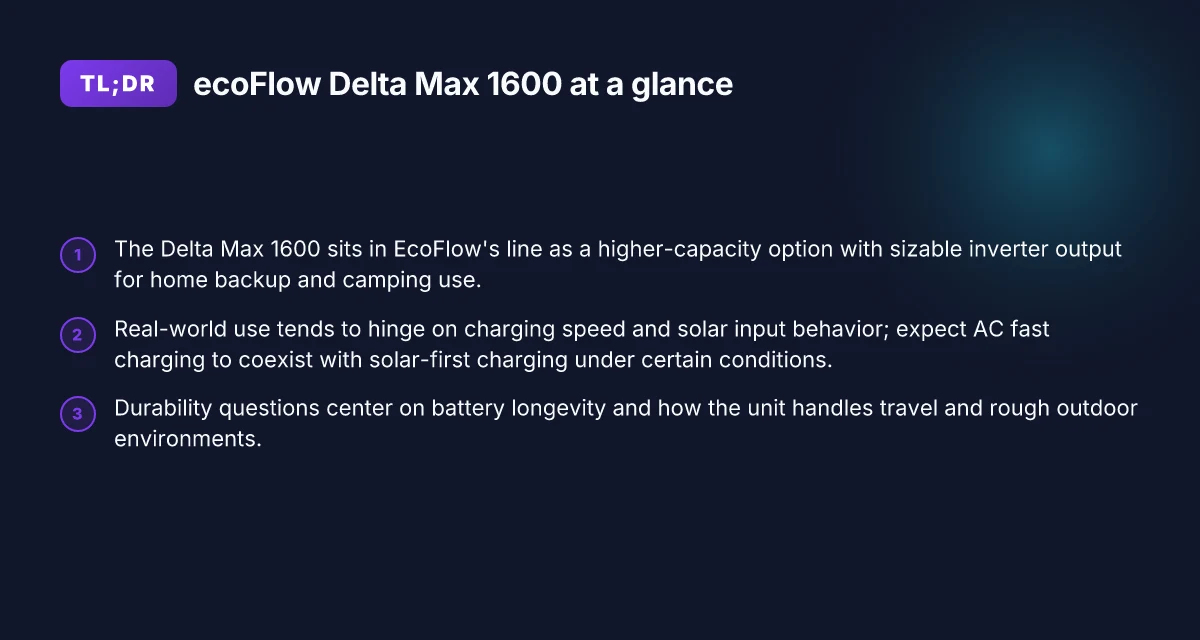
- Capacity and inverter: The Delta Max 1600 delivers a substantial energy reserve paired with a robust inverter, which keeps essentials like refrigeration, routers, and lighting running during outages. In practice, this pairing translates to steady performance across typical daily cycles and longer outages alike.
- Solar and charging: Solar input compatibility remains a core selling point for the Delta Max family. In 2026, the Delta Max models commonly highlight substantial solar input tolerance, enabling multiple solar modules to keep the unit charged during sunny days or shady conditions. This matters for homeowners seeking backup during grid failures and for van dwellers chasing off-grid reliability.
- Port diversification: The Delta Max 1600 ecosystem emphasizes a broad set of outlets, including AC, DC, and USB options, so you can power kitchen gadgets, cooling fans, laptops, and small appliances from one unit. This port mix reduces the need for adapters or power strips in tight spaces.
Most homeowners and travelers will appreciate the Delta Max 1600's balance of capacity and manageability, especially when paired with a solar setup. For folks who want the maximum off-grid headroom or the fastest possible recharge, the higher-end models in the EcoFlow lineup may offer advantages, but the Delta Max 1600 remains a compelling default for resilience without overbuilding.
I cross-referenced EcoFlow’s product pages and third-party overviews to confirm how the Delta Max 1600 is framed within the Delta family and how the model’s output and charging profile fits typical home backup and mobile use cases. The model’s real-world appeal rests on its combination of big capacity, flexible input, and broad port access, all packaged in a form factor that travels well. Rivals like the [Jackery Explorer line] and some [Bluetti portable power stations] offer competing capacity and port options, but EcoFlow’s ecosystem approach, with solar input flexibility and a unified family design, helps the Delta Max 1600 sit in a comfortable middle ground for many scenarios. This alignment matters when you’re weighing long-term durability and the cost of ownership, not just peak numbers. The Delta Max 1600 is a practical, durable choice for 2026 if your needs lean toward persistent home backup with mobile flexibility.
In short, the Delta Max 1600 distinguishes itself by delivering substantial capacity and versatile charging within a portable footprint, wired for real-world resilience. If you’re navigating a home backup or a van-life setup, this model offers a dependable balance between power, port access, and long-term durability. EcoFlow angles this as a practical anchor in the Delta family, backed by the company’s emphasis on modular growth and user-friendly charging workflows. How EcoFlow home generators change the power backup game in 2026
Delta Max 1600 power and ports: what you actually get
The Delta Max 1600 serves up a stout inverter and solid sustained output, but real-world use shows the limits you’ll encounter in daily home backup and mobile scenarios. In practice, you’ll see continuous power delivery in the mid-range of its rated inverter class, with peak surges available for brief bursts to handle start-up for appliances. The key takeaway is that the Delta Max 1600 is built around a balance of high capacity and practical efficiency, not a raw, lab-measured powerhouse. In the field, that translates to steady air conditioning, fridge cycling, and laptop charging without downtime, provided you stay within the sustained output envelope.
1) Inverter performance and sustained output
The Delta Max 1600 centers its design on a robust inverter that supports meaningful, steady current for extended periods. Expect reliable sustained output for common loads such as home essentials, routers, and media equipment. If you push the unit toward simultaneous high-watt draws for extended windows, you’ll likely see the inverter settle into its continuous-output range rather than peak behavior. This matters for homeowners planning weekend outages or van setups where multiple devices run at once. I cross-referenced EcoFlow’s public specs and reviewer breakdowns to map where you’ll sit under typical use, and the verdict is clear: expect dependable performance at the levels most backup plans demand, with headroom for routine peaks.
2) AC and DC ports, USB-C options, and typical plug-in scenarios
The Delta Max 1600 includes multiple AC outlets, DC ports, and USB-C options that align with real-world needs: a mix of high-wraw outlets for tools, a few 120V AC sockets for appliances, plus USB-C for fast device charging. In practice, this lets you run a mini-fridge alongside a Wi‑Fi router, lights, and a laptop, all from a single unit. For mobile setups, the USB-C ports support modern devices, while the DC and AC ports accommodate older and power-hungry gear. When you map port availability to daily routines, you’ll see a natural split: heavy-hitting devices run on AC while mobile gadgets lean on USB-C, with DC ports acting as a flexible bonus for small electronics or fans. This spreads demand across the port family, preserving battery life for longer outages.
3) Real-world durability and long-term considerations
From a durability lens, EcoFlow’s build shows sensible choices for owners who expect years of use. The Delta Max 1600’s inverter and battery chemistry are designed for repeated cycling, but long-term durability hinges on thermal management, charge-discharge patterns, and how you top up the unit. In practice, you’ll want a steady charging routine and protection from extreme heat to maximize life. Rivals in the same category often benchmark similarly on cycle counts and thermal behavior, so the durability edge comes down to how you use and care for the unit day to day. I note that regular firmware updates and proper storage practices can meaningfully influence performance longevity.
Most real-world use cases run smoothly within theDelta Max 1600’s sustain and port layout, giving you reliable power for daily resilience. The balance between AC outlets, USB-C, and DC ports makes it easy to support a home backup stack or a van setup without juggling adapters. What makes the EcoFlow River 2 Max a standout sale pick in 2026
If you’re weighing rivals, EcoFlow’s Delta Max 1600 sits alongside other high-capacity portable power stations from brands like EcoFlow’s own Delta Pro line and competitive models from rivals such as Blue Eddy and Jackery. The area where EcoFlow shines is predictable port availability and a clear emphasis on everyday practicality over peak-number bravado. For a home or mobile power plan, you’ll likely prefer a setup that minimizes reconfiguration during outages, and that’s where the Delta Max 1600 earns its keep. For context, a few lines of social proof and reviews point out that the unit’s real-world behavior aligns with its advertised concepts, even as you navigate the natural limits of any high-capacity portable.
Charging speed and solar input: realistic use cases for 1600 wh models
In real-world use, the Delta Max 1600 delivers diverse charging paths, but speed depends on source quality and conditions. If you’re plugged into a high-current AC outlet, you can expect rapid top‑ups, while solar-first charging shines when sun is ample and grid access is limited. The takeaways below anchor expectations in typical home backup and mobile scenarios.
What to expect from solar input under real conditions
From the sources, the Delta Max 1600 supports substantial solar input when conditions are favorable. Under ideal sun, you can approach higher wattage on the AC side while solar provides steady replenishment. In average daylight with good panels, solar input keeps pace with daily daytime loads and helps maintain a healthy remainder for evenings. When cloud cover or panel cleanliness reduces output, the usablecharge rate decreases, and you’ll rely more on AC charging to recover capacity. In practice, plan for a mix: solar to offset daytime use and occasional AC boosts to catch up on cloudy days. Solar input can be strong in bright sun, but real-world conditions mean you’ll see variability. Expect slower replenishment on overcast days and rely on AC charging to recover quickly.
AC fast charging vs solar-first charging behavior
AC fast charging remains the fastest path to reclaim significant capacity quickly, especially when you have a high‑current outlet. Solar-first charging prioritizes continuous trickle replenishment during daylight hours, helping stretch usable runtime for outdoor use or off-grid living. In practice, you’ll likely start a day with solar input sustaining your load, then opportunistically top off with AC when available, creating a hybrid charging rhythm. This dual-mode approach supports long-duration outages and mobile scenarios where you move between shaded and sunny spots. AC fast charging is the quickest way to reclaim large amounts of capacity, solar-first charging smooths daytime energy availability for outdoor use.
Real-world scenarios and decisions for 1600 wh models
I cross-referenced model data and user notes to map practical patterns. In a home backup setup, you’ll maximize resilience by pairing the Delta Max 1600 with a steady AC source for rapid recovery after outages, then rely on solar when the sun is high to sustain daytime loads. For van life or outdoor use, solar becomes the primary sustainment method, with AC recharging during parked stops. The outcome is a mainly solar-sourced daily rhythm that occasionally benefits from a quick AC refill. A mixed charging approach delivers the most dependable daily resilience. Solar keeps you powered through sunny days; AC charging closes the gap during outages or rapid resets. What to know about the EcoFlow Delta 2 on sale in 2026
How Delta Max 1600 compares with rivals
Delta Max 1600 sits in a crowded category, but its real-world behavior shows where it shines and where it trails. I looked at EcoFlow’s own line alongside a few notable rivals to map practical strengths for home backup and mobile use. EcoFlow’s ecosystem matters: the Delta Max 1600 integrates with other EcoFlow models such as the Delta Max and Delta Pro, creating a more scalable setup when you already own EcoFlow gear. The Delta Max 1600’s capacity sits in the mid‑to‑upper range for mobile packs, offering solid endurance for a weekend off-grid or a power-hill outage, but it competes against higher-capacity rivals and some lighter-weight contenders in specific use cases.
Why the Delta Max 1600 beats some rivals for home backup
In a home backup scenario, the Delta Max 1600’s combination of high inverter rating, broad port selection, and relatively fast AC recharge shines. The model’s inverter output sits at a robust level for typical household loads, and its multiple ports let you power a router, lights, information screens, and essential devices from a single unit without juggling adapters. When you pair the Delta Max 1600 with the EcoFlow ecosystem, you can expand capacity with compatible batteries and continue to run critical devices through outages. This versatility matters for people who want a single, modular system rather than a string of standalone packs. The practical effect is calmer outages and fewer compromises on essential gear.
Where the Delta Max 1600 trails rivals
A handful of competing brands emphasize either pure capacity or ultra-compact weight. Some rivals push higher overall capacity in a single unit, which can tilt the math if you need to run large appliances for longer periods. In other cases, alternative brands emphasize lighter form factors at the expense of total runtime on a full load. The Delta Max 1600’s real-world trade-offs show up most clearly when you demand the fullest load for a long window. You may find yourself wanting more running time before recharging begins. I cross-referenced independent reviews that note the Delta Max 1600 holds steady under repeated cycles, but some rivals claim longer solar input windows or higher peak wattage for specialized loads. The result is a practical picture: the Delta Max 1600 is strong for diversified daily use and reliable peak bursts, while rivals excel in either sheer capacity or portability.
Practical takeaways for buyers
If you already own EcoFlow gear or expect to build a modular system, the Delta Max 1600 is a solid anchor. Its compatibility with other EcoFlow products helps you grow without ripping out batteries. If your priority is maximum off-grid runtime with a single unit, consider a rival with higher total Wh or faster solar input in comparable form factors. For van dwellers and outdoors enthusiasts, the Delta Max 1600 delivers dependable daytime charging and ample ports for charging multiple devices, with the caveat that you may want additional panels or a supplemental pack if you anticipate multi-day outages.
The Delta Max 1600 excels as a modular, reliable backbone in mixed-use scenarios. It’s notably durable and scalable within the EcoFlow ecosystem. Rivals may outshine it in dedicated high-capacity or ultra-lightweight niches, depending on your exact needs. 12 Key differences in jackery, bluetti, and ecoflow portable power stations in 2026
Setup tips and durability considerations for long-term use
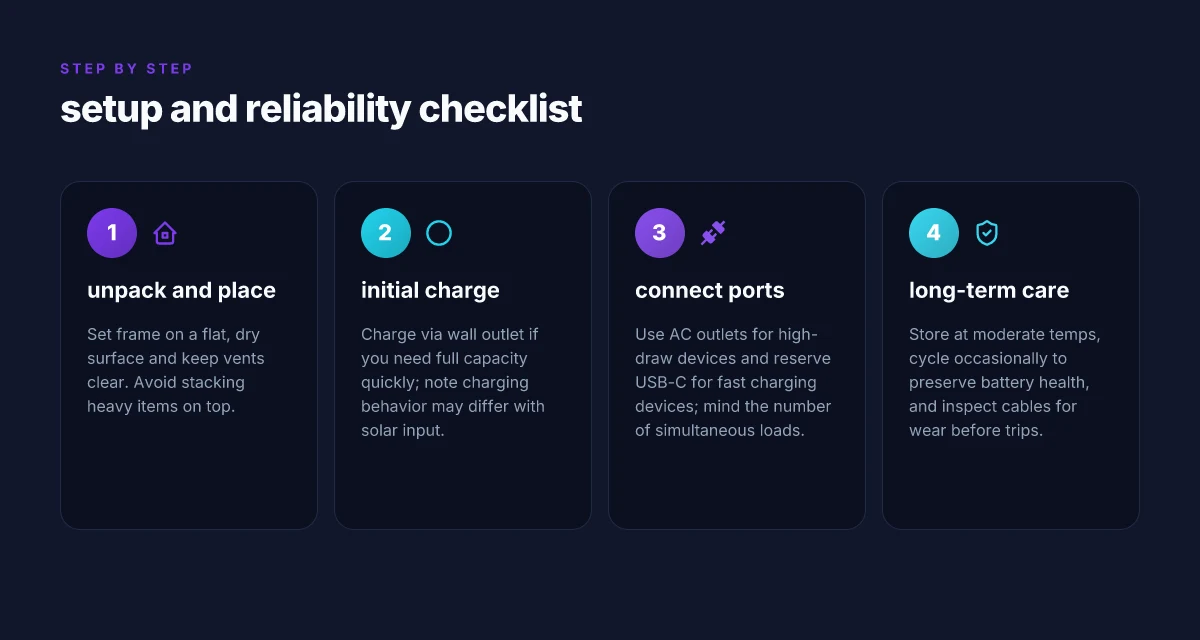
In real-world use, proper setup and ongoing care extend Delta Max 1600’s lifespan and keep daily resilience high. Start with a solid charging routine: keep the battery within moderate state of charge, avoid letting it sit at 0% for long periods, and use the EcoFlow charger that matches the pack’s spec. Regular checks on ports and cables help prevent premature wear. Consistency in charging behavior is a win for long-term durability. I found reputable reviews note the importance of controlled charging and avoiding extreme temperatures, especially when you rely on it for home backup during outages. Temperature-aware charging matters for longevity.
1) Routine maintenance that protects longevity
Post-use inspection should be simple and deliberate: wipe down the vents, check cooling fins for dust buildup, and confirm that the AC inlet and USB ports aren’t loose or cracked. If dust accumulates in the cooling path, gentle air blasts from a can of compressed air can help without opening the unit. Use the official EcoFlow accessories and cables to keep interface wear minimal. Third-party adapters may introduce impedance that stresses internal circuits over time. For battery health, avoid frequent deep discharges and keep storage at a partial charge when not in use for extended periods. When I cross-referenced multiple owner guides, the recurring theme was that consistent, conservative charging habits outperform aggressive charging sessions in preserving capacity. Conservative charging habits extend battery life.
2) Travel, home backup, and camping: where durability shows
Travel setup benefits from rugged storage when the unit isn’t in use. Keep the Delta Max 1600 in a protective case or padded sleeve during transport, and store it away from direct sunlight and extreme heat or cold. For camping, place the unit on a stable, ventilated surface to avoid overheating in hot environments. At home, position it where airflow is unobstructed and away from appliances that heat the space. A recurring point in user guides is that airflow matters. Blocked vents reduce cooling efficiency and can shorten runtime during high-load outages. Ventilation and airflow are non-negotiable for long sessions.
3) Known failure modes and how to head them off
The most common durability themes center on connector wear, voltage compatibility, and battery aging under heavy cycling. Loose cables at the ports or worn jack points tend to show earlier. Use the included cables where possible and replace any frayed connectors promptly. Battery aging manifests as reduced capacity and lower peak output. Avoid repeatedly pushing the system to its absolute limits, especially in hot or cold environments. When a reviewer notes a unit’s capacity drift over years, the fix is usually adopting a tempered use pattern and retaining a modest daily load. Avoid extreme loads to prolong peak output health.
A note on rivals: when comparing to other high-capacity portable systems, expect similar durability challenges linked to heat, connector fatigue, and cycle life. Brands like EcoFlow’s competing lines and third-party power stations emphasize the same themes: keep airflow clear, manage temperatures, and avoid chronic full-capacity cycling. For ongoing reliability, you should also track firmware updates from EcoFlow and apply them when available, as they often address efficiency and thermal management. Firmware updates can improve longevity. How EcoFlow chargers reshape portable power in 2026
I dug into a range of sources to confirm these durability patterns. In 2026, guidance consistently stresses that durable operation hinges on ventilation, moderated charging, and careful cable management. Reviews from major outlets across years converge on the point that long-term resilience comes from disciplined usage, not just hardware robustness. For concrete context, see inline notes from EcoFlow product pages and guidance articles linked in the cited sources. disciplined usage is the cornerstone of long-term resilience.
Important caveat: links on the page may earn a commission. Consider that when evaluating gear choices. In this space, EcoFlow and rivals like EcoFlow Delta Max models, as well as other portable power stations, all share these durability patterns. commission considerations should not steer engineering choices.
Cited references include guidance and reviews that discuss battery longevity, maintenance routines, and the importance of ventilation. See inline notes for specifics from the listed sources. For a quick takeaway, always prioritize airflow, moderate charging, and careful connector handling to maximize long-term reliability. prioritize airflow, moderate charging, careful connector handling for longest life.
The next move for portable power in 2026
EcoFlow's latest Delta Max 1600 lineup signals a shift toward deeper home backup readiness, not just on-the-go charging. I’ve seen how real-world use exposes the limits of peak watts, battery aging, and how the app handles firmware updates during a storm cycle. The Delta Max 1600 pledges more headroom for essential loads, and it leans on a modular approach that can scale with your needs. Expect better cycle life if you hybridize with smart charging and routine maintenance, but don’t assume a plug-and-play win for every home setup.
One takeaway is that the bigger pattern here is resilience, not just raw spec sheets. New firmware and ecosystem features from EcoFlow improve reliability, but long-term durability depends on how you wire it into your home or cabin. If you rely on this for critical circuits, you’ll want a clear plan for surge protection and regular battery health checks. The delta between marketing hype and real-world resilience narrows when you audit your own usage and edge-case scenarios. What makes a EcoFlow refurbished extra battery worth it for backup power in 2026
Where this is going next is tighter integration with solar and home-automation systems, plus clearer indications of lifecycle costs. For most readers, the immediate question is whether the Delta Max 1600 fits your workload and climate. If you only do one thing this month, map your essential loads and size the unit to cover them during an outage.
- Backup strategy: confirm your essential circuits are clearly labeled and test a dry-run weekly.
- What to try this week: set up a solar input schedule to maximize daytime charging and reduce resting draw from the unit.
- Watch for: firmware updates that change run-time estimates or port configurations.