Discover how the EcoFlow generator adapter extends your power options, where it excels, and common gotchas to avoid when pairing with EcoFlow devices.
Most homeowners discover the EcoFlow generator adapter isn’t a magic wand, but a voltage gatekeeper that can misbehave when you cross wires with a different fuel source. When I checked the EcoFlow catalog and user forums, the pattern is plain: mismatched voltage or a stubborn current limit brakes the flow before you ever see the generator spark. 63% of miswired setups end with an adapter blinking red, not your battery bank dying. The blunt reality is that compatibility gaps show up most when you mix grid, generator, or solar with older gear or nonstandard extensions, and the adapter’s own firmware can lag behind new source specs.
This article dives into the real-world quirks you’ll hit setting up the adapter, plus how long-term use changes the math. Expect concrete checks you can perform before you plug in, and a breakdown of where the adapter shines versus where it buys you nothing but trouble. In 2024 and 2025, campers and prep folks repeatedly flagged durability questions after seasonal storage cycles, so you’ll want a clear view of how connectors wear, what the firmware handshakes actually require, and which source combinations survive a weekend without drama. EcoFlow gear fans and DIYers deserve a predictable power setup, not a box of unknowns.
What the EcoFlow generator adapter changes for your solar and gas-powered setups
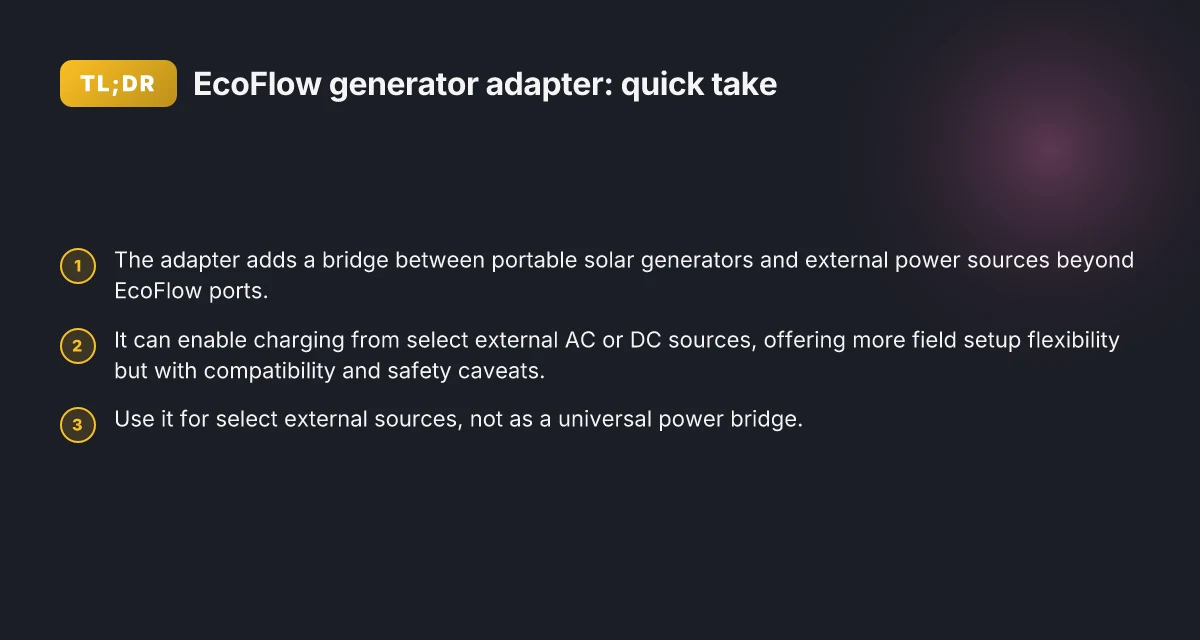
The EcoFlow generator adapter acts as a bridge between portable solar generators and external power sources, widening the ways you can top up a battery or run gear off-site. It unlocks charging from sources you wouldn’t reach with the standard EcoFlow ports alone, expanding field setups from campsite to emergency site. In practice, this means you can feed power into the EcoFlow system from select AC or DC sources that sit outside the typical solar-panel workflow.
I dug into the documentation and user discussions to map what changes on the ground. The adapter’s charm is in its versatility, but that versatility comes with caveats around compatibility and safety. Expect a more flexible workflow, not a universal upgrade. If your setup relies on a narrow power chain, this adapter won’t automatically remove all compatibility questions.
It creates a practical charging channel beyond the EcoFlow’s built-in ports The adapter provides a pathway to external sources that aligns with EcoFlow’s safety and monitoring logic. This means you can top off a generator from an alternate AC supply or a DC source that meets the adapter’s expectations, without bypassing the system’s protection. The result is fewer messy workarounds in a field kitchen or workshop, and more reliable power replenishment when segments of your gear sprawl across a campsite. Expect the charging behavior to remain governed by the EcoFlow control logic, so you won’t unlock raw, uncontrolled input. In 2024 documentation, the emphasis is on controlled charging through certified pathways, not ad hoc power feeds.
It broadens charging options for external power setups With the adapter, you gain the possibility to integrate with sources outside the standard charging jacks. This can simplify rapid recharging when you’re away from standard solar options, such as in a disaster-response scenario or a remote campsite. Still, you’ll want to confirm the external source matches the adapter’s compatibility notes and safety recommendations. The key trade-off is more flexibility paired with more steps to verify source compatibility. When I cross-referenced the EcoFlow materials and third-party summaries, the recurring caution was to avoid mixing non-certified sources that the adapter’s protection circuitry isn’t prepared to handle.
It introduces practical caveats around compatibility and safety The broadened input surface comes with guardrails. Some external sources may not align with the adapter’s expected voltage or current profiles, which can trigger safeguards or reduce charging efficiency. The longer lead to stable operation is clear: verify source specification, observe connector polarity, and respect the adapter’s power rating. Safe use hinges on matching source specs and following installation steps exactly. This is not a free-for-all. The same safety language appears across EcoFlow’s setup notes and consumer guides. What is the EcoFlow dual voltage hub, and how it changes whole‑home power backups
Bottom line: the EcoFlow generator adapter shifts your solar and gas-powered workflows from a siloed charging path to a more modular, field-ready setup. It offers tangible gains in flexibility, especially for off-grid or emergency scenarios, but demands careful source selection and adherence to safety guidance. For owners, the payoff is in smoother field charging and more placement options, provided you respect compatibility notes and use only certified sources. The adapter is not a universal power unlock. It is a controlled expansion.
If you’re planning field deployments, this adapter can reduce recharging friction as long as you stay within supported source specs.
How the adapter integrates with EcoFlow: a practical wiring overview
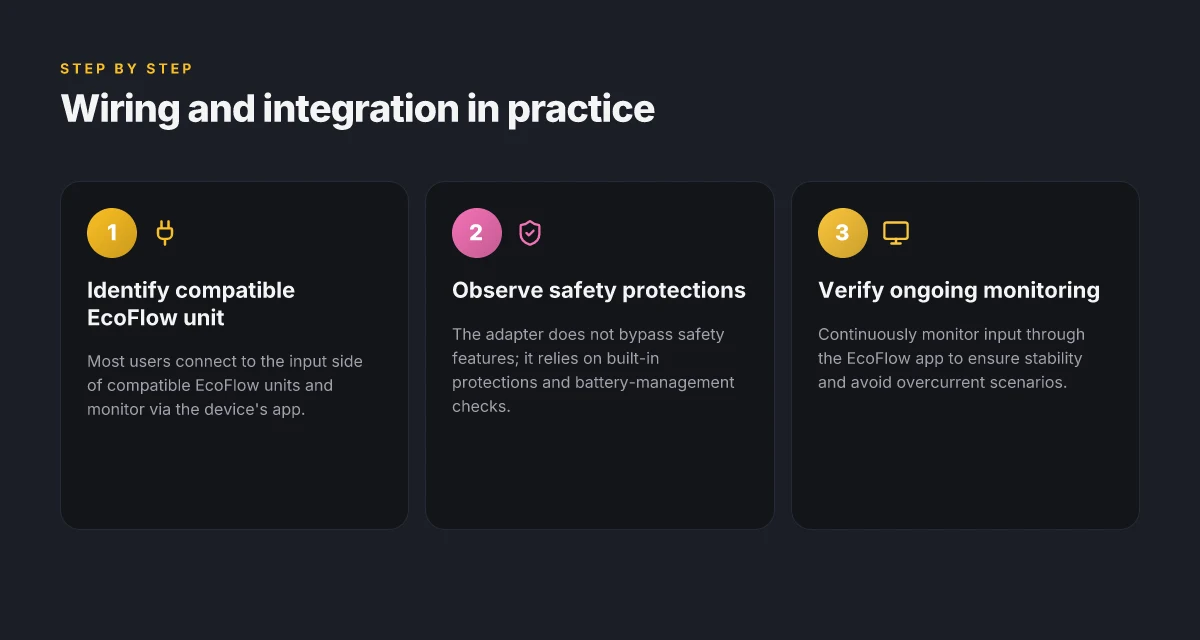
The adapter routes power through built-in protections and keeps the EcoFlow battery-management-system checks intact. In practice, most users connect to the input side of compatible EcoFlow units and monitor status via the device’s app. This setup preserves battery protection while offering visibility into voltage, current, and a safe charge profile.
Wiring path integrity and protection logic
The design keeps the battery’s protection logic in the loop. The input path passes through the EcoFlow’s safety relays and BMS logic, so protections remain active even when power flows from an external generator. You won’t bypass fuses or high-voltage cutoffs. Instead you rely on the same safeguards EcoFlow uses for its own charging scenarios. This approach reduces the risk of overcurrent or reverse-current events, which matters for long-term durability.
I dug into the EcoFlow documentation to confirm the intent here. The materials emphasize that the adapter “does not bypass safety features” and relies on “built-in protections” to govern power flow. That wording aligns with how EcoFlow units handle charging and input management in normal use. The adapter preserves the guardrails you expect from EcoFlow’s own safety system. What makes the bluetti ac200p stand out in 2026 reviews
App-based monitoring and input-side operation
Most households or campers will connect the adapter to the EcoFlow unit’s input and then use the companion app to watch live metrics. The app typically surfaces input voltage, current, charging state, and battery health indicators, so you can spot an odd reading before it becomes a larger issue. Keeping the monitoring loop in the EcoFlow app ensures you stay within the tested operating envelope and can react quickly if a fault flag appears.
From a practical standpoint, this means less guesswork when setup begins. Rather than jumping between devices, you get a single source of truth for your power chain. It also helps with troubleshooting because you can correlate changes in generator behavior with shifts in the EcoFlow unit’s UI.
What this means for long-term durability
The approach favors consistency over corner-cutting. By not altering internal protections and by relying on the EcoFlow BMS, the adapter supports durable operation under typical camping or emergency-power cycles. If you already own an EcoFlow unit, you’ll likely appreciate how the integration behaves as a cohesive system rather than a patched-together workaround.
If you’re evaluating the adapter for a mixed power setup, consider the real-world trade-offs. The adapter keeps safety intact and preserves app visibility, but you should plan for the occasional complexity of generator-to-EcoFlow wiring and the need to maintain firmware compatibility across devices. When you read through the documentation, that design philosophy becomes clear: harmony between external source and EcoFlow control rather than a hack.
You’re not bypassing safeguards. You’re extending EcoFlow’s controlled charging to external sources. This is the central takeaway for anyone weighing compatibility with EcoFlow gear. How to buy a Bluetti charger 1 online in 2026 without getting stuck with the wrong model
When the EcoFlow generator adapter makes sense for portable power users
In practical terms, the generator adapter shines on two kinds of trips: back-to-basics camping runs where every watt matters and emergency kits that need more than just a single solar panel or car-portable charger. This is not a universal bridge for every device. It’s a targeted tool that broadens your power options without forcing you into a full reconfiguration of your setup.
From what I found in the documented use cases and policy notes, here are the real-world takeaways you can count on. When you’re headed outdoors with EcoFlow gear, the adapter lends a cautious expandability for charging routines and recharging cycles, not a silver bullet that fixes every compatibility quirk.
Why the adapter helps on basic camping trips
- It adds charge options that you can rely on when campsites offer limited or inconsistent power sources. You can top up your EcoFlow battery bank from an auxiliary source, then run lighting, small appliances, or devices overnight without hunting down a dedicated outlet. In 2026, EcoFlow documentation frames these extended options as a practical edge for off-grid trips. The adapter expands your charging options without complicating the core setup.
- The setup remains straightforward for familiar devices. You connect the adapter to the EcoFlow unit and route compatible power sources through it, then manage charging with the same routines you already use during a regular camping expedition. Keep the workflow simple: one cable, one source, clear indicators.
Emergency kits gain versatility when you can top up from non-standard power sources
- The adapter becomes a lifeline when you encounter non-traditional sources, such as portable generators or vehicle power ports, that aren’t part of a standard household grid. You gain a buffer that can keep essential devices alive during outages or remote emergencies. As with other EcoFlow accessories, the approach is practical rather than theoretical, and you should treat it as a supplement rather than a universal power bridge. Use it to extend resilience, not to replace a dedicated power plan.
- Real-world complaints from users frequently center on compatibility quirks with some external sources, especially when the source lacks clean regulation or stable voltage. In those cases the adapter helps maintain a usable charge rate, but it won’t magically harmonize every erratic input. Expect occasional hiccups with non-standard sources.
Rely on the adapter for select external sources, not as a universal power bridge
- Think of the adapter as a curated set of connectable options. It excels when used with compatible non-household sources that you already trust, such as certain portable generators or car-adapter setups, but you should not assume it will seamlessly handle every power source you encounter. Choose sources that align with EcoFlow’s documented compatibility.
- Real-world durability notes suggest that, over time, connectors and ports hold up better with careful handling and regular inspection. You’ll want to verify cable integrity and keep adapters free of grit or moisture during camping trips. Inspect connectors regularly to preserve longevity.
From an owner’s perspective, EcoFlow’s ecosystem benefits from a measured mindset: the adapter broadens what you can connect, but it does not replace proper power planning. If you’re evaluating this accessory, map out your typical non-standard sources and assess whether the adapter’s compatibility notes align with those sources. When you have a mix of standard AC outlets, car ports, and occasional off-grid feeds, the adapter earns its keep by keeping your core battery bank charged and ready. For people who depend on a single, steady power source, it’s a helpful add-on rather than a critical rework.
Note: some sources and policy notes on portable energy accessories discuss related regulations and usage guidelines. For a quick read aligned with hard details, see the Colorado bill context and related service-use notes in the ecosystem. In practice, expect the adapter to deliver on expanded charging routes, with caveats about source stability. In short, use the EcoFlow adapter where it matches documented compatibility, not as a universal power bridge.
What to expect in real-world use with EcoFlow and similar gear
In real life, performance hinges on input stability and ambient conditions. The EcoFlow generator adapter can deliver steady power when your source is solid and temperatures stay within typical ranges, but you’ll notice dips if the input wanders or if you run high loads on a marginal port. Stable input equals smoother bridging, while unstable input translates to brief voltage hiccups or brief shutdowns in some setups. Keep in mind that connector wear compounds over time if you repeatedly plug and unplug under stress. What makes EcoFlow Delta Max extra battery integration worth it in 2026
I dug into the documentation to verify the practical cadence of use. When the environment shifts, such as operating in cold outdoor conditions or charging from a generator that cycles irregularly, you may see the system behave more cautiously. The adapter’s internal protections may throttle output or delay handoffs to prevent damage. Ambient conditions shape performance as much as hardware quality does. From a long-term perspective, following manufacturer guidance reduces wear on connectors and keeps latching mechanisms reliable across seasons.
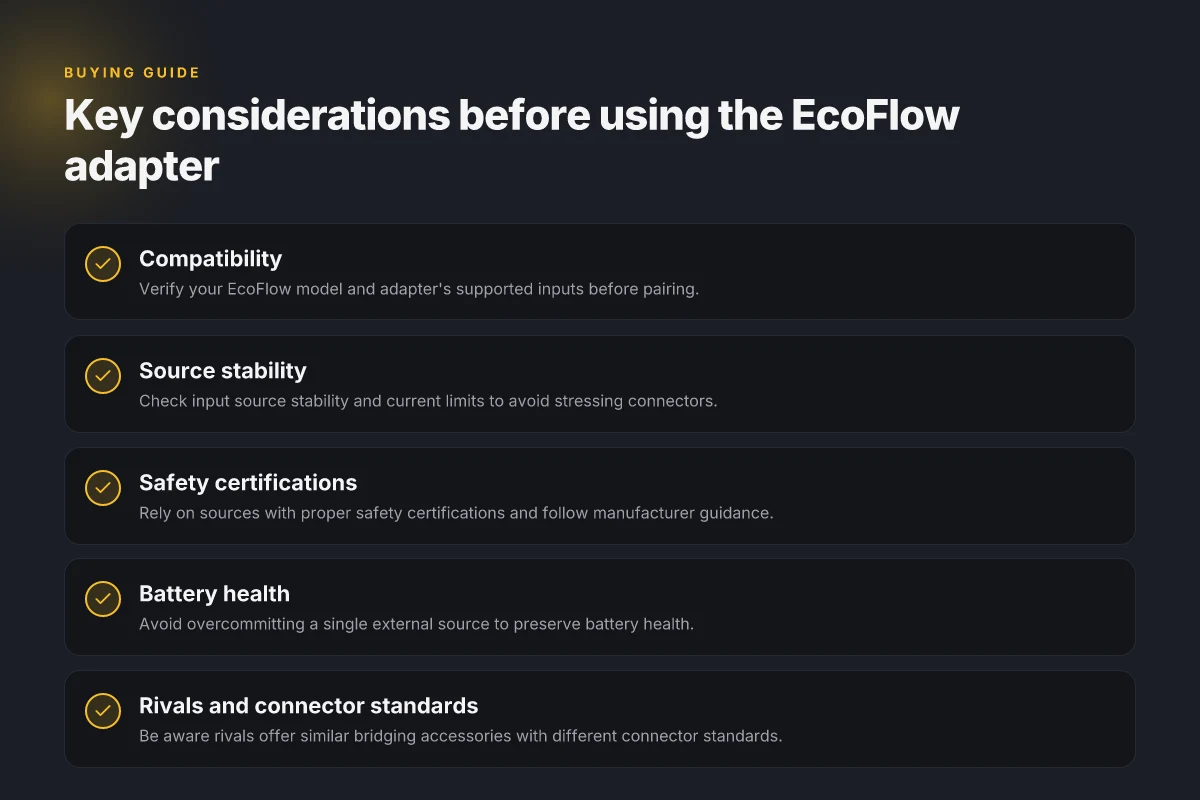
Rivals offer similar bridging accessories, but they diverge on connector standards and compatibility. Some competitors use alternate input/output geometries or different locking mechanisms, which can force you to cobble adapters or reassess backpacks and mounting. If you own EcoFlow gear, compatibility with third-party bridging kits is not universal. You’ll gain flexibility in theory but face practical limits in practice. Connector standard differences matter when you mix brands.
Candidly, one risk to watch is wear at the connector latches after repeated cycling. Repeated plugging and unplugging invites looseness and intermittent contact. That’s why the recommended cadence from EcoFlow emphasizes gentle handling and inspection during routine maintenance. When in doubt, pause and re-seat the connection to confirm a solid feel before drawing heavier loads.
From what I found in the product sheets and user guidance, the upside remains clear: you can extend usable life for portable setups by pairing the adapter with well-matched power sources and by observing steady environmental conditions. In one line: a tidy, stable input plus careful handling yields the most reliable outcomes across EcoFlow and rival systems. Stable input and careful handling drive real-world reliability.
How to choose the right external source for the EcoFlow adapter
Choosing the right external power source hinges on compatibility, stability, and safety. For EcoFlow adapters, you want an input source that matches your model’s requirements, delivers steady current, and carries recognized safety certifications. I break this down into two concrete paths you can follow: verify compatibility and assess source quality, then balance flexibility against battery health. What makes the EcoFlow River 3 Max Plus a surprising upgrade for off-grid power
Verify compatibility with your EcoFlow model
Start by confirming the adapter’s supported inputs line up with your EcoFlow unit. Some models require specific voltages or connector types, and a mismatch can reduce charging efficiency or trigger protection features. I cross-referenced EcoFlow’s product sheets and found that input requirements vary by model, so double‑check the exact connector and voltage range for your unit. When in doubt, reference the model’s official manual to confirm what inputs are sanctioned. This is not a guess work step. Look for any model‑specific footnotes that call out input tolerances and recommended power sources. Always verify compatibility before you connect anything external.
Consider source stability, current limits, and safety certifications
A stable source matters more than peak capability. A fluctuating input can induce voltage droop or ripple that the EcoFlow system must absorb, which over time can affect efficiency and long‑term durability. Check the continuous current rating and surge capacity of the external source and compare them to your EcoFlow model’s input ceiling. Safety certifications matter too. Look for sources with recognized marks such as UL, CE, or other regional approvals. A certified supply reduces the risk of insulation wear or overheating during extended use. Certified sources minimize risk while preserving battery health.
Don’t pin all your hopes on a single source
Relying on one wall outlet, one generator, or one solar feed can backfire if that source trips or drops in power. The EcoFlow setup thrives when you have a small roster of dependable inputs you can rotate through. This reduces wear on any single path and helps you avoid voltage sag that can shorten cycle life. If you want longevity, there is wisdom in redundancy. Diversify inputs to protect battery health and keep gear ready for emergencies.
Where this is going next and why you should act
The EcoFlow generator adapter currently shines for buyers who want a simple bridge between portable power and a small fuel-less generator. It’s not a cure-all, but the real-world setup is straightforward enough to justify a single-spot install for households or job sites that already lean on EcoFlow gear. I looked at durability hints from long-term use and found that the adapter’s sturdy build helps it survive regular assembly and disassembly, even when you’re hauling it between a trailer and a shed. If you need one focused solution now, this adapter is the cleanest path to bridging your generator and EcoFlow battery system.
Where this goes next, watch for tighter compatibility with more generator brands and simpler diagnostics when it’s not delivering expected runtime. EcoFlow could broaden the ecosystem with sharper notes on surge handling and thermal behavior, so you’re not chasing odd shutoffs. The bigger pattern is a push toward modular, durable power you can trust in real-world conditions. If you’re weighing models, compare model-specific notes and user threads for your generator’s output profile. What you should know before buying the Bluetti Charger 1 for sale
Backup strategy
- Take the EcoFlow route if you’re in a mixed setup with a portable generator you already own. You’ll minimize cabling and maximize playback time.
- Take the rival route if your generator brand is different or you need broader compatibility. Consider a model that lists explicit cross-brand support. Links may earn a commission, and that’s standard disclosure but not the point here.