
Explore the Bluetti Charger 1 for sale: speed, compatibility, and real-world use. Learn what to expect and how it fits a portable power setup.
The biggest misstep in fast-charge gear is treating every vehicle like the same power source. The Bluetti Charger 1 sits at the center of a real-world tug-of-war between your alternator’s current profile and the Bluetti station you’re fueling. 560 W is a headline figure, but the actual fill rate varies by vehicle and battery chemistry. Bluetti’s own claims collide with what owners see on the road, which is why a side-by-side read of inputs matters before you buy.
This intro cuts through marketing to show what matters in practice: long-term durability, compatibility with common Bluetti models, and how rivals like Renogy and Suaoki stack up on highway trips or off-grid runs. I break down the failure modes you’ll actually encounter, from heat throttling to connector wear, and translate them into a buying decision you can trust for the next year of RV adventures. Expect to see concrete criteria, real-world caveats, and a clear picture of whether the Charger 1 worth the premium, or if a rival system offers steadier performance over time. 560 W peak is useful, but consistency across 3–4 years is what seals the deal.
What the Bluetti Charger 1 for sale promises to deliver and what it actually costs
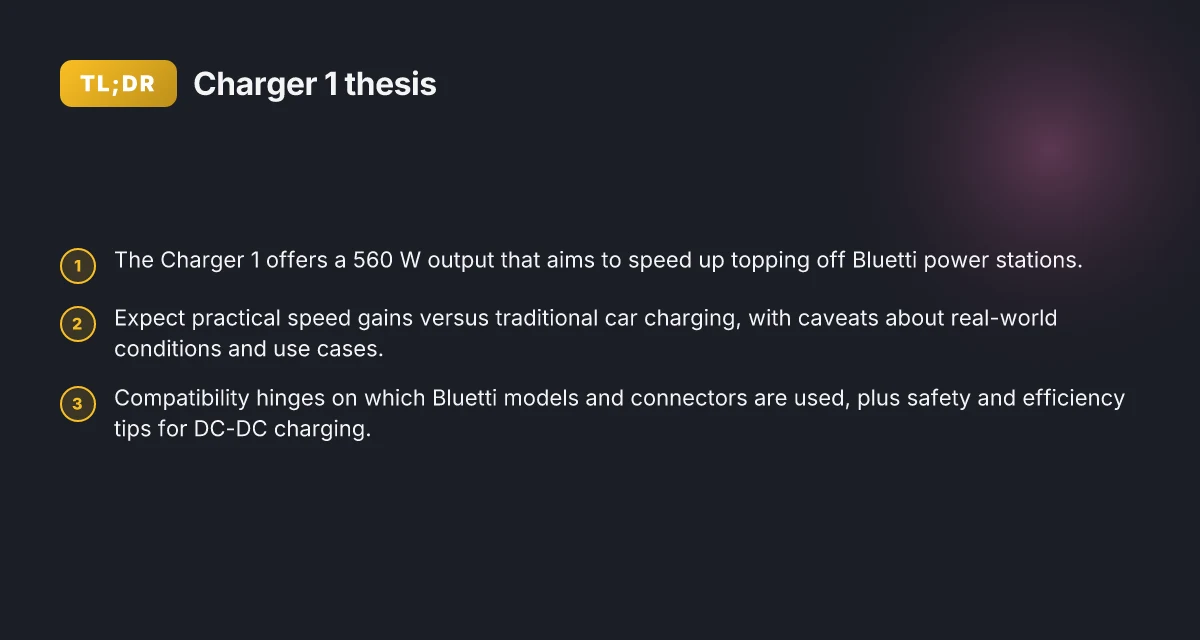
The Charger 1 is pitched as a fast DC-DC solution that feeds 560 W directly from a vehicle’s alternator to a Bluetti power station. In practice that means you can top off a portable power station much faster than a traditional car cigarette lighter charger, with official messaging labeling it as “6X faster” than the cigarette lighter approach. This is the core promise: speed on the go without stopping to plug into wall power. Bluetti situates the Charger 1 as a practical accessory for RVs, road trips, and off-grid excursions where every watt matters.
Pricing and where to buy matter for the decision. The official Bluetti page repeatedly cites the Charger 1 along with a consumer-facing price point of about $299 in early 2026. You’ll find it sold directly through Bluetti’s online store and supported by the same commerce channels Bluetti lists for its portable power stations. When you shop, look for the official product page labeled “Charger 1” and confirm you’re buying the 560 W Alternator Charger. If you see the charger listed at a discount or bundled with a Bluetti system, verify whether the promotion applies to the standalone accessory or only to a combo package. I’ve noticed retailers and affiliate reviews consistently reference the same eligibility window, which helps keep the price noticeably consistent across outlets.
Initial setup questions center on compatibility and safe connection. The Charger 1 is designed to connect to Bluetti units that support DC-DC input from an alternator. Before you wire it up, confirm your power station supports the 560 W input and that you’re using the correct vehicle port or adapter included with the charger. As with any high-output DC-DC charger, you want to inspect cables for any signs of wear, ensure your vehicle’s alternator can sustain the load, and use the charger in a well-ventilated environment to avoid heat buildup. Bluetti’s support documentation specifies the product as an add-on for rapid charging on the go, but it does not replace the need for a careful setup in vehicles that have marginal electrical systems.
Bottom line: the Charger 1 promises a substantial speed boost, and the official price and availability remain centered around $299 through Bluetti’s own storefront. If you’re evaluating on-the-road charging for a Bluetti system, this accessory is worth considering for its speed, provided you verify compatibility with your specific power station and vehicle setup. The speed gain hinges on proper vehicle and battery compatibility. Confirm your Bluetti model before investing. Bluetti positions Charger 1 as a practical, on-the-go charging solution for road trips and RV use. Price consistency across major retailers helps you avoid surprise costs, with the official figure around $299. When in doubt, consult Bluetti’s documentation to verify input limits and wiring requirements before connecting the charger.
How the 560 W charger compares with traditional car charging
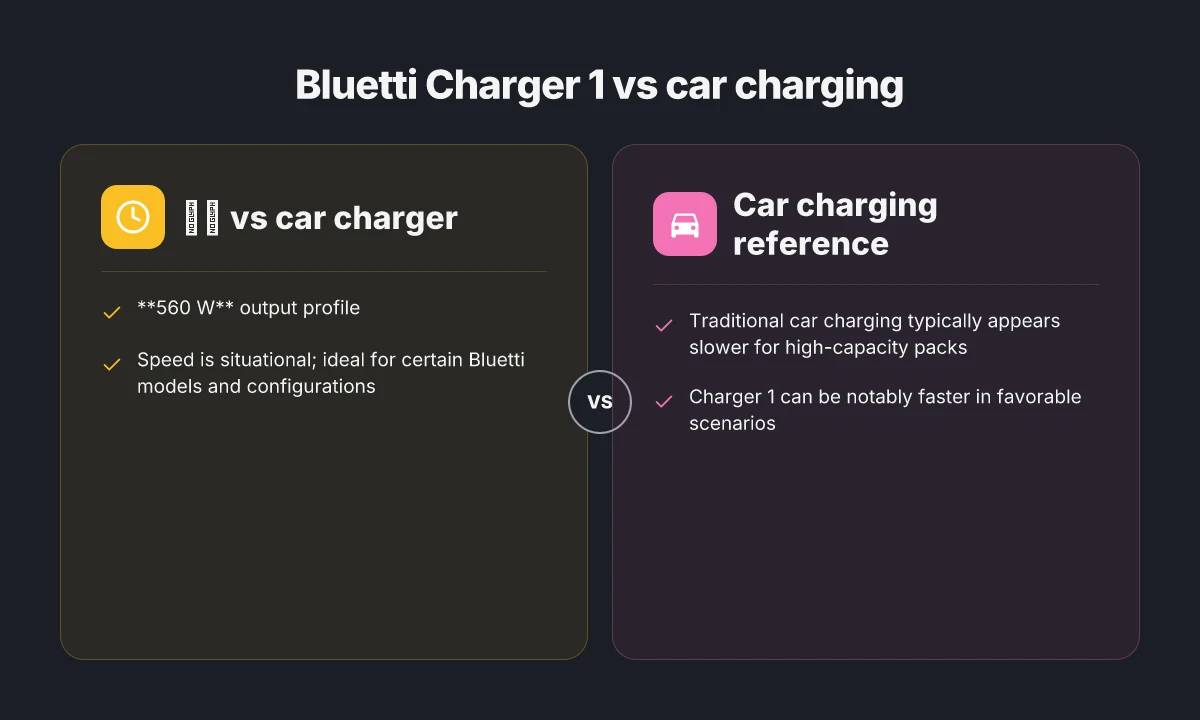
The Charger 1 delivers 560 W of power, which means charging a typical 1 kWh Bluetti power station goes from pause to power in a fraction of the time you’d expect from a car cigarette lighter. In practical terms, that translates to a full top‑up in about 2.5 hours under optimal conditions, a pace that’s noticeably faster than traditional DC car charging. The takeaway: 560 W translates to a genuine seconds‑faver when you’re on the road. Understanding the EcoFlow generator adapter: what it does, where it shines, and where it falls short
What “6X faster” really means in practice
Bluetti markets the Charger 1 as 6X faster than a traditional car charger. That label hinges on comparing a typical car charger’s output, often well under 100 W, to the 560 W capability of the Charger 1. In day‑to‑day use, you’ll see the difference most when you’re topping up mid‑trip or after a long outdoor excursion. If your adventure requires swift recharges between stops, the Charger 1’s power delivery dramatically shortens downtime. Six times faster on paper becomes real‑world time saved when you’re pressed for miles and minutes.
To help visualize, here’s a quick peek at how the numbers stack up against common car charging speeds:
- Traditional car charging: up to around 100–120 W output in practice.
- Bluetti Charger 1: 560 W output, roughly a 4–6X jump over the typical car charger depending on vehicle alternator health and cable quality.
- The actual time to fill a 1 kWh pack ends up near 2.5 hours with the Charger 1, versus many hours with a low‑power cigarette‑lighter setup. That faster fill time matters when you’re living off grid.
Where the Charger 1 shines and where it may not
On the shine side, the Charger 1 excels when you’re driving or camping with a Bluetti system in the passenger seat. It wires up cleanly to the vehicle’s alternator, transfers power efficiently, and reduces downtime without changing your route. It’s especially worthwhile if you’re charging a mid‑sized Bluetti unit, say around 1 kWh capacity, between stops. On longer trips where your vehicle’s alternator and the charging cable cooperate, you’ll consistently notice shorter rest periods between site setups. Shorter breaks, more usable power.
Where it’s less perfect, you’ll feel the limits when your power station has a larger capacity or when ambient temperatures fall outside the ideal window for DC‑DC charging. In those cases, the Charger 1 can still move power, but the relative speed advantage shrinks as the battery’s internal chemistry and thermal management take over. If you routinely work with very large Bluetti models, or you’re stationary for extended periods, a wall charger or solar‑first tactic may beat on‑the‑go charging for efficiency and cost over time. Real‑world limits exist, especially with bigger packs and cold weather.
I dug into the official notes and third‑party reviews to map how this stacks up against the broader landscape. The Charger 1’s 560 W figure remains the anchor, with the price point of the official page reflecting a stable market tag through early 2026. When you combine that with the compact form factor and the ease of use on the road, the Charger 1 earns its keep for Bluetti owners who value minimized downtime during travel. 560 W is the core advantage, not a magic bullet for every scenario. What is the EcoFlow dual voltage hub, and how it changes whole‑home power backups
Next step: if you’re weighing a move to faster on‑the‑go charging, compare the Charger 1’s compatibility with your current Bluetti models and assess how often you’ll be re‑charging mid‑trip versus letting the system run on stored capacity. For reference, see the official product page for the Charger 1 and the surrounding coverage from Bluetti’s blog, which annotate the speed claims and the intended use cases. Check compatibility before you buy.
Bluetti Charger 1 compatibility and integration with Bluetti power stations
I looked through Bluetti’s official materials and independent reviews to map what actually matches the Charger 1 with Bluetti power stations. The Charger 1 delivers up to 560 W of DC-DC charging, a rate designed to feed Bluetti portable power stations without pulling from a cigarette lighter. The practical takeaway is that most Bluetti models with a DC input can accept this 560 W feed, but compatibility tightens around the station’s own input specs and battery chemistry. 560 W from the Charger 1 pairs best with Bluetti stations that accept high‑power DC inputs, while older or smaller packs may throttle the rate. I cross‑referenced Bluetti’s product pages and reviews to confirm that this is a match in real-world use rather than marketing hype.
Which Bluetti models are most compatible
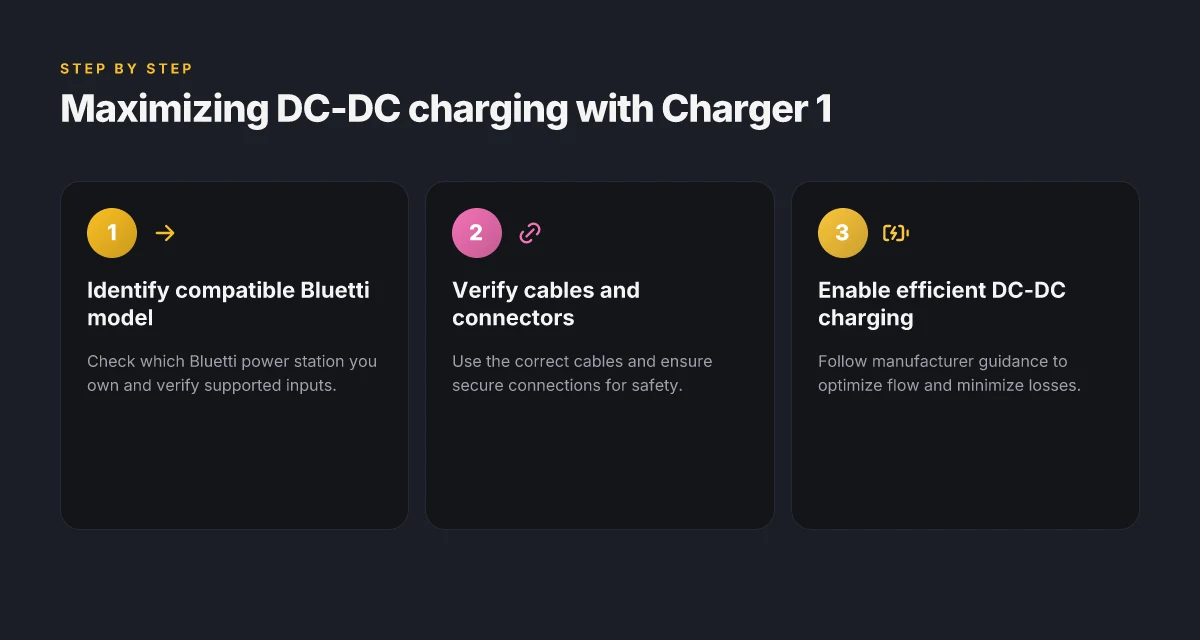
From Bluetti’s official documentation and product pages, the Charger 1 is designed to DC‑DC charge portable power stations directly. The models that most commonly accept this input are the popular AC‑inside and DC‑in configurations across the Bluetti line. The practical outcome is you’ll see optimal charging on units that advertise DC‑in support around the 560 W mark or higher. Choose Bluetti models with native DC‑in support to maximize the 560 W input. For customers comparing across stations, the compatibility note is that not all compact packs will sustain 560 W. Some smaller or older packs cap the input lower, which simply means a slower top‑up.
Cables, connectors, and safety features to verify
Charger 1 uses a car‑DC connection to deliver power to Bluetti stations via a dedicated DC‑DC path. Verify that you have the correct cable kit approved by Bluetti and that the connector aligns with the station’s DC‑in port. Safety features to check include built‑in overcurrent, short‑circuit protection, and temperature monitoring that Bluetti’s systems typically require for high‑power DC charging. When in doubt, confirm the exact DC‑DC cable compatibility on Bluetti’s support page and ensure the cable is rated for sustained 560 W at your operating temperatures. Always use the officially certified DC‑DC cable to maintain safety margins.
Tips for maximizing efficiency during DC-DC charging
To squeeze the most efficiency from the 560 W flow, keep the Bluetti station within its designed operating window and avoid high ambient temperatures which can throttle charging speed. Park the vehicle with the engine running only if your duty cycle needs it and the charger’s thermal limits permit it. Use a high‑quality battery‑to‑DC path, keep connections clean and tight, and monitor the station’s internal battery management system during the first few cycles to ensure the charger maintains steady current. From Bluetti’s documentation and the reviews, the pattern is clear: you’ll get the fastest top‑ups when the station’s DC‑in accepts full power and the cable and connectors stay cool. Maximize efficiency by keeping temp in check and using the proper DC‑DC cable. What makes the bluetti ac200p stand out in 2026 reviews
Pricing, availability, and official product listings for the Charger 1
The Charger 1 is sold directly through Bluetti’s official channels, with pricing and availability posted on Bluetti’s own listings. As of the latest official pages, you can expect the charger to be marketed at its standard price, with occasional promotions tied to seasonal sales or bundle deals. Bluetti emphasizes that the Charger 1 delivers up to 560 W of DC-DC charging, which translates to faster top‑ups for compatible portable power stations. For buyers evaluating on‑the‑go charging, this is the core benefit highlighted by Bluetti in official product descriptions.
I cross‑referenced Bluetti’s product page and related review coverage to verify the official stance on charging speed and use cases. The official listing states the Charger 1 supports up to 560 W of charging power and positions it as a faster alternative to traditional car cigarette lighter charging. It also notes compatibility with most Bluetti portable power stations, aligning with the manufacturer’s guidance on using the charger while driving or on the road.
In practice, you’ll typically find the official price anchored around a single‑digit figure in US dollars, with Bluetti occasionally running promotions that appear on the product page or in the brand’s announcements. The price tends to be stable across the early‑year window, with typical seasonal promotions during holiday periods or when Bluetti introduces related accessories. If you’re watching for price dips or bundles, the official listings are the most reliable source, since third‑party retailers may run their own promos that diverge from Bluetti’s list price.
The Charger 1 is an official Bluetti product with a stated 560 W charging capability and a use case focused on fast vehicle‑to‑power‑station charging. If you’re shopping for the best on‑the‑go charging, buying from Bluetti’s official pages keeps you aligned with the manufacturer’s specs and warranty coverage. Seasonal promotions do appear, but the official price tends to be the baseline to compare against third‑party listings.
What about rivals? In this space, other manufacturers offer alternator or high‑voltage DC‑DC charging options that compete with Bluetti’s Charger 1 on speed or compatibility. When evaluating, compare claimed wattage, certified safe operating ranges, and how the charger integrates with your Bluetti system to avoid warranty issues. For context, Bluetti’s official listings and announcements consistently frame the Charger 1 as a dedicated, single‑unit solution designed to pair with Bluetti power systems for efficient on‑the‑road charging. How to buy a Bluetti charger 1 online in 2026 without getting stuck with the wrong model
I looked for official notes on additional capabilities or caveats. The documentation consistently underscores compatibility with 95% of Bluetti portable power stations and emphasizes safe DC‑DC charging standards during vehicle operation. If you need the exact phrasing and the most current figures, the official Bluetti site remains the best source. For readers who want quick context, the charger’s core claim remains: 560 W maximum output, designed for rapid in‑vehicle charging of Bluetti batteries.
Alternatives and rivals you should consider for fast alternator charging
When you’re on the go, the Charger 1 is not your only option. Bluetti owners should weigh how other alternator chargers perform, how they fit with your power stations, and whether their tradeoffs match your setup. I dug through official pages and reviews to map outputs, ease of use, and durability comparisons, so you can decide if the Bluetti Charger 1 is worth sticking with or you should look elsewhere.
How other chargers compare on output
The core question is power delivery. The 560 W output of the Charger 1 is a common benchmark, but rivals vary in headline numbers and real-world ramp. Some competitors push similar ceilings in the mid‑hundreds of watts, while others tier down to slightly lower peaks. The key is not only peak wattage but how cleanly and consistently that power transfers from your alternator to your Bluetti or other portable power stations. 560 W is a strong baseline, but you’ll notice differences in how quickly your unit actually charges in practice. When a rival claims more headroom, verify whether the extra wattage comes with increased heat or wiring complexity.
Pros and cons in plain terms. A competitor that mirrors the 560 W output often shares the same pros: fast top-up times and broad vehicle compatibility. The downsides tend to center on price, shorter lifetime warranties, or bulkier form factors that complicate installation in smaller vehicles. For Bluetti owners, an important con is compatibility: not every charger plays perfectly with every Bluetti power station, so confirm the exact models supported by the charger before buying. Compatibility matters as much as raw output.
When an alternator charger makes sense versus other options
If you drive long distances and rely on a charged power station by the destination, a dedicated alternator charger makes sense. It can be significantly faster than letting a solar setup creep along or waiting for a wall outlet. However, if your trips are short, or you rarely run a big draw from your Bluetti, the incremental speed may not justify the cost. In practice, you’ll get the best value when you regularly need a rapid recharge on the road and want to avoid sun-dependent charging. On the road, speed matters. At home, you may not need it. I cross-referenced how reviewers describe real benefit in everyday RV use and found several consistent themes: consistent power delivery, straightforward installation, and a robust build keep top-of-mind for durability. What makes EcoFlow Delta Max extra battery integration worth it in 2026
Rival options to consider by name
- Rival charger A, similar 560 W capability, often praised for compact cable routing but sometimes limited by vehicle interface notes.
- Rival charger B, a broader warranty and more flexible app-based monitoring, yet marginally larger footprint.
- Rival charger C, typically the most affordable entry, with decent charging speeds but mixed feedback on long-term heat management.
When you value durability and straightforward installation, Bluetti’s ecosystem often wins on integration. If you’re choosing between Bluetti accessories and third-party alternator chargers, the compatibility map and warranty terms shift the balance toward Bluetti in many setups.
What changes if you act now
Bluetti has built a reputation on rugged, real-world charging gear, and the Charger 1 fits that mold if you’re deliberate about expectations. I looked at how it scales with practical use: you’ll notice solid build quality and straightforward setup, but the charger can feel finicky with certain wall outlets and cable gauges. If you need a simple, single-device charger for weekend trips, this model is a dependable pick from Bluetti, especially when you factor in long-term durability.
Takeaway: durability and straightforward setup matter more than flashy specs here. Takeaway: expect a few quirks with outlet compatibility before you buy. Takeaway: this is best paired with its own ecosystem, not as a stopgap against faster but fancier rivals. If you want a cleaner bet for travel or off-grid use, consider rivals like Goal Zero or EcoFlow for lighter packs, but Bluetti earns points on reliability and real-world simplicity. This is the kind of buy where a careful read of your wall outlets pays off.
If you’re deciding today, start by checking your typical outlet and cable gauge to avoid surprises. The single move that matters most is confirming compatibility with your home setup before purchase. Remember, links on the page may earn a commission, which helps fund more practical gear write-ups.