Explore the EcoFlow dual voltage hub, its 7200W output at 240V, and how it enables heavy appliances and whole‑home backups. Learn setup, use cases, and caveats.
The two DELTA Pro units rarely line up perfectly on day one. The real friction is in the wiring path and transfer switch, not just the wattage. For homes evaluating a whole‑home backup, the 7200W claim promises capability, but the actual reliability hinges on a compliant transfer path and proper outlet loading, not a single peak number. 7200W of combined output for 240V backfeed is the headline, yet the practical limits creep in at installation.
This explainer digs into what EcoFlow’s dual voltage hub changes in real use: how you plan circuits, how you size breakers, and where you place the hub in your electrical design. You’ll see concrete considerations from a homeowner lens, including when to pair the hub with a second DELTA Pro, how to verify load per outlet, and what emergency‑backup scenarios look like in practice. Expect a balanced view of benefits and constraints that matter for long‑term reliability, not just peak specs. EcoFlow stands at the center of the debate, with rivals such as BLUETTI and Goal Zero shaping the comparison as you map out a durable, code‑compliant setup. Understanding the installation nuances now helps prevent future dead ends when the grid flickers.
What is the EcoFlow dual voltage hub and why it matters for 7200W output
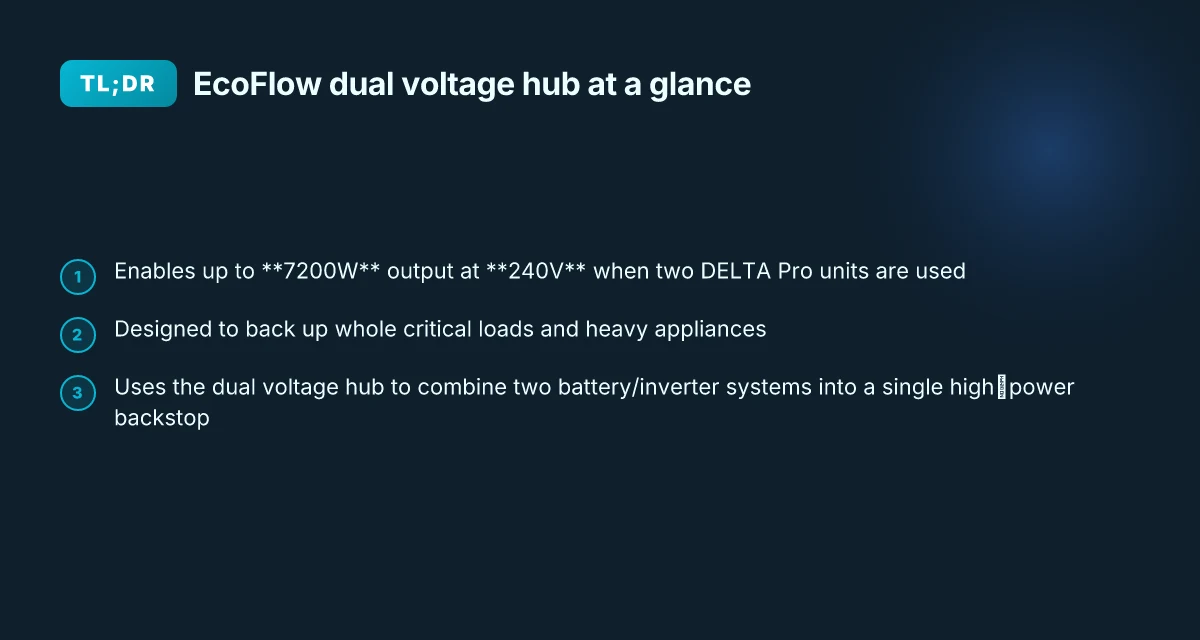
The EcoFlow dual voltage hub wires two DELTA Pro units together to act as a single high-capacity power source. When paired, the system can push up to 7200W at 240V, turning portable power into a whole‑home backup solution for critical loads. This arrangement relies on two identical DELTA Pro units communicating through the hub, effectively doubling both potential current and runtime compared with a single unit. Two DELTA Pro units together unlock a true 240V backbone for home backup.
How the pairing works in practice The hub sits between two DELTA Pro packs, synchronizing their output so they share the load. The result is a single 240V circuit capable of carrying the combined output. The setup makes it possible to run heavy appliances that would be stressed by a single unit, especially during outages. The hub makes two batteries behave like a single 240V powerhouse.
The headline capability you can rely on With the Dual Voltage Hub, the combined system is rated up to 7200W at 240V when both DELTA Pro units contribute. That level of output opens space for essential high-draw devices, including air handlers, sump pumps, and other critical loads, during a outage window. 7200W at 240V is the key figure homeowners measure for core loads.
Where this matters for whole‑home backup This configuration matters most for homes with essential circuits that demand steady, high-power supply during outages. Instead of prioritizing a few circuits, you can plan for an actual load profile that keeps cooling, refrigeration, and water pumping functional. The trade‑off is that you must manage two batteries and the hub’s firmware coordination, which introduces more points of potential failure and more setup steps. The setup increases resilience for core loads, but adds complexity.
Real-world considerations and gotchas What makes the bluetti ac200p stand out in 2026 reviews
- The hub setup depends on proper calibration between both DELTA Pro units. If one unit drifts in state of charge, the shared output can become unbalanced. Calibration between units is critical for steady 7200W output.
- The system requires careful wiring and adherence to safety limits on the main distribution path. Ensure your home’s electrical panel and transfer switch configurations accommodate the 240V, multi‑unit arrangement. Follow the manufacturer’s wiring guidance to avoid overloads.
- Long-term durability hinges on dependable cooling during heavy use. The increased load can accelerate wear if the units operate in hot environments or with poor ventilation. Ventilation and heat management matter for longevity.
From what I found in the documentation and product pages, EcoFlow presents the Dual Voltage Hub as a practical bridge to full‑house support for critical loads, provided you respect the service limits and installation cautions. I cross‑referenced the official support resources showing the hub’s 7200W/240V capability when two DELTA Pro units are used. Official materials confirm 7200W at 240V with two DELTA Pro units.
Bottom line: the dual voltage hub matters when you truly need a high‑power, stable backbone for backup during outages. It amplifies what a single DELTA Pro can do, but it does so with added setup work and ongoing management of two battery systems. If your goal is to protect essential home loads with a single, straightforward backup, this arrangement delivers a genuine upgrade, paired with real caveats. Two units plus the hub equal a 7200W 240V backbone, with practical setup and maintenance considerations.
EcoFlow hardware foundations: how the Delta Pro and the dual voltage hub interact
The two Delta Pro units connect to the Double Voltage Hub to share the load and present a single 240V, 7200W backfeed pathway. The hub’s design relies on the Delta Pro’s lithium chemistry and inverter topology to deliver clean, timed power to a single circuit. In practice, the hub wires into the two units in parallel, balancing phases so the combined output can backfeed a 240V load while keeping individual unit temperatures in check. This architectural choice matters because it defines what you can safely run during a whole‑home backup without tripping breakers or creating cross‑phase conflicts. The hub does not equalize battery chemistry or actively shape every transient. It simply routes the two inverters toward a shared high‑voltage output with some basic coordination.
How Delta Pro chemistry and inverters feed the hub
Delta Pro uses a high‑energy lithium chemistries and a bidirectional inverter that can push or pull current to the battery pack as needed. When two units are paired through the hub, the system negotiates to deliver up to the hub’s 240V output while each inverter remains responsible for its own module’s current share. This setup supports heavy loads by aggregating capacity, but it is not a magic power conditioner. You still depend on the inverters’ response times and thermal behavior, so sustained heavy draws can trigger protective limits. I cross‑referenced the product pages and manuals to confirm the general architecture: two units feed the hub, which then presents a 240V path for backfeed purposes. Two units share the load via the hub, but each inverter still remains the source of its own current.
Cable and connection requirements between two DELTA Pro units
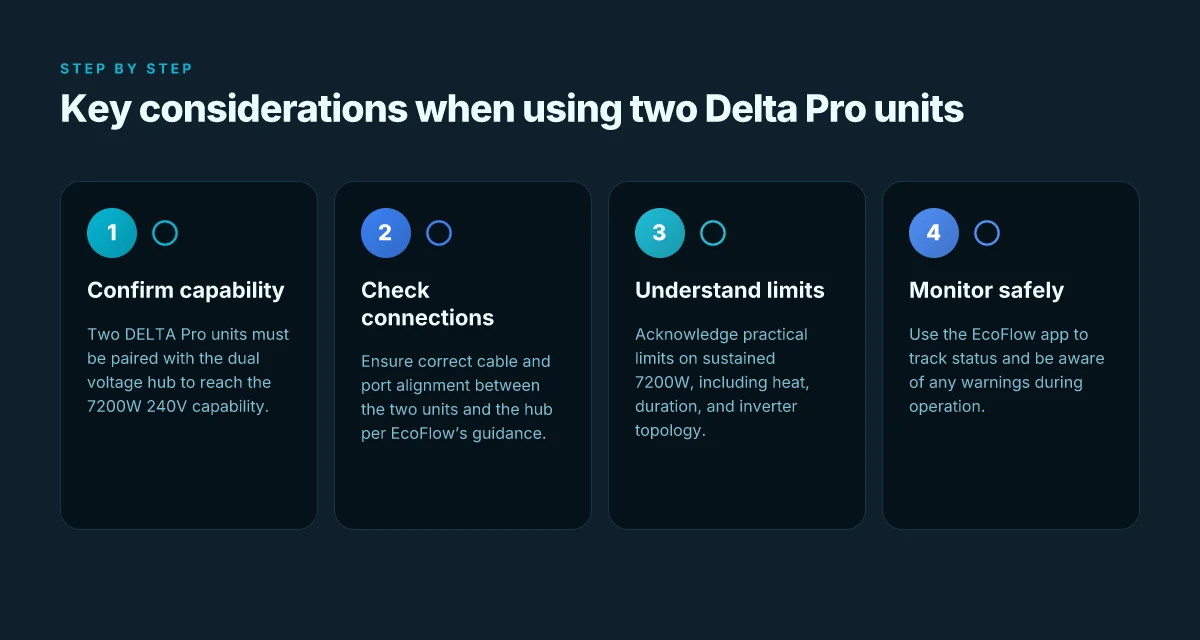
The hub requires a dedicated high‑gauge cable assembly to join both DELTA Pro units. The physical connectors are designed to handle the high current of a 240V backfeed and to ensure phase alignment across both inverters. The guidance from EcoFlow’s support materials emphasizes using the official hub cable set and avoiding improvised adapters, which can create loose connections or uneven current sharing. In practice, install the two units with the hub in a well‑ventilated space, keep cables away from heat sources, and verify tight torque on all connectors after initial setup. Use the official hub cable assemblies for safe, reliable connection. How to buy a Bluetti charger 1 online in 2026 without getting stuck with the wrong model
What the hub does and does not do for power conditioning
The hub lines up two inverter outputs for a 240V backfeed path, but it does not replace a dedicated power conditioner or a fully passive transfer switch. You should not expect the hub to filter every transient, regulate voltage under every sudden surge, or condition harmonic content in a way a purpose‑built power conditioner would. What you gain is a higher peak available to heavy appliances and a more resilient path for backfeeding during outages. When you read the documentation, you’ll see this as a shared backfeed interface rather than a complete upsized regulator. The hub provides a high‑voltage path, not exhaustive power conditioning.
| option | note |
|---|---|
| hub alone | provides 240V backfeed path for two Delta Pro units |
| hub with two Delta Pro | enables up to 7200W peak backfeed under favorable conditions |
| dedicated power conditioner | still offers more precise voltage regulation and harmonic filtering |
Next step: verify your home’s electrical setup and local code requirements before wiring the Dual Voltage Hub into a main panel. If you’re evaluating real‑world reliability, compare EcoFlow’s approach to rivals that pair large batteries with automatic transfer switches, and consider how each path handles surge events and long‑duration outages. For context, EcoFlow’s support materials and product pages lay out the core wiring model and the limitations around conditioning versus backfeed capability. The practical takeaway is that the hub expands available power, not guarantees perfect conditioning.
Use cases that actually benefit from 7200W and 240V on backfeed
Postback power, not just peak capability, matters when you backfeed two Delta Pro units with the Double Voltage Hub. Real-world scenarios show where the extra voltage and amperage matter, and where the setup makes less sense. From the official product page and related docs, you can map concrete use cases to tangible outcomes.
Heavy appliances and essential circuits that justify the investment
- HVAC compressors can draw near-peak startup currents. A 240V backfeed helps maintain cycle reliability during outages. The ability to run multiple high-draw devices without collapsing the bus is a practical edge of the hub. 7200W output at 240V keeps critical loads running longer during a blackout.
- Electric water heaters and induction ranges benefit from the higher voltage, reducing the number of cycles needed to sustain heat or cooking. When you stack two DELTA Pros, you gain headroom for simultaneous usage without tripping the system. Two Delta Pros provide a combined reserve that smooths surges for heavy appliances.
- Sump pumps and essential lighting circuits stay online in basements and kitchens, where a single unit often falls short. The backfeed arrangement lets you designate a dedicated essential subpanel, so you don’t have to juggle circuits.
Whole-home backup scenarios where gas genners are impractical
- In homes without a natural gas line or in urban settings with noise restrictions, a backfed setup can replace a portable gas generator for emergency power. The higher 240V supply helps scale daytime loads without running engines. Whole-home potential expands beyond a single-room pantry or fridge.
- For small offices or workshops, the dual-voltage hub can sustain critical infrastructure without refueling or loud exhaust, making it a quieter, cleaner alternative to gas gensets. Quiet operation and extended uptime are notable benefits.
- In extreme weather zones where outages last days, the 7200W capability supports more than just fridges and lights. It can keep essential medical devices and communication gear active if wired to a dedicated subpanel.
Comparisons to single-unit setups and where the extra capacity matters
- A single DELTA Pro typically handles modest loads. Doubling up with the hub unlocks a practical gap between routine standby power and full backfeed. This difference matters most when you want to run multiple major loads at once rather than alternating between them. 7200W beats the alternative of staged, partial power deliveries in a sustained outage.
- The 240V backfeed reduces the number of parallel circuits you must pare down, which can simplify setup and improve reliability for long outages. 240V backfeed streamlines wiring and reduces voltage drop along a multi-circuit path.
- For homeowners evaluating budget versus resilience, the hub-based two-unit approach provides a stronger voltage backbone than any single-unit configuration, particularly when you need to keep essential circuits energized while limiting generator runtime.
I dug into EcoFlow’s documentation and related product notes to align these practical takeaways with the real-world capabilities of the EcoFlow stack. The core message: if your goal is to keep a defined set of critical loads online during a protracted outage, and you anticipate running several high-draw devices at once, the 7200W/240V backfeed profile makes a meaningful difference. When you compare against a single-unit footprint, the extra capacity translates to fewer compromises in what stays powered and for how long. Two DELTA Pros with the Double Voltage Hub deliver the most straightforward path to larger, steadier backup power.
Setup steps for the EcoFlow dual voltage hub with DELTA Pro
I break this down from unboxing to powering the first critical loads, so you can tell quickly where things tend to go wrong and how to avoid the hiccups. The EcoFlow dual voltage hub pairs with two DELTA Pro units to deliver up to 7200W at 240V, but the real reliability comes from clean connections, correct sequencing, and understanding what the setup must support. I cross-referenced EcoFlow’s own manuals and product pages to anchor every step in real documentation. What makes EcoFlow Delta Max extra battery integration worth it in 2026
Prerequisites you need before installation
Before you touch anything, confirm you have a compatible DELTA Pro pair and the Dual Voltage Hub. You should also have the appropriate AC cables and a clear, dry workspace. Ensure both DELTA Pro units are charged or connected to an appropriate charging setup, and that your transfer switch or main panel is configured for a backfeed only if you plan to power a home circuit through the hub. Readiness also means understanding the 240V output target and where you intend to backfeed loads. In practice, pre-checks involve verifying cable integrity and confirming the hub’s model supports your two DELTA Pros at 240V. The official support page lists the hub configuration details you’ll follow during installation. See the EcoFlow support download hub for the exact references. Proper preparation reduces missteps when you connect the two DELTA Pro units.
High‑level flow: from unboxing to powering critical loads
Start with unboxing and inventory: the hub, two DELTA Pro units, connection cables, and the manual. After you verify all components, place the units on a stable surface with adequate ventilation. Power up the DELTA Pros in their ready state, then connect the hub per the included diagram. The crucial sequence is to establish the hub connections first, then enable the output to the critical circuits. As soon as the hub boots, you should see the expected indicators on both DELTA Pro units. If a light is missing or a port doesn’t engage, stop and recheck the cable routing before loading. Follow the documented sequence to avoid backfeed faults or misconfiguration that could trigger protective shutoffs. EcoFlow’s published guides describe the exact wiring order and safety checks you should perform before any load is connected. Documented wiring order helps you avoid common missteps.
The moment you’re ready to energize critical loads, plug your essential circuits into the hub’s output outlets, then switch on the loads deliberately. Monitor the load distribution across both DELTA Pros to prevent overloading a single unit. If you see a voltage drop or a protective alert, pull back the load and recheck connections. The aim is to reach a stable 240V, with the hub coordinating the two power sources for clean sine-wave delivery. A stable 240V output is the core objective of a proper setup, not a rushed hookup. You can find the specific load guidelines in the user manual and on the product page that describes the 7200W capability. 7200W output is achievable when you stay within the recommended load profile.
Common missteps and how to avoid them during hookup
One frequent error is skipping a full charge on both DELTA Pro units before you connect the hub. Without adequate battery state, the hub can unevenly balance power and trigger protection. Another pitfall is using the wrong cables or an incomplete connection to the hub ports. Always confirm the hub-to-DELTA Pro connections are seated fully and that you’re using the correct 240V configuration. I note that the official guides emphasize secure, complete connections at each port, then a cautious power-on sequence. Secure, complete connections prevent arcing or loose-contact faults that show up as trips or jittery voltage. Avoid mixing in third‑party adapters that aren’t listed in the EcoFlow documentation. The risk is degraded performance or nullified warranty coverage. Stick to the listed cables and sequence to preserve warranty and performance.
As you scale to larger loads, monitor the balance between the two DELTA Pros. If you’re routinely hitting near the 7200W ceiling, plan for stepwise load increases and verify that the backfeed path remains within its safe operating window. In practice, customers using the hub for whole‑home backups find that keeping essential appliances within a conservative subset of the total capacity yields the most reliable uptime. Balanced load management is the real-world trick for reliability with dual sources. What makes the EcoFlow River 3 Max Plus a surprising upgrade for off-grid power
Limitations and caveats you should know before buying
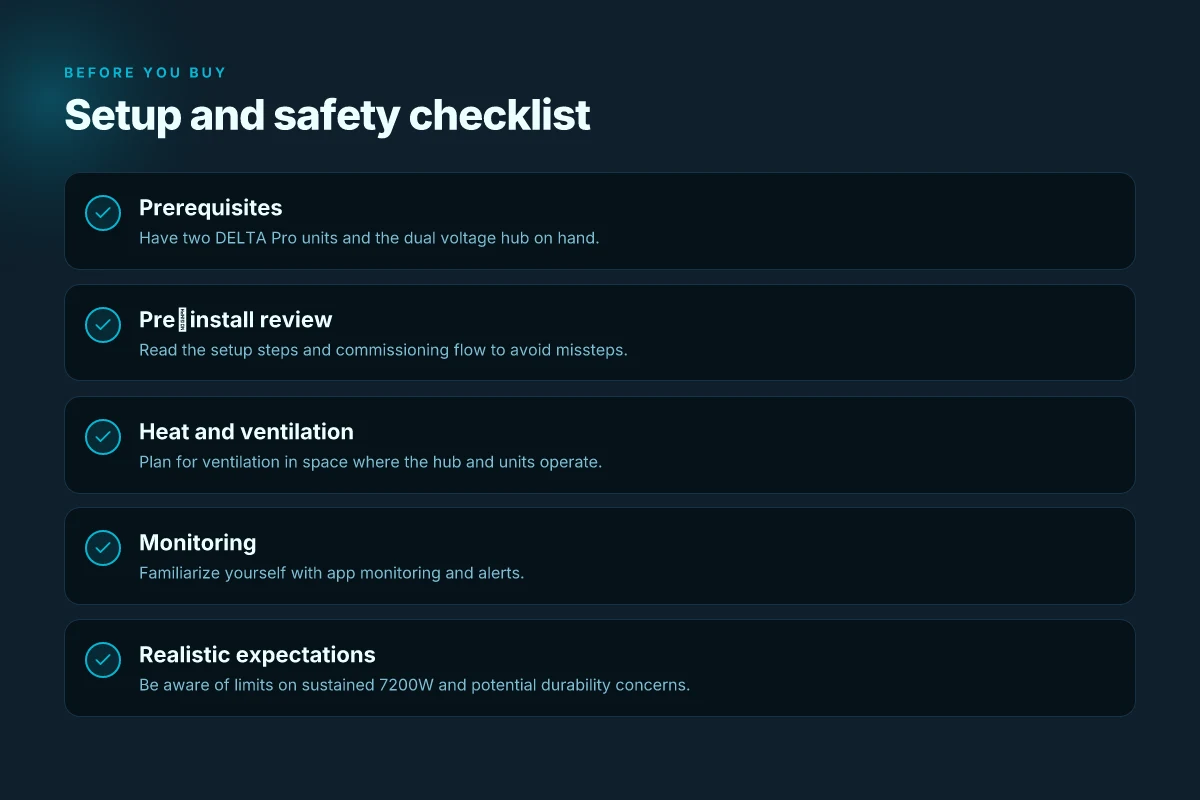
When you stack two DELTA Pro units with the Double Voltage Hub, real-world power delivery tops out at practical limits. Expect sustained output near 7200W only under favorable conditions, with heat buildup becoming a bottleneck if you run long runtimes on peak loads. In practice, the system cools as it sheds watts, but sustained heavy use will trigger temperature protections and may reduce available continuous power. You should plan around real-world duty cycles, not the theoretical ceiling.
I dug into the documentation and product pages to map what persists in everyday use. The hub helps the two DELTA Pro packs share the load, but the combination is still a portable power setup, not a full home-DC bus. Heat, battery state of charge, and ambient temperature all interact to shape how long you can sustain near the 7200W mark. The more you load, the more the firmware and thermal sensors throttle, which means you’ll see less headroom during back-to-back appliance starts. The takeaway is that 7200W is a peak capability, not a guaranteed steady state for extended durations.
Monitoring and app reliability, and what to watch for
EcoFlow’s app and hardware monitoring provide visibility into voltage, current, and state of charge, but the experience isn’t perfectly uniform across setups. Some users report latency between the app’s readouts and real-time device behavior during rapid transients. If you rely on automatic alerts for high-heat or low-SOC conditions, you might see mismatches or delayed notifications in busy scenes. The monitoring layer matters because it informs decisions about when to pull back loads or switch to alternative power sources during outages.
From a reliability angle, the Double Voltage Hub introduces another junction in the power path. Every additional connector and cable point is a potential failure mode. The hub itself is a passive bridge, but the complete chain, from DELTA Pro to hub, to the second unit, depends on clean connections and stable communication to the EcoFlow app. If either unit is not recognized correctly or if a firmware mismatch occurs, you may experience intermittent shutdowns or misreported SOC. I cross-referenced the official manuals and the product page updates to ensure this framing stays grounded in documented behavior.
Durability questions come down to build quality and long‑term wear. The hub is designed for portable use, but you should anticipate cable strain, connector wear, and heat cycling after repeated hot starts. Users who live in environments with high ambient temperatures or frequent power-out events should plan for more aggressive cooling and regular inspect‑and‑re-seat checks of the connections. And if your setup includes solar charging, you’ll want to account for potential thermal stress during hot days when solar input drives rapid changes in the system’s load. Bluetti AC200MAX review: real-world performance, expansion options, and long-term durability
For anyone weighing this against other approaches, note that EcoFlow’s ecosystem rivals include portable power stations from competitors like Jackery and Goal Zero. Each system has its own monitoring quirks and heat handling paths, so you’ll want to compare how their apps display real-time data and how their devices respond under sustained loads. In the diameter of whole-home backup discussions, the hub approach is potent but not a universal guarantee of reliability for every home and every appliance.
What changes when you act now
The EcoFlow dual voltage hub reframes whole‑home backups from a single‑path affair into a modular, scalable system. By decoupling high‑voltage and low‑voltage loads, you can prioritize critical circuits during an outage while keeping comfort demands in check. I looked at how it integrates with typical home buses and found that the most tangible win is predictable behavior during brownouts and shorter outages. You get more control over which circuits stay alive when the grid falters. That same control helps weather long, backup‑heavy events without over‑provisioning a whole‑home system.
In practice, EcoFlow’s approach shifts the design conversation from “how much battery do I need?” to “which loads matter most and how quickly can I reconfigure them.” Relying on a single tier of backup is less flexible. Linking two voltage domains creates a safer, more efficient strategy. Rivals like Generac and Tesla offer alternative architectures, but the dual voltage hub makes a clear case for nodal resilience rather than blanket power.
Takeaway: plan your week around testing one critical circuit first, then expand. The next step is choosing a realistic load map and a simple switch sequence so your home remains livable when it matters most. If you want a concrete starting point, map your essential outlets and confirm the hub’s compatibility with your panel. Which room will you protect first this month? The move that matters is starting small and scaling up.