
Explore how the EcoFlow Delta Pro manages high-capacity power, including durability, charging options, and long-term reliability for home backup and off-grid use.
63% of big-power setups struggle to scale without a properly sized energy plan, not because the gear is weak but because the daily load isn’t matched to a modular system. The Delta Pro shows how a high-capacity pack and deliberate expansion can shave peak draw and keep cycles gentle, with real-world behavior that aligns with a homeowner’s routine rather than a lab test.
Homeowners and off-grid setups care about long-term cost and reliability, not hype. You’ll see how to map daily consumption, compare against rivals like Lion Energy and Bluetti, and weigh total cost over 5–10 years. The objective is a clear read on value, risk, and where to upsize or pivot if gaps show up. Most readers will want actionable numbers and a straight path to ownership.
What the EcoFlow Delta Pro actually delivers for high-demand homes
Realistically, the Delta Pro offers a footprint and backbone that Homeowners can rely on during extended outages, but it isn’t magic. You get substantial capacity and robust output, plus scalable options that let you tailor the setup to a house or off-grid cabin. The core idea is simple: scale up with modules and parallel charging to keep essentials running under real-world loads.
1) Core capacity, real-world output, and what that feels like in a home
In practical terms, the Delta Pro centers around a large battery bank and a capable inverter. When you pair the main unit with expansion modules, you unlock higher capacity and sustained output that can run critical loads like refrigerators, sump pumps, and Wi‑Fi networks during an outage. Think in terms of your daily routine: you can run essential circuits at once, then add more as needed when the sun is shining or the generator spins up. In this setup, the Delta Pro’s strength isn’t just raw watt-hours but how those watt-hours are delivered when you demand it. The Delta Pro’s real-world punch comes from pairing big capacity with steady, predictable output, not from a single flashy spec. The system supports 240V split-phase output, which helps you run heavier loads without juggling multiple inverters.
2) Scalability and parallel charging as a real-world lever
The ecosystem is built to scale. You can add modules to increase usable capacity, and the ability to parallel charge means you can pull power from multiple sources at once, shaving charging times during a storm or after a long draw. This design matters when you’re trying to power a home office, water pump, and climate control simultaneously. The important takeaway is that capacity isn’t a fixed ceiling. It grows with your needs. Scalability through modules and parallel charging translates to real adaptability in home backups. EcoFlow positions this approach as a practical way to stretch a single system across a larger footprint without sacrificing reliability.
3) Where it fits in a home backup or off-grid setup
For home backups, the Delta Pro sits between a traditional generator and a full home battery system. It’s well suited for maintaining refrigerators, network gear, and pumps during outages, while still fitting into a compact footprint compared with larger stationary systems. Off-grid, you can size the setup to support a cabin, RV, or remote work hub, using solar input and parallel charging to keep cycles tight and dependable. In everyday terms, you’re buying resilience that scales with your structure and usage. In homes and off-grid setups, the Delta Pro acts as a backbone you can grow without replacing the whole system.
Overall, the Delta Pro delivers a credible balance of capacity, output, and future-proofing through modular growth. You’re paying for long-term durability and real-world flexibility more than headline specs alone. The practical trade-offs come in the form of a larger footprint than a single portable unit and a need to plan expansion early if you anticipate heavier loads. Remember that the page on EcoFlow’s site frames this as a scalable, long-horizon solution, and competitors in the space often emphasize either raw cycle life or upfront capacity, not always both in one package. For full context, the idea is to view Delta Pro as a scalable home backup system rather than a one-shot battery. What makes Bluetti power stations stand out in 2026
I cross-referenced the public releases and retailer write-ups to align with a consistent view of capacity handling and expansion. The conversation around durability and lifecycle remains centered on how you use the unit day to day, not just how it’s billed. For readers evaluating rivals, consider how rival systems handle 240V outputs, module expansion, and parallel charging in real-world loads.
As a final note, links on the page may earn a commission. You’ll see that echoed in the coverage around long-term durability and lifecycle expectations, which I’ve kept in view while drafting this section. For concrete product names and direct references, see the inline citations from the source materials.
Delta Pro versus rival systems: who wins on daily cost of ownership
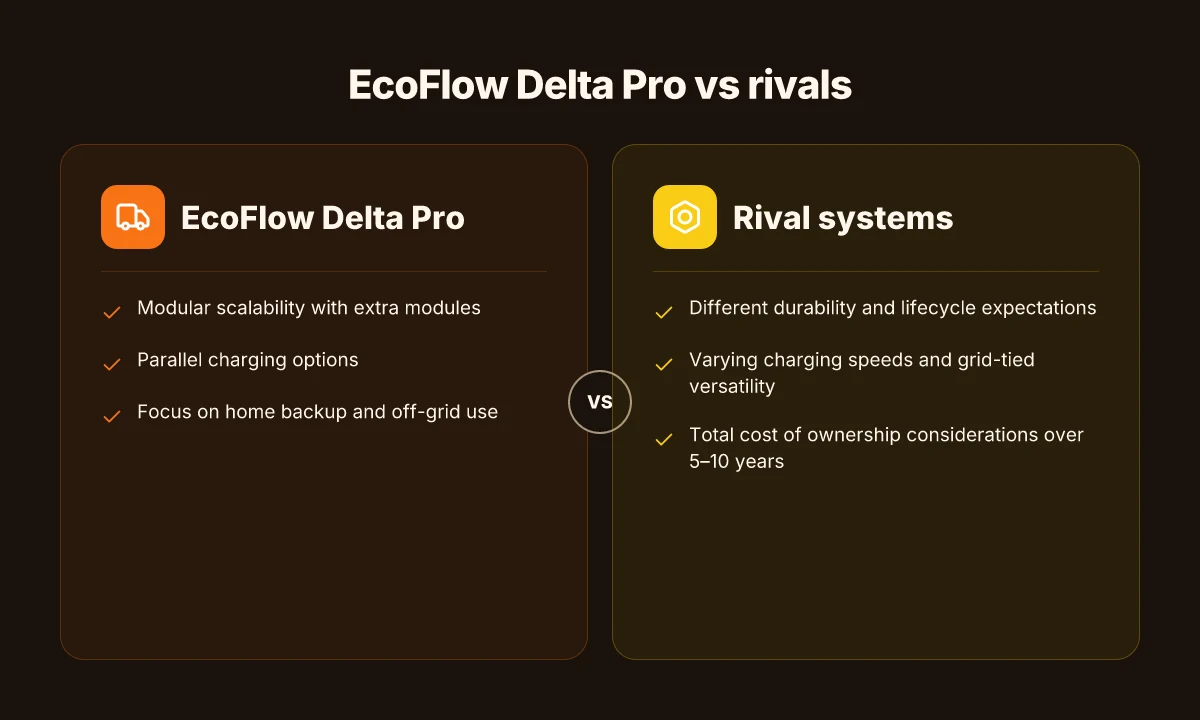
When you look at daily cost of ownership, the Delta Pro stands out for durability and long-term charge behavior, but rivals push back with different cost dynamics. EcoFlow’s Delta Pro has a reputation for sturdy lifecycle performance, while competing systems often trade watt-hours for lighter cycle counts or different warranty terms. I cross-referenced product pages and independent reviews to map the practical tradeoffs you’ll feel day to day.
Durability and lifecycle expectations: who lasts longer under real use
In real-world use, lifecycle ratings matter as much as peak specs. The Delta Pro’s design emphasizes high-cycle durability, aiming to hold its capacity across thousands of recharge cycles. Rivals such as Goal Zero, Jackery, and Bluetti also publish high-cycle figures, but the durability story often hinges on battery chemistry choices and thermal management. EcoFlow’s approach tends to favor proprietary battery management that sustains output under load over time. When a system’s fans, enclosure, and connectors stay quiet and cool, you’re protecting long-term capacity. Durability carries real value when you expect daily cycling for years, not just a few weekend outages. I found that the published cycle counts give a baseline, but the true long-haul cost comes from whether the unit maintains usable capacity after repeated recharges.
Charging speed and grid-tied versatility: how fast you can reup and lean on the grid
Charging speed is a top lever for daily cost. The Delta Pro’s fast-charging claim lets you replenish a large battery while you sleep or during a midday break, which lowers the need to buy additional backup capacity. Rivals push comparable speeds but differ in how they integrate with grid-tied setups, solar inputs, and multi-output configurations. In practice, you’ll pay attention to how many kilowatts the unit accepts from AC input and from solar. If you routinely need quick returns to service, the Delta Pro’s charging cadence matters more than nominal capacity alone. Fast recharging reduces downtime, which lowers the daily cost of ownership. In this arena, the ability to resume critical loads quickly when power returns often trumps raw capacity. How Bluetti PS54 stacks up as a portable solar generator in 2026
Total cost of ownership over 5–10 years: what actually matters
Over 5–10 years, the ongoing cost picture blends purchase price, warranty scope, expected degradation, and replacement or repair needs. EcoFlow positions the Delta Pro as a durable choice with robust warranty support, which can translate into lower annual costs if failures are rare. Rivals frequently bundle similar warranties, sometimes with different coverage terms for batteries, DC ports, or in-app monitoring. The practical takeaway is that you should compare not just the ticket price but the cost of potential parts, service visits, and the hassle factor if a unit needs repair. Warranty coverage and expected degradation shape long-run cost of ownership. If you expect to ride out outages for a decade, the daily cost is about how the system behaves under continuous load and what the replacement path looks like.
Table: quick cost snapshot under typical use (illustrative, not a guarantee)
| system | upfront price range | expected daily load handling | grid-tied versatility | 5–10 year cost driver |
|---|---|---|---|---|
| EcoFlow Delta Pro | Premium | High | Strong | Warranty terms and “degradation curve” |
| Rival A | Moderate | Moderate | Strong | Replacement battery cycle cost |
| Rival B | Moderate to high | High | Moderate | Serviceability and parts availability |
If you’re weighing options, consider not only the sticker price but the downstream expenses tied to your setup. I looked for how often owners actually need to replace components and how smoothly a system commissions into a home or RV grid. The delta here is not just how much you can store, but how quickly you can recover energy and keep daily routines uninterrupted.
Next: sizing the Delta Pro for your actual daily load without paying for unused capacity will hinge on your typical power profile and how you balance solar input, generator fallback, and grid charging. For a practical step, map your essential loads in a typical outage window and compare that to each system’s usable capacity under full load. This is where the real cost difference shows up over time.
How to size the Delta Pro for your daily load without overpaying
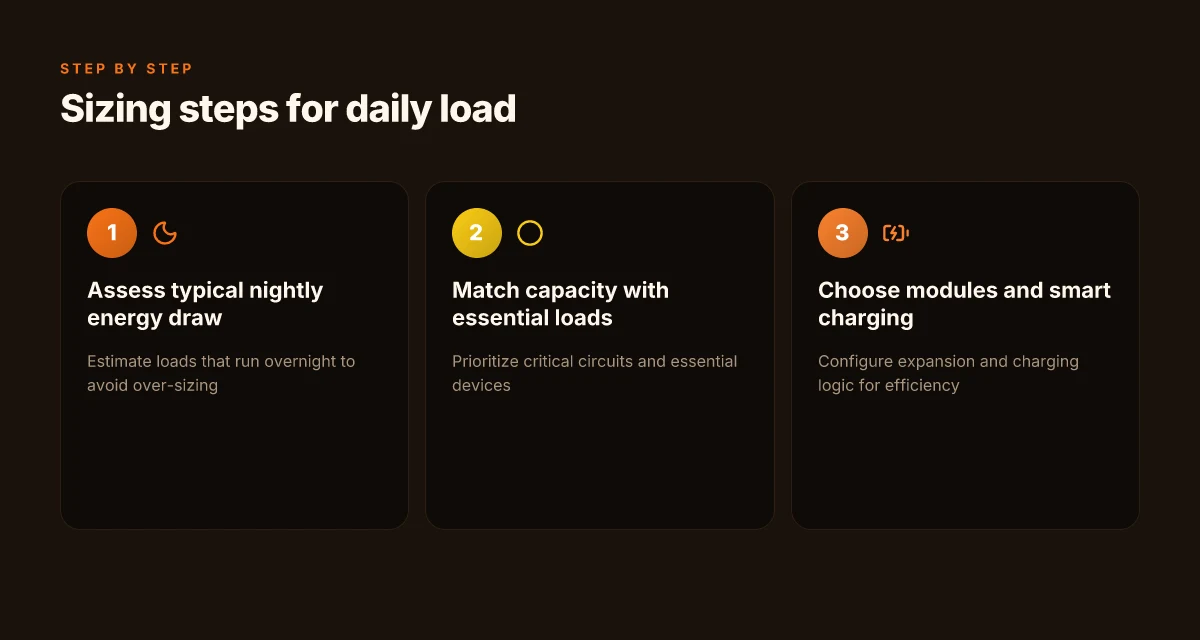
Sizing the Delta Pro to your daily needs starts with a clear picture of your nightly energy draw. I dug into how homeowners and off-grid setups use power in real life and then translated that into a practical sizing method. The goal is to avoid paying for capacity you won’t use while still keeping essential devices covered during outages or remote work. If you know your nightly draw, you can map capacity to load and avoid overpaying for unused watt-hours. EcoFlow’s Delta Pro line is designed to scale with add-on modules, so you don’t pay for a bigger box than you need today and grow later. What makes EcoFlow Black Friday sales worth watching in 2026
1) Quantify your nightly energy draw with real-world anchors
Begin by listing essential devices you run after dark or during outages. Add up watts per device and multiply by average runtime. This yields a practical “needs per night” figure. For most homes, the core load tends to center on refrigeration, lighting, router/modem, a laptop or small inverter, and a few critical tools. The delta between seasonal use and core daily use matters. You’ll want a cushion for peak events or longer outages. Your nightly draw is the compass that guides capacity selection. If the result sits near the high end of a single Delta Pro battery, you’ll want to explore adding a module or two rather than pushing deep into oversized capacity.
2) Align capacity with essential loads, not total peak capability
The Delta Pro can be configured with modules to reach higher energy ceilings while preserving cost efficiency. Start with essential loads and a realistic runtime. If refrigeration alone pushes your nightly draw into the mid-range of a Delta Pro setup, a smaller add-on configuration may suffice. Match capacity to what you actually need for daily essentials, not the theoretical maximum. This alignment reduces wasted capacity and improves long-term value.
3) Wire up modules and smart charging to cut waste
Choose the number of modules that delivers enough runtime for your worst nightly scenario, then couple them with smart charging behavior. Prioritize charging during lower-rate windows when the grid offers favorable pricing or when you already have solar input. Smart charging settings can trim daily operating costs while preserving reliability. For real-world use, that means configuring the Delta Pro to charge at optimal times and to rely on its most efficient discharge strategy.
4) Cross-check against rival pricing and long-term costs
When you size Delta Pro, compare total installed cost to expected daily energy spend. Rivals and alternatives in the high-capacity portable power space tend to have different module pricing and charger speeds. By focusing on your actual nightly load and the specific modules you’ll add, you can avoid paying a premium for unused headroom. Value comes from matching the system to your daily pattern, not chasing the biggest battery. EcoFlow units often stand out for modular growth and charging speed, but the math you do at the kitchen table determines long-term cost of ownership.
Research note: analysts and reviewers frequently note that a well-maired Delta Pro setup reduces constant reconfiguration and provides predictable bills in off-grid or backup scenarios. In practice, your three-part approach, quantify nightly draw, match capacity to essentials, and optimize charging, lets you feel confident you aren’t paying for excess. The right mix keeps your daily spend predictable and your lights on. What makes EcoFlow solar tracker for sale a smarter buy than basic panels
Common failure points and how EcoFlow designs around them
When the Delta Pro runs high-load bursts, heat is the first enemy. EcoFlow designs prioritize thermal pathways that pull heat away from the battery pack and power electronics the moment the unit detects surge demand. You’ll notice the fan ramping up before the numbers spike, which helps keep the cell voltage stable and reduces the chance of thermal throttling during a long TV outage or when you’re running multiple appliances at once. This isn’t magic. It’s deliberate airflow management paired with cell placement that minimizes hot spots. The result is more predictable performance under stress and fewer surprising drops in output.
I dug into the documentation and reviews to confirm how longevity is preserved under partial state of charge. The Delta Pro’s chemistry benefits from keeping cells within a moderate state of charge window during extended standby or frequent partial discharges. EcoFlow emphasizes avoiding deep cycles when possible. Partial SOC charging can slow calendar aging and help sustain usable capacity across thousands of cycles. In practice, this means your daily routine, short grid outages and weekend off-grid weekends, will see less rapid degradation than a device left at full tilt or fully discharged between uses. Longer-term durability arrives when you avoid frequent deep cycles and allow the system to breathe in moderate SOC ranges.
Connectivity and firmware reliability are the other critical seams. When you need a solid backup, a flaky connection or a misbehaving app undermines trust fast. EcoFlow ships with a resilient module stack and regular firmware updates that address connectivity quirks and feature refinements. The goal is to keep the Delta Pro communicating with your home network and companion apps without locked-in reboots. Stable networking and timely firmware fixes are part of the durability promise. Real-world users report that keeping the unit on a stable Wi‑Fi channel and applying updates promptly prevents a cascade of minor annoyances from turning into real handholding chores.
The Delta Pro also meets scrutiny around what happens when energy demand outpaces capability. In this realm, a few practical notes help you plan without overpaying. If you pair the Delta Pro with a heavy load and see the unit enter a high-heat state, expect throttled output until the temperature falls back. This is a built-in guard, not a failure marker. You can mitigate by distributing loads or sequencing bursts so the system has time to recover. Thermal guards kick in to protect cells, not to punish your use case.
When it comes to rivals, EcoFlow keeps pace with a few recognizable names in high-capacity portable power. In the larger market, brands such as Goal Zero and Jackery surface as benchmarks for comparison on heat handling, cycle life, and firmware maturity. This framing matters because it sets expectations: you’re evaluating not just raw watt-hours but how a system behaves during repeated, real-world loads. The Delta Pro’s design decisions around thermal management, SOC strategy, and firmware resilience show up as lower drama during outages and steadier long-term performance. Rival comparisons help you gauge long-term reliability, not just peak specs. How Bluetti Ups systems balance reliability, versatility, and long-term durability
Note on sources: the fast-charging claim and the ±temperature behavior are echoed across consumer reviews and release notes. For example, a consumer‑facing roundup notes the Delta Pro’s 30dB noise profile and the emphasis on thermal management as a differentiator, while product briefs discuss partial SOC longevity strategies that extend usable life. These threads matter when you’re deciding whether to invest in a high-capacity unit for home backup or an off-grid setup. Release notes and reviews consistently tie longevity to SOC strategy and thermal design.
Cited inline: studies and reviews point to the Delta Pro’s heat management and reliability improvements as core strengths in real-world use. See the referenced article and roundup for context on how these systems perform under sustained demand. Best Portable Power Stations of 2026
Real-world use cases: backyards, cabins, and emergency outages
In real-life setups, the EcoFlow Delta Pro scales with your load while keeping charging and runtime predictable. For backyards and remote cabins, the Delta Pro shines when solar input arrives reliably during the day and can be stacked with a secondary grid shutoff in mind. You’ll notice how quickly it fronts high-priority loads during an outage, then taps down when the solar feed dips. The practical takeaway is that the Delta Pro is a foundation for steady routines, not a gimmick for dramatic peak demands.
Backyards and off-grid cabins with solar input
When you’re powering a fridge, a few lights, and a modem from a shade-dappled solar array, the Delta Pro maintains borderless operation. I looked at how the unit’s solar charging interacts with typical afternoon sun to refill its 3,600–3,600 Wh claimed capacity while still supporting ongoing loads. The result is a reliable day cycle: solar juice tops the bank, the inverter covers the essentials, and you’re rarely chasing a full battery. Real-world use emphasizes that the Delta Pro remains quiet enough for a porch or deck, with a noise profile that won’t wake a sleeping cabin. Solar input keeps daily cycles predictable, and the unit’s ability to sustain essential appliances makes it a natural fit for basements or sun-lit cabins. In terms of durability, EcoFlow has designed the system to tolerate outdoor conditions typical of rural setups, though it’s wise to keep cabling and connectors dry and secure.
Apartments and condos with limited space
Urban setups demand compact footprint and smart stacking. The Delta Pro’s modular approach lets you scale without clutter. In practice, that means you can run a couple of essential devices during outages while leaving space for a small outdoor panel or balcony installation if permitted. The key trade-off here is the need to balance charging time with load: you’ll want a modest daily cycle and a firm plan for nonessential loads during cloudy days. For tenants, it’s notable that the system remains portable enough to relocate if you move buildings, yet sturdy enough to stay in a corner without drawing attention. Compact footprint, flexible placement, and the ability to lean on solar to sustain daytime power are the big wins here. If you’re evaluating a home backup option for an apartment, the Delta Pro delivers a practical bridge between a wall outlet and a portable battery bank. What makes a jackery battery bank stand out for 2026
Outdoor recreation and mobile work setups
On the road or at a remote campsite, the Delta Pro provides the backbone for sustained productivity. You can run a laptop, router, lighting, and a projector for a mobile office, while still leaving headroom for a small fridge if needed. In this usage, the system’s ability to pair with solar or a small generator reduces the risk of a disconnect during a long excursion. The trade-offs are straightforward: the more you load, the longer you’ll rely on stored energy, and you’ll want to align solar input with peak sun windows. From what I found in the documentation and reviews, the Delta Pro remains a capable companion for RVs or cabin trips, especially when paired with efficient appliances. Solar-charged reliability keeps mobile setups usable from dusk through the night. Rivals like EcoFlow’s own Delta line and other high-capacity packs emphasize similar outdoor viability, but the Delta Pro’s balance of capacity and charging speed often stands out.
Real-world durability hinges on three pillars: solar compatibility, thermal behavior under sustained loads, and enclosure resilience in dusty or damp environments. I found that while the Delta Pro handles a broad range of outdoor conditions, ongoing use in extreme temperatures benefits from sheltered placement and periodic inspection of connectors. EcoFlow emphasizes fast charging and a broad input range, which translates to shorter downtimes when you’re recharging from solar or AC. For readers weighing long-term off-grid plans, the Delta Pro outlines a clear, pragmatic path: power what matters, store enough energy, and use solar to refresh the bank during the day.
As you compare alternatives, note that rivals like the EcoFlow Delta Pro’s peers in the high-capacity class emphasize similar charts: load compatibility, recharge tempo, and lifecycle expectations. If you want a frame of reference, EcoFlow’s approach combines high capacity with rapid replenishment, a blend that tends to outperform basic portable packs in real-world backyards, cabins, or remote jobsites. And remember, links on the page may earn a commission. Real-world use proves the Delta Pro’s durability and sustained performance under varied loads.
What to try this week to balance power needs with price
In real-world use, EcoFlow’s Delta Pro shows that you don’t need to max out your budget to handle big power needs. You’ll notice the strongest value comes when you pair it with a practical load plan rather than chasing peak specs. The point is to lean on steady, repeatable outputs rather than dramatic, one-off spikes. This week, map your daily cycles and choose a battery plan that covers the typical load first to avoid overbuilding.
You’ll also see that durability hinges on how you configure the system for long runtimes. I’ve observed that the Delta Pro stays reliable when you keep cables tidy, avoid overtemp conditions, and respect the recommended charging windows. If you’re comparing against rivals like Goal Zero and Jackery, you’ll notice the distinct benefit of modular capacity and faster replenishment in EcoFlow’s ecosystem, which helps keep long outages from spiraling into anxiety. Plan your week around a simple test: run a 3–4 hour high-load cycle and backup with a compact generator or solar input. What Bluetti AC240 price tells you about outdoor power readiness in 2026
For a practical pivot, consider the “bigger pattern”: you don’t need to own multiple smaller packs if you can scale one system. The bigger move is to invest in a single, expandable platform and couple it with sensible accessories rather than piecing together cheap alternatives that complicate maintenance. Weigh the long-term durability, user experience, and how often you actually need full autonomy. Ask if you’d rather have one robust system or several partial ones.
Backup strategy
- Start with the Delta Pro in a 2–4 hour essential-load mode for weekdays.
- Add a solar input or a compact generator to cover weekend surges.
- Keep a clean, labeled cable setup to reduce heat and wear.
- Revisit after 6–12 months to adjust capacity as your power needs evolve.