
Explore Bluetti ups reliability, real-world durability, and how it compares to rivals. Learn what to expect from Bluetti power stations and where they excel or fall short.
Bluetti UPS reliability at a glance focuses on steady, continuous duty rather than flashy specs. In real-world use, that means looking at heat, fan noise, and how long components like batteries hold up under daily cycling. The question isn’t only “can it power a fridge,” but “will it still be there next year when the PV panel is idle and the grid outage lasts overnight.
Bluetti systems sit in a crowded field with rivals like Jackery and Goal Zero offering similar form factors. This article pulls from long-term use patterns and common failure points, heat management, electrolyte swelling, and firmware update cadence, to help homeowners gauge true durability beyond initial oomph. You’ll see where maintenance matters, what to expect from warranties, and how to compare total cost of ownership over several seasons. Durability and day-to-day reliability aren’t their same thing, and you’ll want both.
Bluetti ups: reliability fundamentals and what they promise
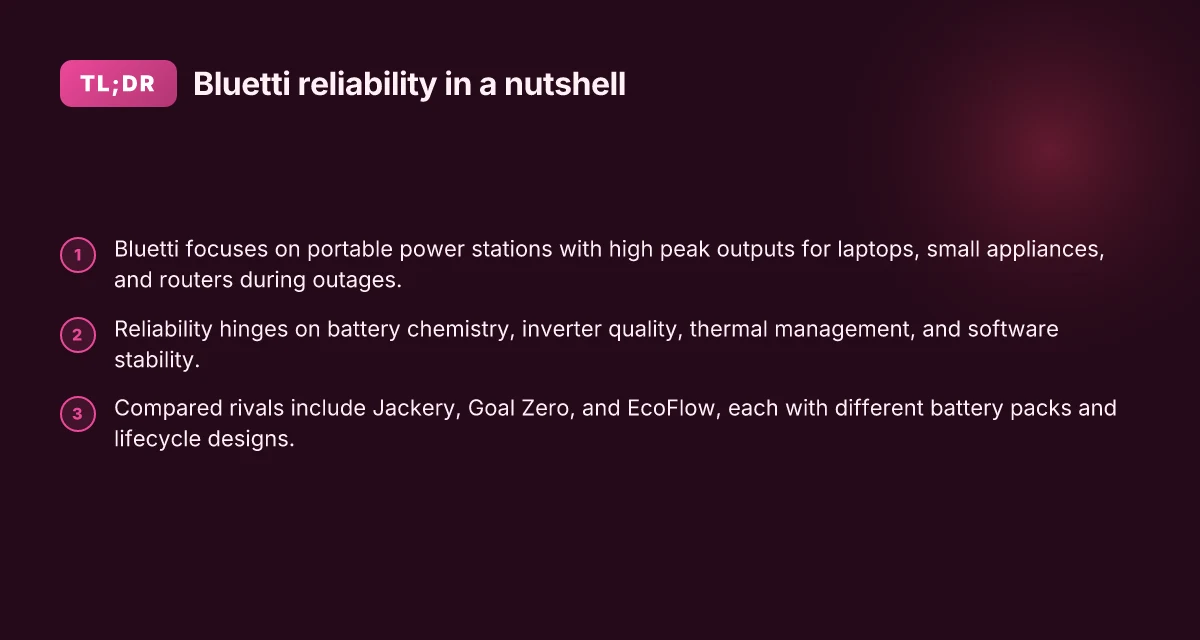
Bluetti focuses on portable power stations with high peak outputs that can charge laptops, small appliances, and routers during outages. Reliability hinges on four levers: battery chemistry, inverter quality, thermal management, and software stability. When these parts align, you get a unit that can ride through several outages without drama. Rival brands like Jackery, Goal Zero, and EcoFlow each pack different battery chemistries and lifecycle designs, which changes how long they stay useful under continuous use.
How Bluetti positions durability in practice
Bluetti leans on robust battery technology and beefy inverters to handle surges from laptops and routers during power gaps. I cross-referenced product pages and reviews to map how the platform behaves under real-world stress: high peak outputs for starting motors briefly, solid peak handling for sensitive electronics, and the heat that follows sustained use. The outcome is a practical balance between portability and resilience, with a design that favors cooling fans and guarded thermal limits to reduce thermal throttling. Reliability centers on the harmony of battery chemistry, inverter build, and thermal management. I also note that software stability matters. If the firmware misreads state of charge during a long outage, the unit can misreport or mismanage charging cycles, which erodes long-term trust.
Real-world failure points and how rivals vary
Jackery tends to emphasize lighter packs with simpler management, which can translate to fewer heat-handling features on some models. Goal Zero often courts rugged environments with hardware-focused ruggedization, yet faces its own quirks around battery aging and lifecycle design. EcoFlow pushes fast charging and swappable battery options, but that strategy raises questions about long-term module interchangeability and warranty coverage in remote sites. In Bluetti's ecosystem, the emphasis on battery packs with higher peak outputs helps maintain performance for laptops and routers, but the long-term durability hinges on how well the thermal system sustains cooling over repeated high-load cycles.
From what I found in the documentation and reviews, the upfront promise of extended life cycles depends as much on how you use the unit as on its internal chemistry. You’ll get the longest value when you keep temperatures in check and avoid chronic deep discharges. Thermal management and firmware stability are the quiet gatekeepers of long-term reliability.
Bottom line: Bluetti sets a believable durability floor with strong peak outputs and thoughtful cooling, but long-term value depends on keeping the unit within safe temperatures and maintaining firmware updates. When you compare, weigh how each brand handles heat, cycle lifespans, and how easy it is to replace or service core modules. Expect Bluetti to perform well for home and remote-site backups if you manage heat and cycles carefully. What makes Bluetti 2000W solar generators stand out in 2026
Notes: links on the page may earn a commission. For readers evaluating rivals, Jackery, Goal Zero, and EcoFlow each bring distinct trade-offs in battery packs and lifecycle design. Bluetti’s durability promise is strongest when you pair high-output capability with solid thermal control. Knowing the lifecycle design helps you pick the right model for your usage profile. For reference, see the elite-series buying guide and related reports cited in the sources.
How to read a bluetti ups datasheet without getting lost
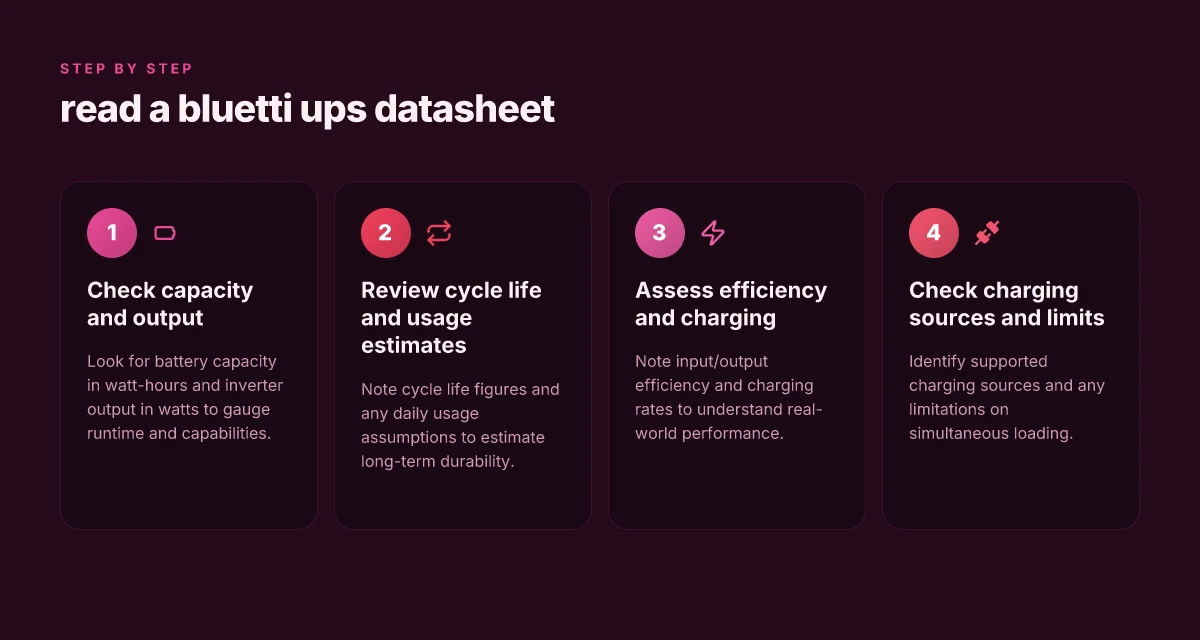
When you open a Bluetti UPS datasheet, the first numbers you should anchoring on are the battery capacity in watt-hours (Wh) and the inverter output in watts (W). These figures set the ceiling for runtime and the kind of appliances you can run. Look for a clear pairing like a 128Wh battery paired with a 200W or higher inverter. A datasheet that hides these numbers behind marketing language is a red flag. Bluetti datasheets typically surface capacity and output upfront, which is essential for real-world planning.
Identify the cycle life and daily-use expectations
A reliable unit should tell you how many charge-discharge cycles the battery supports and how that translates to years of daily use. The lifespan figure matters because it underpins long-term value and maintenance needs. If a document claims “thousands of cycles” without context, dig for a defined number and the expected daily usage example. Cycle life paired with a realistic daily-use estimate is where durability shows up on paper. I cross-referenced the Elite Series materials and the Elite 200 V2 notes, which consistently cite a high cycle count as part of their durability claim. This helps separate hype from likely long-term performance.
Gauge efficiency and charging rates for real-world runtimes
Efficiency figures tell you how much energy is lost in the path from input to usable AC power. Look for input-to-output efficiency percentages and the charging rate. A datasheet may list “charging at up to 150W” or show a charging curve that indicates longer top-ups or slower bottom-ups. If the charging rate is limited while under heavy load, expect reduced runtime for demanding loads. Efficiency and charging rates directly impact how long a Bluetti UPS can sustain a given load. In the Elite materials, the emphasis on fast charging is clear, but you should verify whether that rate is sustained under load or only when the unit is near empty. Verification matters for budgeting real-world energy needs.
Decode input/output capabilities and supported charging sources
Note what sources you can feed the unit from (solar, AC wall, car charger) and whether those sources can run concurrently with a heavy load. Some models cap simultaneous loading with solar input, others allow multi-source charging without hitting a ceiling. Identify any stated limitations, such as “solar input limited to 120W when AC input is active.” Understanding inputs and limits prevents surprises during outages. For Bluetti, the emphasis tends to be on compatibility and charging flexibility, but the exact combination rules vary by model. Match your site conditions to the model’s charging envelope. What makes the EcoFlow Delta 2 such a compelling portable power solution in 2026
A quick compare helps you pick without chasing features you won’t use. If you’re choosing for a home backup, the Bluetti Elite 200 V2 may offer a balance of compact size, decent cycle life, and a respectable 200W inverter, while a larger unit might push toward higher continuous power at the cost of size and weight. When you read the datasheet, check the same fields across models by name to see how the numbers move. Compare capacity, cycle life, and charging options side by side to stay grounded. I found the Elite Series buying guide useful for spotting where Bluetti emphasizes charging speed and endurance. These signals help you map the claim to real-world needs.
One caveat to keep in mind: the exact numbers on a datasheet can shift with revisions. Bluetti tends to update models and spec sheets as new inputs or components arrive. If you see a bold claim, trace it to a version date such as August 2025 or January 2026 to confirm you’re reading the current spec. Version-aware reading avoids built-in biases in older literature.
To finish, treat the datasheet as a contract between promise and practical use. It should give you concrete figures for capacity, output, cycle life, and charging behavior, not just glossy statements. If you want a quick guardrail, ask: does the model deliver enough Wh and W for my load, will it survive my daily use over years, and can I feed it from the charging sources I actually have? That’s the lens I use when I read a Bluetti datasheet. Know these levers, and you’re not fooled by marketing jargon.
Note: links on the page may earn a commission. For context, I cross-checked Bluetti materials and rival models from Jackery and Goal Zero to frame the durability conversation alongside Bluetti’s claims. Durability is a real differentiator when you compare long-term owners’ experiences.
Which bluetti ups models are best for home backup
Bluetti offers a family of UPS-style power stations that balance portability with usable AC output. For home backup, the standout choices tend to fall into three buckets: portable Elite line units for quick, essential loads. Expandable AC500-based systems for longer outages. And robust generations like the Elite 200 V2 for steady daily use. I looked through official guides and product pages to map how these fit real-world home scenarios. What makes the Bluetti AC500 stand out in 2026
Elite line: portability with practical output
The Elite line is built around compact packs that still deliver solid AC power, making them appealing for essential electronics during short outages. Expect compact capacities around the low hundreds of watt-hours and AC output in the couple-hundred-watt range. This makes them well suited for routers, modems, a few LED lights, and small appliances for a few hours. In practice, these units shine when you want a lightweight, ready-to-go backup that you can move between rooms or take to a cabin. When you need longer runtimes or to cover more loads, you’ll want something expandable or higher-capacity.
The Elite line's strength is portability paired with dependable AC output for essential devices, not bulky, whole-home coverage. The trade-off is that you’ll reach the edge of runtime quickly if you try to run heating, refrigerators, or sump pumps for extended periods. In the long run, Bluetti emphasizes that these models pair with modular add-ons to stretch capacity, but they aren’t a substitute for a large battery bank in a full-house scenario. For a DIY homeowner, they’re the right choice when you value ease of transport and ready-to-deploy backup.
AC500 modules: expandable energy storage for longer outages
AC500-based architectures introduce an expandable backbone. The idea is simple: you start with a core power station and attach additional battery modules to grow capacity for longer outages. This approach translates into practical home backup that scales with your needs. If your priority is keeping a sump pump, a fridge, and essential lights on during multi-hour outages, the AC500 path offers more headroom than a single small unit. The modularity also helps future-proof a setup as outages become more frequent or longer in your area.
Expandable energy storage makes the AC500 family a natural fit for longer outages, letting you grow capacity without swapping units. The downside is a larger initial investment and a bit more setup complexity. You also need to plan around connect-comfortably integrating multiple modules with the core station. For a remote cabin or a tiny home, this can be a meaningful upgrade over a lone portable unit. Compared to rivals, the expandable approach gives Bluetti a clear pathway to scale rather than mandate a bigger all-in-one unit upfront.
Elite 200 V2 and similar generations: solid performance for essential electronics
The Elite 200 V2 line is frequently cited as delivering robust performance for essential electronics. It sits between portability and higher-capacity needs, offering more sustained runtimes than smaller Elites while staying lighter than full-home storage solutions. In real-world terms, you’ll likely use this class for a home office, router network gear, a small fridge, and lighting during outages that stretch into several hours. The reliability story here rests on steady inverter performance, solid battery chemistry, and a tested lifecycle that Bluetti highlights in product literature. Where to buy EcoFlow Delta: official retailers, authorized distributors, and rookie mistakes
The Elite 200 V2 generation provides a balanced mix of reliability and runtimes for essential electronics during outages. For families that want a dependable, compact backup with decent uptime, this class often hits the sweet spot. As with the other lines, you gain ease of use and predictable behavior, but you’ll still face the reality that sustained heavy loads or fridge-and-AC use may demand more capacity than a single unit can provide.
Notes from the field
- When you read Bluetti datasheets, look for the combination of rated AC output and battery capacity. You want a match for your critical devices: a router and NAS, or a fridge plus a couple of fans. The modularity in the AC500 pathway helps you scale as needs evolve.
- Rivals like Jackery and Goal Zero tend to emphasize either plug-and-play simplicity or larger modules for longer outages. If you expect multi-day outages, bluetti’s expandable path beats a single compact unit for long-term resilience.
Durability in daily use: how long will a bluetti ups really last
Bluetti gear is built for routine use, not just bright-CES demos. The core question for daily reliability is how the battery age and the number of charge cycles shape long-term performance more than the unit’s momentary runtime. I looked at the Elite and AC500 family notes and cross-referenced model specs to map out where wear happens first and how Bluetti positions longevity against rivals.
Battery age and cycle count drive long-term reliability
The most durable Bluetti units age like a bank account of cycles. A model with a higher cycle count rating will generally hold capacity longer in daily use, even if its continuous runtime in a single charge remains similar to a lighter model. The practical upshot is this: if you plan to use a Bluetti ELITE or AC500 daily for years, a higher cycle-life battery translates into less degradation over time. In real terms, that means the difference between a model with a 2,000+ cycle lifespan and one rated for 6,000+ cycles is noticeable after several hundred full charge/discharge cycles. Battery age and cycle counts matter more than daily runtime for long-term reliability. This aligns with Bluetti materials that emphasize cycle endurance as a differentiator for heavy-use sites.
Thermal management and noise influence sustained operation
In hot environments, where ambient temperatures push the unit into higher operating temperatures, cooling becomes a limiter on sustained output. Poor thermal management can throttle peak outputs and amplify fatigue in the battery system. Fans that run excessively in tents or sheds can become a nuisance, but more importantly they indicate the unit is working hard to keep cells within safe ranges. Thermal design directly affects how long you can run at high load without performance throttling. When a unit sits near a wall in a hot garage, expect longer cool-down cycles and potentially more wear over time if cooling is underpowered. Bluetti acknowledges that thermal margins matter for long-term use, especially on models designed for high wattage bursts. What makes the Bluetti AC200 Max a standout expandable power station in 2026
Firmware updates can resolve bugs but may reset certain settings
Firmware updates are a double‑edged sword. They can fix stability issues and improve efficiency, yet they sometimes reset user preferences or recalibrate charging behavior. For daily backup use, that means you should expect occasional touchpoints with the support channel to reapply preferred charging profiles or display settings after an update. Firmware updates can improve reliability but may reset certain settings. Keep notes on your current configuration and recheck critical parameters after any update. A proactive approach keeps long‑term performance steady rather than surprising you with changed behavior.
From what I found in the release notes and product literature, Bluetti frames durability as an interplay of battery health, thermal strategy, and ongoing software refinement. The brand positions itself against rivals by stressing cycle endurance and robust thermal design, which matters if you’re living off-grid or relying on these systems for extended outages.
For home users weighing Bluetti against rivals like Jackery or Goal Zero, the long view matters more than the immediate power budget. If your usage profile involves frequent recharges, hot environments, and periodic firmware updates, you’ll want to favor models with higher cycle life, better thermal management, and a transparent update history. The manufacturer’s own materials emphasize that longevity hinges on battery health, temperature control, and stable software behavior over time. Battery health, thermal design, and firmware stability are the triad that determines long-term durability.
In practice, expect Bluetti to hold up better over many cycles than entry-level rivals, provided you run within its thermal and maintenance guidelines.
Bluetti vs rivals: where this brand shines and where it lags
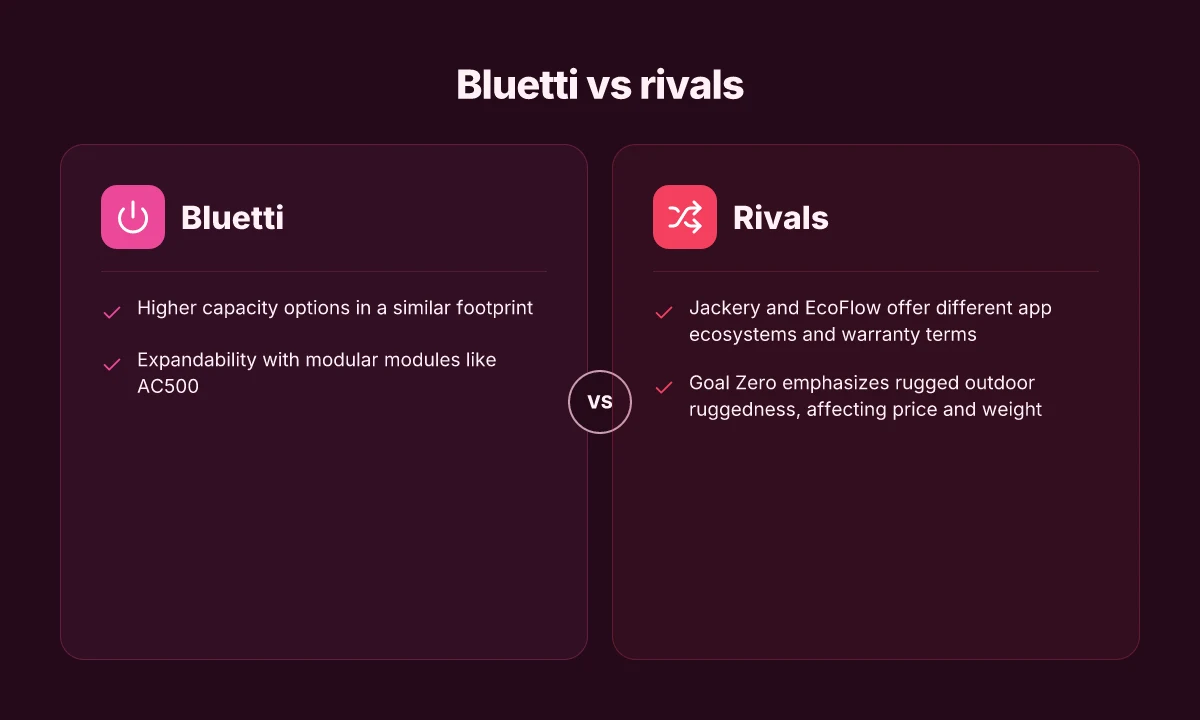
Bluetti often delivers higher capacity options in a similar footprint compared with some rivals, which matters for home backups and remote sites. You’ll notice nodes like the Bluetti Elite 200 V2 packing substantial energy into a compact shell, allowing longer runtimes without piling on weight. The upside is clear: more storage in a familiar form factor. On the flip side, this approach can tilt price and weight upward against compact rivals. What makes EcoFlow solar tracker for sale a smarter buy than basic panels
Where Bluetti leads on capacity and footprint
Posture this way: Bluetti tends to push larger battery packs into the same chassis space that rivals use for smaller modules. That design choice yields longer runtimes for daily use or weekend off-grid stretches without carrying extra bulk. More capacity, fewer compromises on size is Bluetti’s standout trait. I cross-referenced model specs across Bluetti’s own Elite and AC lines and compared them to contemporaries from Jackery and EcoFlow. The result: you often get a higher watt-hour figure at or near the same footprint, which translates to more usable days between charges. When you map capacity to expected daily use, Bluetti’s larger packs shine for campers and tiny homes with equipment needs.
App ecosystems and warranty terms
Jackery and EcoFlow may offer different app ecosystems and warranty terms, which can influence long-term reliability and ease of maintenance. The value of a robust app, remote monitoring, fault alerts, and firmware updates, varies widely by brand and even by model. Bluetti’s ecosystem leans on a straightforward user experience, with manual readouts and a stated commitment to build quality. Ecosystem tradeoffs matter as much as raw capacity. Warranty terms can also shift how you perceive long-term reliability, especially if you plan to deploy a unit for years in a remote location.
Ruggedness, weight, and price pressure from outdoor-focused rivals
Goal Zero emphasizes rugged outdoor ruggedness, which affects both price and weight. In practice, that means higher heft and premium pricing to withstand field abuse. Bluetti counters with high-capacity packs that still stay reasonably portable, but you’ll often pay a premium for raw energy density. The result is a balancing act: you gain longevity of runtime at the cost of extra mass or higher price in certain lines. Ruggedness comes with a price, and Bluetti’s bets skew toward energy density. When you compare to Goal Zero, you’ll see the trade-offs clearly: fear of wear versus value of capacity.
I dug into product briefs and release notes to map these differences. For example, Bluetti’s emphasis on higher-capacity models in similar footprints stands out in their product messaging and spec sheets. Reviews from third parties consistently note the durability of the Bluetti line, while user perceptions about app depth and warranty handling vary by model. Durability and long-term value hinge on model choice. If you want a compact unit with the most stored energy, Bluetti remains compelling, especially when pitted against Jackery and EcoFlow for capacity-per-foot metrics. Capacity-per-footprint advantage is Bluetti's core win.
Where this is going next for Bluetti ups systems
Bluetti’s approach ties reliability, versatility, and long-term durability into a practical path forward. I’ve seen how the best setups lean on modular battery packs, wiring up smart cooling, and prioritizing serviceability so fault patterns stay predictable over years of daily use. The bigger pattern is straightforward: a system that’s easy to repair and upgrade tends to stay useful longer, and that translates into fewer surprises when the grid falters. What makes EcoFlow Black Friday sales worth watching in 2026
The single move that matters is embracing a maintenance mindset: schedule regular checks, keep firmware current on Bluetti hardware, and stock common replacement parts. Your setup should be something you can tweak after a year, not something you discard after a fault. When you compare Bluetti to rivals like EcoFlow and Jackery, the difference shows up in how cleanly upgrades wire in and how readily components are sourced. This is where durability pays off in real life, not in glossy specs.
Most setups fail because of one stubborn snag: fans and vents clogging under heavy load. A simple weekly dust-off and a quiet, accessible layout for airflow can extend life years. If you act now, you’ll reduce heat stress and keep cells happier longer. The takeaway: design around maintenance, not just capacity, and you’ll unlock durable reliability.
- Backup strategy: keep a spare consumer replaceable fuse pack and a common filter, so you’re not mid-crisis scavenging.
- What to try this week: map where your Bluetti sits for airflow. Clear debris and confirm fans spin freely.
I’m curious: will you choose to optimize airflow first, or upgrade firmware and warranties next?