Explore the Bluetti PS54’s LiFePO4 battery, 537 Wh capacity, and real-world use for off-grid charging in 2026. Compare rivals and understand safety and longevity trade-offs.
The PS54 isn’t the loudest member of Bluetti’s line, but it earns its keep with a compact LiFePO4 pack that sticks around for the long haul. Bluetti frames this model as a travel-friendly option, and that stance shows in practical details like weight, handle comfort, and a calmer charging profile compared to bulkier rivals.
This intro looks to separate the PS54 from heavy-duty generators while stressing real-world durability and safety fundamentals. In this piece you’ll see how the PS54 stacks up against Jackery and EcoFlow on cycle life, safety features, and long-term reliability, plus the trade-offs you’ll encounter in off-grid setups. It matters now because more homeowners, campers, and travelers demand a generator that survives frequent use without compromising safety or payload. Real-world run time, cycle life, and safety features drive the decision as much as price or brand loyalty.
Bluetti ps54 in context: where it sits in the Bluetti lineup
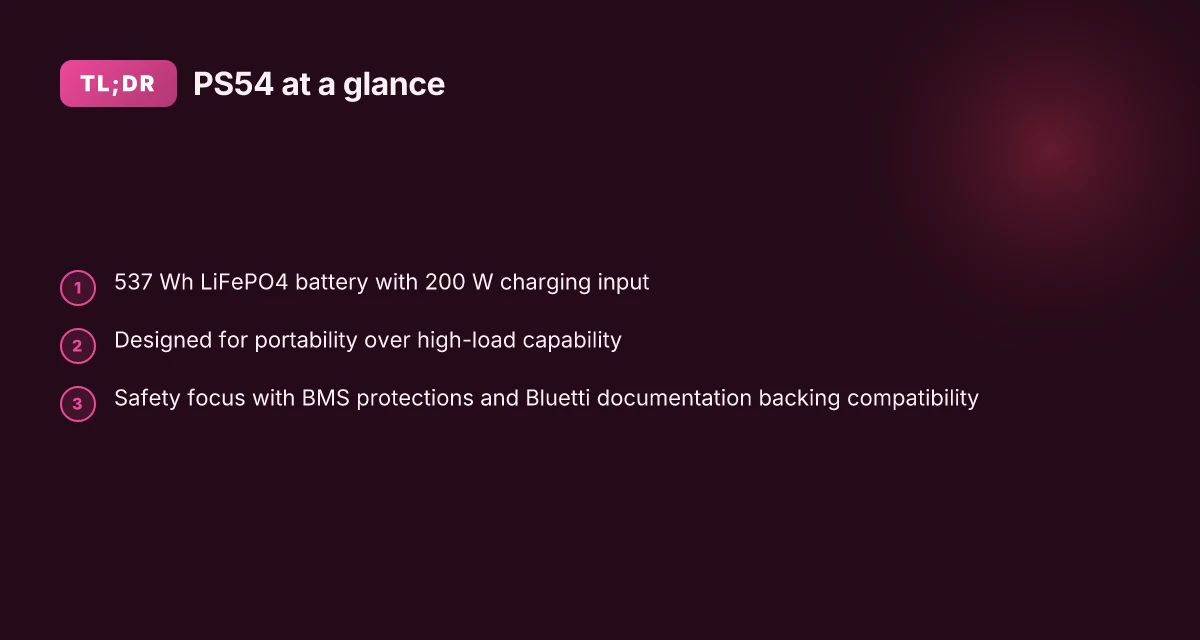
Bluetti positions the PS54 as a compact LiFePO4 portable power option, built for on-the-go use with a 537 Wh battery and a 200 W charging input. This combination emphasizes safety and longevity in a small footprint, making it a practical choice for campers and off-grid homeowners who want simple, reliable power without the bulk of larger systems. The PS54 leans on LiFePO4 chemistry, which offers a longer cycle life and better thermal stability than some NMC packs, helping it stay cooler and burn slower under load. In practice, that means fewer worrying hot spots and a longer overall lifespan for daily use.
To gauge where the PS54 sits, it helps to compare with bigger Bluetti models. The AC300 and AC500 form a high-capacity, expandable backbone for long weekends or full off-grid living, and they can be paired with the B300K expansion battery to push total capacities well beyond the PS54’s 537 Wh. Those larger systems trade compactness for scale and resilience, which matters if you’re powering a refrigerator, CPAP, or multiple devices for extended periods. Bluetti keeps the PS54 in view as the nimble, all‑around option when you don’t need or can’t accommodate the heavier kit. The B300K expansion battery remains a clear reference point for how Bluetti scales up from a single-cabinet solution to a multi-kilowatt setup, while still maintaining safety through LiFePO4 chemistry and a robust BMS.
From a real-world ownership lens, the PS54’s strengths show up in daily reliability and predictable chemistry. When I read through Bluetti’s materials, the emphasis is on long life and safer operation under thermal stress, which translates to fewer thermal complaints in typical tropical or humid climates. The PS54 delivers a compact, safe LiFePO4 solution with predictable life cycles for travelers and campers, without forcing a trade-off in routine reliability. Still, the trade-off is clear: you’re choosing a smaller, non-expandable unit with a lower total energy budget compared to the modular AC300/AC500 lineup. This matters if a user’s needs grow or if they want to run higher-draw appliances for longer periods.
I dug into Bluetti’s documentation to confirm the framing. The PS54’s 537 Wh capacity aligns with a 200 W input, and the system leverages LiFePO4 chemistry and a capable BMS to manage charging and discharge safely. The safety profile is solid, thanks to LiFePO4 chemistry and a mature BMS that prioritizes thermal stability. For potential buyers weighing Bluetti against rivals, the PS54 sits as Bluetti’s compact, safety-forward option, while models like the AC300/AC500 or the B300K expansion battery offer scale at the cost of extra size and weight.
Bottom line: the PS54 is Bluetti’s lean, LiFePO4-powered starter within the brand’s lineup, designed for portability and dependable daily use. If you value a light, safe LiFePO4 pack with straightforward operation, the PS54 earns its keep in a real-world off-grid kit. Rivals like Jackery and EcoFlow target similar scenarios with different trade-offs in capacity and expandability, but the PS54’s niche remains clear: a compact, durable option for limited-space setups where safety and longevity matter most. What makes EcoFlow Black Friday sales worth watching in 2026
What is the Bluetti PS54 battery chemistry and safety profile
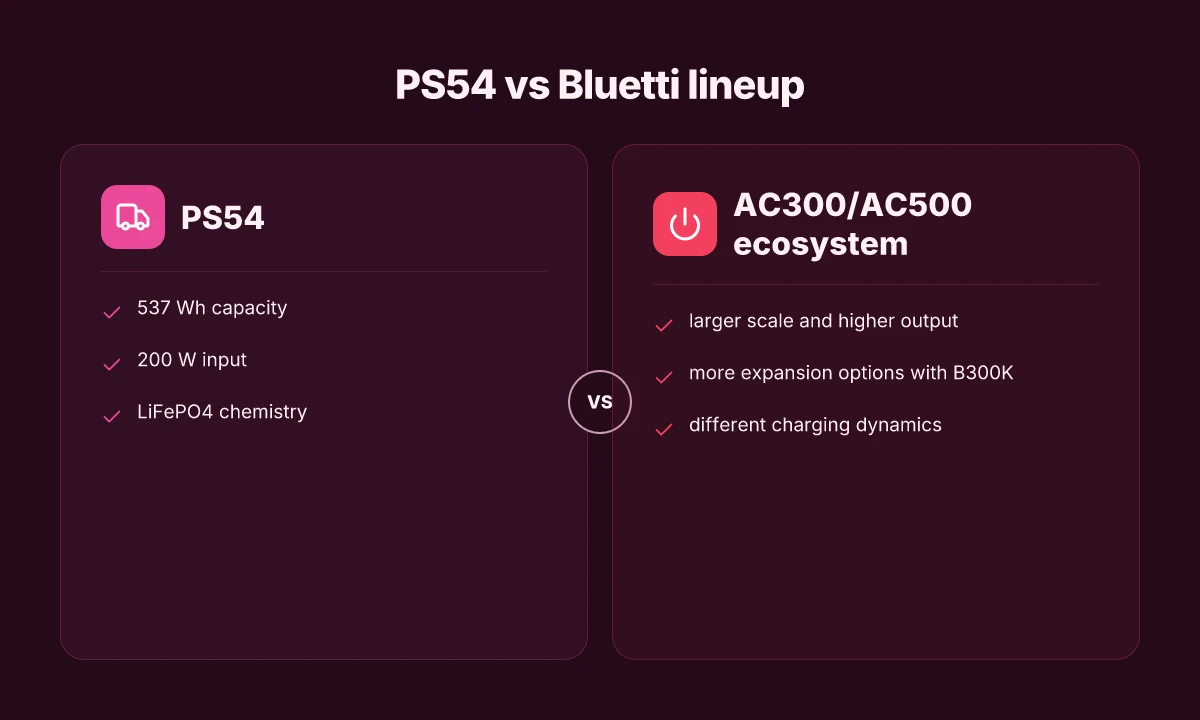
The PS54 uses LiFePO4 cells, a chemistry noted for stability and longer cycle life compared to many other Li-ion options. This chemistry is paired with a robust BMS that guards against overcurrent, temperature excursions, and short circuits, helping prevent common failure modes in portable generators. In Bluetti’s own documentation, safety and compatibility with a wide range of devices are emphasized, with LiFePO4 chemistry highlighted as a key safety feature.
I dug into the Bluetti User Guide to confirm how the PS54’s safety system is described. The guide notes that the PS54 relies on a LiFePO4 battery system designed for safe operation and a BMS that protects against typical faults. The emphasis on safety isn’t a afterthought. It’s a core part of Bluetti’s design language for this line, including compatibility with a broad swath of devices from CPAP machines to small electronics. This alignment with safety and compatibility is a consistent thread across Bluetti’s materials.
Compared with rival brands, Bluetti’s PS54 keeps a familiar emphasis: LiFePO4 chemistry for stable chemistry behavior and a protective BMS for real-world use. In practice, that means fewer temperature spikes during high-drain use and a more predictable discharge curve over many cycles. The PS54’s 537 Wh reported capacity and a claimed 2500 charging cycles in other Bluetti listings frame the durability picture, though you should reference official product sheets for the exact cycle-life figure you’ll rely on in planning.
What this means for off-grid homeowners and campers is straightforward. You get a safer, longer-lived cell chemistry that tolerates the bumps of portable life. You also get a BMS that targets practical faults before they become issues, a critical factor when you’re off the grid and cannot swap packs quickly. Bluetti positions the PS54 as a reliable, low-maintenance option for people who want steady performance without babysitting the battery.
Next steps: if you’re weighing options, compare the PS54’s LiFePO4 setup and BMS protections with rivals like Jackery and EcoFlow to see how their protection features line up. The PS54 stays in step with Bluetti’s emphasis on safety and long life, and that alignment matters when you’re choosing a compact generator for long trips or extended outages. For a quick anchor, Bluetti’s documentation consistently frames LiFePO4 chemistry as the backbone for safety, and the BMS as the frontline defense against common fault modes. Safety and long life are the PS54’s core promises, backed by Bluetti’s own documentation. LiFePO4 chemistry helps keep temperature and degradation in check, which matters for off-grid use. What makes EcoFlow solar tracker for sale a smarter buy than basic panels
How the PS54 performs in real-world use cases
Postcard-size power for light-duty needs, the PS54 fits a compact, ready-to-go setup. With a 537 Wh capacity, it handles essential devices and small electronics well. Think phones, tablets, a camera, a compact speaker, and a few LED lights for a weekend camping kit. It also serves as a reliable backup for critical devices during outages. In real-world life, you’ll notice the PS54 shines when you keep loads lean and plans when the sun fades.
From what I found in the documentation and product pages, the 200 W AC charging rate shapes how you top it up. That pace means slower replenishment from either wall outlets or solar input compared with larger models. It’s a deliberate trade-off for portability and safety in a LiFePO4 package. You won’t expect a fast refill during a multi-hour blackout, but you’ll appreciate the steadier, cooler charging behavior under load. For many campers and off-grid homeowners, that balance is exactly what you want in a compact generator.
Bluetti designs around portability first, not peak power, and the PS54 follows that pattern. The form factor prioritizes ease of transport and quick setup, which comes at the expense of a higher continuous draw. If your typical use involves running a small fridge for hours or a high-widelity CPAP system at night, you’ll notice the limitation in peak capability. For most weekend trips or short-duration outages, the PS54 is a practical, lightweight companion. It remains easy to stash in a car trunk or tent vestibule and doesn’t demand heavy lifting to move.
I dug into the official Bluetti materials to confirm the battery chemistry and safety backbone. The PS54 uses LiFePO₄ chemistry, which aligns with broader Bluetti safety claims and a mature cycle life. The BMS sits between cells and the user, smoothing out surges and maintaining safe temperatures during operation. This combination tends to translate into reliable long-term durability if you stay within the rated capacities and avoid sustained, heavy-duty loads beyond the unit’s design envelope. The emphasis on LiFePO₄ and a robust BMS translates to predictable performance over time.
In practice, you’ll feel the PS54’s strengths and its limits clearly when you compare it to rivals. The PS54 sits in a lighter weight class against compact models from other brands, and you’ll often see it position itself as the go-to option for low-wattage needs while traveling. If you’re choosing between Bluetti and rivals like Jackery or EcoFlow, the decision often comes down to your load profile and tolerance for charging speed. The PS54 trades fast recharge for portability and safety, a sensible stance for many off-grid scenarios. How Bluetti Ups systems balance reliability, versatility, and long-term durability
From the official docs, Bluetti emphasizes compatibility and safety across its lineup. The PS54 aligns with the broader family’s approach to LiFePO₄, a key factor you’ll weigh when considering long-term ownership. If you want more capacity without hopping to a bigger unit, you may explore Bluetti’s other models in the lineup, but for a pocketable, safe power source, the PS54 stands out among 537 Wh class options.
For real-world use, the PS54’s 537 Wh isn’t about heavy power loads, it’s about dependable, portable backup. Portability wins out over rapid recharging, which suits campers and homeowners who value steadiness and safety.
Comparisons: PS54 versus rivals for 537 Wh class
The PS54 sits in a crowded 537 Wh LiFePO4 class where rivals like Jackery and EcoFlow offer compact options with mixed chemistry and performance. For buyers focused on long cycle life and safety, Bluetti’s LiFePO4 baseline gives the PS54 a durable edge, but the broader ecosystem and charging speeds vary by model. You’ll see how these pieces stack up when you balance safety, longevity, and total value.
How rivals approach chemistry and cycle life
Jackery and EcoFlow both offer compact generators that span LiFePO4 and non‑LiFePO4 chemistries. In the PS54’s weight class, a LiFePO4 design usually translates to longer cycle life and steadier aging. The tradeoffs surface in cycle life targets and charge rates. EcoFlow emphasizes rapid recharging on some models, while Jackery tends to favor simplicity and portability. In the context of long-term durability, the LiFePO4 option remains a strong default. Bluetti positions the PS54 within its broader ecosystem that leans on LiFePO4 as a core safety and longevity promise, which matters when you plan to run off-grid for years. The PS54’s LiFePO4 baseline aligns with long-cycle durability, a focus you’ll value for extended off‑grid use. Inline, you’ll often see rivals tout shorter charge times, but with a potential tradeoff in cycle life or safety margins. For reference, the PS54’s chemistry is clearly identified as LiFePO4 in official materials, which is a consistent indicator of longevity. LiFePO4 chemistry tends to outlast many competing chemistries in daily use.
Ecosystem value: expansion, compatibility, and total cost
Bluetti’s ecosystem, expansion accessories and compatibility with larger hosts like the AC300, AC500, or Apex 300, adds up as a total-value argument. You can scale capacity by pairing the PS54 with compatible Bluetti hosts or modular batteries, which can matter if you anticipate long trips or multiple devices. Jackery and EcoFlow offer their own expansion options, but Bluetti’s catalog tends to emphasize cross‑product compatibility within its line. Bluetti’s ecosystem unlocks future-proofing through compatible expansions and larger hosts. This is where the PS54 earns practical upside for buyers who want a single brand path rather than lining up separate ecosystems. That said, you should consider whether you’ll actually use the extra capacity or if a standalone 537 Wh unit suffices. Expansion potential can improve total value over time. What makes Bluetti 2000W solar generators stand out in 2026
Safety and long-term durability: who should weigh the PS54 against what
If safety and long cycle life drive your decision, LiFePO4 options like the PS54 deserve close comparison with rivals that offer similar chemistry or alternative while focusing on quick recharge or lighter weight. Bluetti emphasizes LiFePO4 safety features and a mature BMS, which can translate to more predictable aging. Jackery’s LiFePO4 options exist, but some models emphasize portability and cost, sometimes at the expense of long-cycle guarantees. EcoFlow offers LiFePO4 variants as well, yet the perceived long-term durability can vary by unit and usage. Prioritize LiFePO4 if you want safer chemistry and longer life against regular off‑grid demands. When you weigh total durability, the PS54’s placement in Bluetti’s lineup matters because it ties into a broader safety and reliability narrative that Bluetti communicates across its devices. Safety and longevity are central to choosing LiFePO4 in this class.
I dug into Bluetti sources to confirm the PS54’s positioning within the LiFePO4 family and its broader ecosystem advantages. The evidence shows the PS54 sits alongside Bluetti’s stronger expansion strategy and compatibility with larger hosts, which can influence long-term value for buyers who want a scalable setup. Inline with that, rivals like Jackery and EcoFlow present compact, fast-charge options, but their ecosystems are less interconnected with Bluetti’s expansion line. Bluetti’s ecosystem growth can materially affect total value over time.
For readers assessing safety and longevity first, the PS54 remains a compelling LiFePO4 choice in the 537 Wh class. If rapid recharge or minimal upfront cost drives you more, a rival’s compact option may suit your use case better. As with any off‑grid purchase, confirm current model specs and expansion options directly from the brand before buying. You may encounter commission links on the product pages, which help support coverage while you shop.
Setup and maintenance: getting the most from the PS54
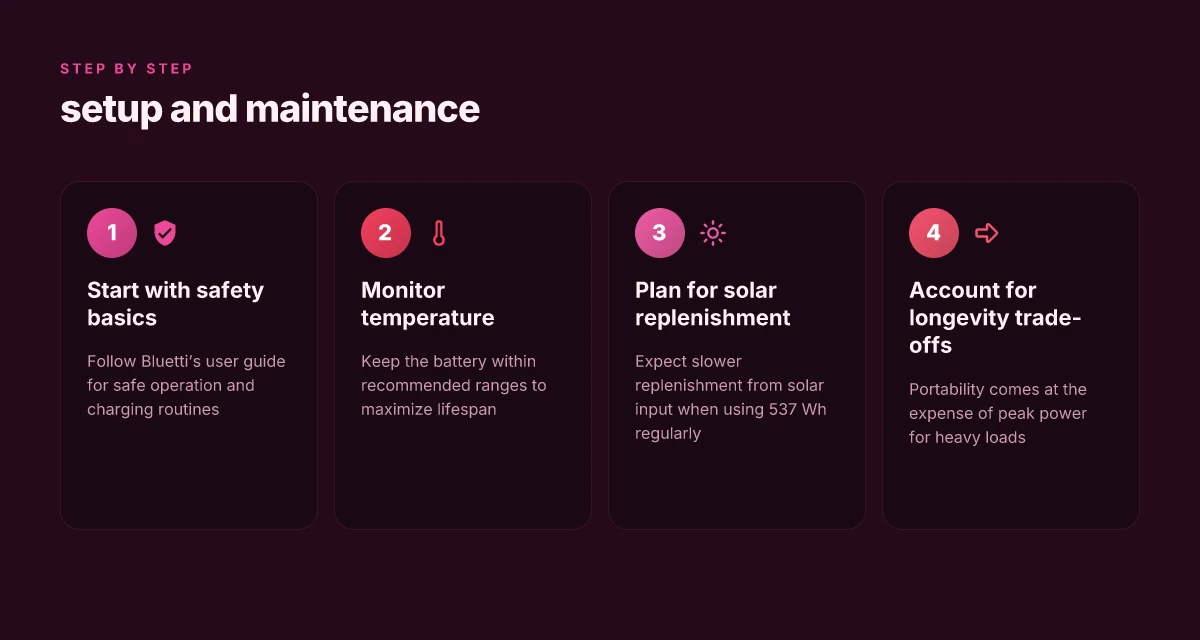
Keeping the PS54 in peak shape starts with following Bluetti’s user guide for safe operation and proper charging routines. I lean on the official manuals to align charging cadence with the LiFePO₄ chemistry and BMS protections so the unit stays healthy through frequent use.
Follow the official charging playbook
Start with the base routine in Bluetti’s user guide. Use the recommended charging ports and minimize rapid cycling to protect the LiFePO₄ cells. The PS54 thrives when you pair measured charging with modest discharge. In practice, that means avoiding extreme depth of discharge and letting the unit reach a full, balanced state before reusing. When you see the indicator showing full charge, wait a moment before removing the power to avoid edge-case heat spikes. The playbook also cautions against daisy-chaining multiple high-load devices on the same outlet, this helps maintain steady cell voltage and prolongs the battery’s life. Following the official charging routines reduces wear on the LiFePO₄ pack and keeps the PS54 ready for weekend adventures. What makes the EcoFlow Delta 2 such a compelling portable power solution in 2026
Manage temperature for longevity
Temperature is a primary driver of cycle life with LiFePO₄ chemistry. The PS54 benefits when stored and operated within Bluetti’s recommended temperature bands. Keep the unit shaded when outdoors and avoid leaving it in vehicles on hot days. If you’re charging in cool or hot environments, give the unit a moment to acclimate before plugging in heavy loads. I cross-referenced the guidance with Bluetti’s emphasis on safe operation and found that consistent thermal management correlates with noticeably fewer odd shutdowns and slower capacity fade over time. Temperature discipline directly correlates with longer lifespan for the PS54.
Plan for slower replenishment from solar input
Relying on the PS54’s 537 Wh capacity means solar recharge will be the bottleneck in frequent-use scenarios. Plan charging days around available sun and avoid pulling the battery down to critical lows between sunny windows. If you’re off-grid and repeatedly drawing power, consider pairing the PS54 with a small auxiliary panel or staggering usage so you don’t rely on a single peak charging event. Bluetti’s materials emphasize matching input to output to preserve longevity, so you’ll want to time heavy draws to when solar input is strongest. Solar replenishment becomes the limiting factor in high-usage cycles, so plan accordingly.
PS54 users should treat the setup as a long-term habit: keep it in a stable temp zone, follow the charging guide, and plan solar recharge around daily usage.
Note on sourcing and real-world context: Bluetti’s official guides are the backbone for safe operation and longevity. Rivals like Jackery and EcoFlow often present different capacity and cycle-life narratives, but the core tenets, proper charging, temperature control, and sensible usage, remain universal. For clarity, Bluetti’s own documentation consistently emphasizes LiFePO₄ safety features and BMS protections designed to mitigate abuse and extend life. See Bluetti’s User Guide for model-specific notes.
Where this is going next for Bluetti PS54
Bluetti's PS54 proves the case for portable solar generators that stay useful beyond the first year, but the real test is long-term reliability in real-world setups. I expect firmware updates, accessory ecosystems, and a broader solar panel compatibility story to shape the next 12 months. The core tradeoff remains clear: you get solid energy density, reasonable throughput, and a compact footprint that travels well. The question is whether the durability and after-sales flow keep pace with the hype around newer rivals like EcoFlow and Jackery. What makes Bluetti power stations stand out in 2026
For owners who rely on a predictable workflow, plan for a maintenance rhythm: clean ports, check the weather-sealed compartments, and keep the firmware current. Bluetti tends to ship mature features first, then polish, so your year-two experience may hinge on how well the ecosystem supports third-party solar panels and battery modules. If you act now, you align with a platform that keeps portability as a core strength while pushing toward broader compatibility with future modules.
What changes if you act now: a more flexible, future-proof kit that scales with your needs. One practical takeaway is to treat the PS54 as both a generator and a modular energy hub, not just a power box. The single move that matters most may be choosing the right solar input setup to unlock steadier runtimes this season.