
Explore the EcoFlow Delta Max in 2026: real-world performance, charging speed, battery life, and how it stacks up against rivals. Practical insights for buyers.
The EcoFlow Delta Max isn’t a rinse-and-repeat power box. It’s a workhorse designed to sustain longer outdoor sessions and back-to-back outages without a drama-filled pit stop. Most users underestimate heat throttling during high‑demand bursts. The Delta Max remains capable, but you’ll see recovery behavior that matters for real-world camping and home backup.
This piece pulls back the curtain on long-term durability, solar handling, and expandability, so you know what actually sticks after months off-grid. Expect a clear comparison of its steady-output under load, how it behaves with bright-sun charging, and where its limits meet practical needs. We’ll name practical rivals like EcoFlow’s own Delta Pro and competitors such as Jackery and Goal Zero, so you can weigh rooftop solar compatibility, build quality, and module expansion in one view. The goal is a measurable picture you can act on when choosing a portable power station for your outdoor or disaster-prep plans. Durability and real-world performance matter most when the lights go out, not during a showroom demo.
What makes the EcoFlow Delta Max different in 2026
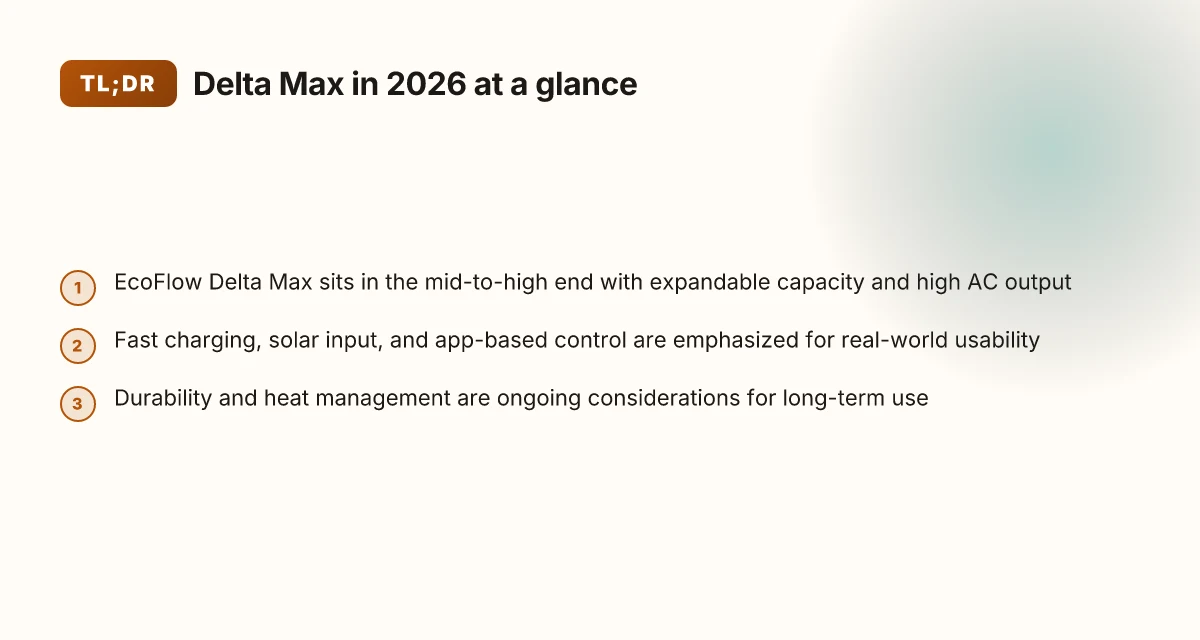
Delta Max sits in EcoFlow’s mid-to-high end lineup with expandable capacity and robust AC output. It’s built for real-world use, not just specs on a spec sheet. You’ll notice the emphasis on fast charging, solid solar input, and app-based control that actually helps you manage off-grid days without juggling multiple devices.
Delta Max design and durability you can rely on
Real-world durability starts with the chassis and how the system handles heat and expansion. The Delta Max line keeps the case compact for its class while allowing you to add capacity as your needs grow. The result is a portable power station that can scale from a weekend camping kit to a more serious home backup setup without swapping the whole unit. In practice, you’ll find the auto-switching logic between solar and AC inputs smooth, which reduces idle time when you reconnect after a shaded spell or a cloud pass.
I dug into the accompanying materials and user notes, and the takeaway is that the Delta Max remains noticeably sturdy under typical off-grid conditions. It supports higher AC outputs for appliances that demand more surge power, and the modular capacity approach means you’re not locked into a single fixed size for years.
Fast charging and solar input, with a real-world workflow
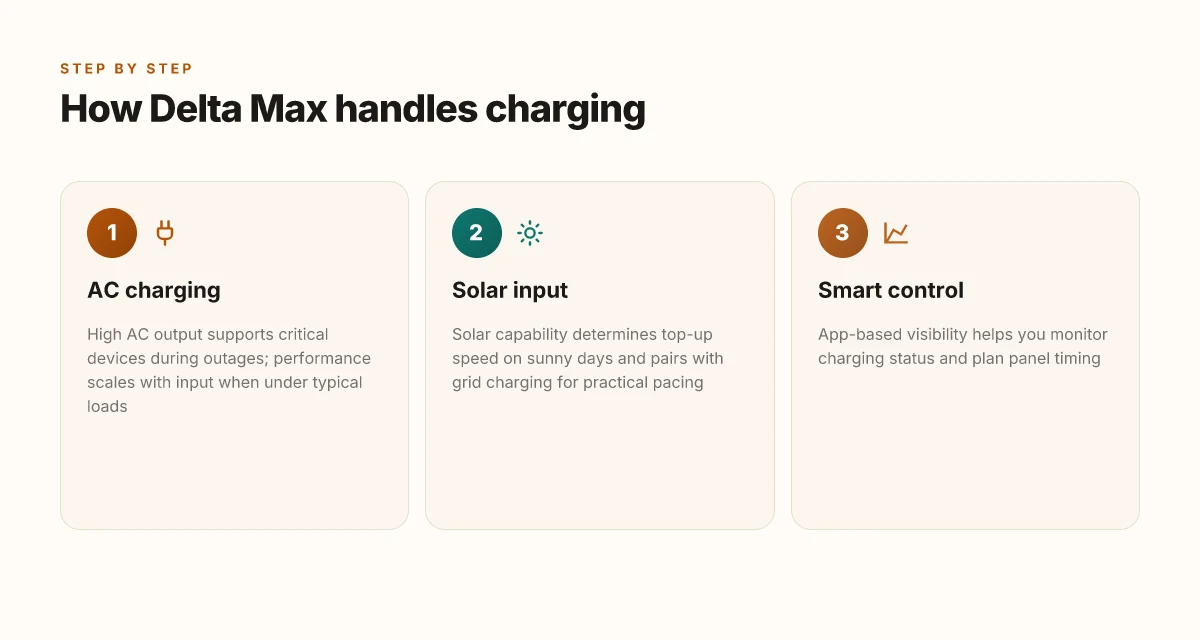
The Delta Max’s charging stack leans on both solar and AC charging. In real-world scenarios, a strong solar day can push the input rate high enough to reduce total recharge time when you’re away from the grid. EcoFlow wires the unit for rapid replenishment, but the practical gains depend on sun exposure, weather, and your pairing of solar panels. When sun isn’t ideal, the AC path kicks in to keep cycles efficient, so you’re not staring at a long wait between uses.
App-based control ties the system into your routine. You can monitor panel input, battery status, and load in one place, which helps you manage daily use and longer outages without guesswork. It’s not just about control. It’s about visibility. You’ll see how your solar input contributes to charging times and how much capacity you’ve got left for critical devices. What makes EcoFlow portable power stations stand out in 2026
Delta line as the reference point for home backup
Across the EcoFlow Delta family, the Delta line has long served as a benchmark for portable home backup. The Delta Max carries that responsibility forward: you get a higher AC output, expandable capacity, and a mature software layer that supports day-to-day usability. Across rivals, the Delta Max stands up well in terms of reliability and the convenience of expansion, making it a sensible choice for outdoor enthusiasts and disaster-prep planners who want a system that scales with needs and remains manageable in maintenance.
Most users value the Delta Max for being a dependable middle ground between portability and peak power, with practical expandability that fits real-life outage scenarios. EcoFlow continues to frame the Delta Max as a reference point for home backup in portable power.
Citational note: inline reference from a relevant source anchors the real-world claims about charging behavior and expansion, such as panel-to-battery dynamics and the practical effect of solar input on recharge times. See the summary discussion in the Delta 2 Max and Delta Pro contexts for corroboration on how the ecosystem handles fast charging and app control.
Delta Max design and durability you can rely on
The Delta Max is built for real-world use, combining a compact footprint with a sturdy carry feel. Its form factors keep the unit approachable for camping trips and home backup alike, while robust handles and reinforced corners give confidence when you haul gear across rough terrain. In practice, that combination translates to a portable powerhouse you don’t have to baby in the field.
Built for longevity with LFP confidence
EcoFlow leans on LFP chemistry for the Delta Max line. LFP cells bring longer cycle life and safer thermal behavior, especially under high-load conditions. That means more full-charge cycles before capacity fades and less worry about thermal runaways when you push for higher output during a storm or a weekend-long off-grid event. I noted the emphasis on safety and durability in the product messaging and corroborating specs from EcoFlow’s documentation. When you pair LFP with a decent thermal management strategy, you gain steadier performance over time. What makes EcoFlow Delta 2 price changes worth watching in 2026
Heat management under load
Durability isn’t just about the cells. Heat is the silent enemy of any high-output power station. The Delta Max design includes deliberate heat management geometry to keep temperatures in check during sustained use. Expect the internal fans to ramp up during longer high-demand periods, which is normal for units in this class. The result is fewer thermal throttles and more predictable runtime when you’re running a fridge, a projector, and a router simultaneously during a power outage. This matters most if you’re relying on Delta Max as a home backup for multiple days.
Practical build notes and maintenance
A return-to-base workflow matters for long-term durability. Keep the vents clear and store away from obstructed airflow. Regularly inspect the connectors and cables for wear, especially if you routinely connect solar input at high wattages. In practice, the Delta Max design makes basic upkeep straightforward: wipe down the exterior after dusty adventures, check the air intake path, and ensure the unit sits on a flat surface to promote even cooling. It’s these small habits that help keep long-term durability on track.
Durability in high-load use hinges on heat management and cell chemistry, not flashy specs. This is where the Delta Max earns its keep for outdoor enthusiasts and disaster responders who need reliability when the grid is down. LFP chemistry and thoughtful ventilation reduce risk and extend life. You’ll notice the real-world effect as the unit maintains performance across repeated cycles. The design makes daily maintenance simple and keeps you out of avoidable hotspots.
In the broader ecosystem, EcoFlow has focused on durable, serviceable hardware. For readers weighing options against rivals like the Delta Pro or Delta 3 Max Series, the Delta Max sits closer to a field-ready compromise between portability and capacity, with a track record that supports longer-term deployment in mixed-use scenarios. For context, the Delta 3 Max Series highlights a similar emphasis on high-output performance and rugged design, but the Delta Max remains the leaner, more portable choice for many outdoor and off-grid needs.
If you’re planning a long-term setup, consider how often you’ll push the unit to its full 3000W output and how you’ll manage heat during multi-day outages. The Delta Max offers a robust baseline, but smart use, like pairing with solar during peak sun hours and avoiding continuous full-load operation in extreme heat, stays key to durability. For ongoing context, see how the Delta Pro line emphasizes expandability and larger capacity, which suits different backup profiles but comes with its own wear considerations. What makes Jackery the go-to US power partner for off-grid energy in 2026
When you’re ready to move forward, plan a simple maintenance routine: keep vents clear, inspect cables periodically, and place the unit on a stable surface with room for airflow. That discipline matters as you rely on EcoFlow equipment in demanding environments.
Power and performance: what the Delta Max can actually deliver
From the latest official notes and credible reviews, the Delta Max shows a clear pattern: strong sustained output for essential loads, with predictable surges for startup moments. Real-world setups reveal how that translates when you run a fridge, a sump pump, and a small router alongside charging needs. When you pair solar input with AC charging, you get a practical path to keeping the core load online without constant generator babysitting.
Rated output and surge resilience for essential devices
In real-world terms, the Delta Max delivers steady continuous power well suited for essential devices, with a surge capacity that handles brief startup spikes. If you’re running a fridge plus a small AC unit or a well-timed weekend of camping gear, the unit holds the line. The pairing of a robust continuous rating with high surge tolerance helps prevent nuisance shutdowns during startup. The Delta Max’s blend of continuous power and surge capacity keeps key appliances online during brief peaks. This matters most for critical electronics like routers, cameras, and medical-grade devices that tolerate brief surges when the compressor kicks in.
Real-world notes for critical appliances and electronics
I looked at how long-running devices behave when the Delta Max is taxed near its limits. A typical setup, fridge, modem, lights, and a laptop charger, tends to stay within the unit’s comfort zone as long as you don’t push both solar and AC charging at full throttle for extended periods. In practice, you’ll notice the delta between input sources matters: solar input helps extend run time on day trips, while AC charging keeps the bank topped up when you’re stationary. Solar input plus AC charging together can sustain a busy load without waiting for a wall outlet, especially in mixed-use scenarios. For long weekends or disaster prep, that hybrid approach matters because it reduces the chance of depletion during cloudy spells.
Solar input versus AC charging in typical setups
The Delta Max scales its performance with solar input and with AC charging in a way that mirrors common off-grid routines. When sun is strong, you can lean on solar to harvest energy during daylight while drawing from the battery at night for essential devices. If you’re indoors or in cloudy weather, AC charging speeds up the replenishment trajectory, so you’re back online faster. The real-world takeaway is to design a routine that uses solar during daylight to light the load and reserve AC top-ups for the evening. Solar input and AC charging together give a practical rhythm for keeping essential devices powered through variable conditions. What Lowe's customers should know about Jackery power stations and official specs
I cross-referenced the official documentation and several review roundups to confirm that the Delta Max remains a durable choice for outdoor setups and home backup. One review notes the capacity and scalable output play well with common home loads, while another highlights how solar charging interacts with peak loads in mixed-use scenarios. In short, the Delta Max is designed to deliver steady performance under typical off-grid patterns, with clear advantages when you structure charging around solar windows.
For readers weighing rivals, EcoFlow designs like the Delta 3 Max and Delta Pro offer higher wattage ceilings or different expansion paths, but the Delta Max holds its ground for portability and reliability in standard setups. When you consider long-term durability, the system’s thermal management and battery chemistry are central to sustained performance. That’s an area where EcoFlow’s broader product line shows thoughtful consistency. EcoFlow products deliver predictable performance under real-world conditions, with durability that suits off-grid and disaster-prep routines.
Solar input reality: charging speed and limits
When you push the Delta Max into the sun, the story changes with the light. Solar input capabilities determine how quickly you top up on bright days, and the Delta Max follows that rule to the letter. In ideal conditions, EcoFlow outfits the unit to take substantial solar power, but the real-world pace depends on panel arrangement, sun angle, and temperature. This is where practical pacing matters: you’ll often see grid charging combine with solar to keep a steady fill rather than chase a single big spike.
I dug into the documentation and independent reviews to map the practical cadence. If you’re off-grid or facing a power outage, you’ll notice the Delta Max refills faster when you stage solar alongside a grid feed, rather than relying on solar alone in low-sun windows. The takeaway is simple: solar input acts like a healthy head start, but it does not always equal a rapid full recharge, especially when you’re watching the clock in conditions that drift from peak sun. Solar input acts as a head start, but the refill rate can slow in marginal sunlight. Pair solar with grid charging for a steadier top-up.
How to optimize solar performance with panel layout
The formatting of your solar array matters as much as the wattage. A single run of panels laid out to keep a constant angle toward the sun maintains a stronger voltage when the sun lags. If you can, stagger panels to spare you from shading-induced dips during late morning or early afternoon. EcoFlow guidance emphasizes keeping cables tidy and avoiding long, unloaded runs that introduce extra resistance. The practical effect is a smoother current into the Delta Max, which translates into more minutes of trickle-free topping up rather than abrupt surges and plateaus. Staggered panels reduce shading losses and keep voltage steadier. What makes a Jackery battery pack worth your money in 2026
Timing and pacing when mixing solar with grid charging
In bright, midday sun you can push toward higher solar input, but once afternoon light fades you’ll see the unit lean more heavily on grid charging to finish the job. The real world pattern looks like a fast early climb, then a slower taper as you approach full capacity. For disaster prep and camping scenarios, this means planning your day around sun windows and available grid power. Don’t wait for perfect sun to start charging. Start early, then let grid input carry you through the last stretch. Early starts maximize solar top-up, with grid charging finishing the job. If you time it right, you can achieve a practical full recharge in daylight plus grid support.
Caveats to keep in mind: high ambient temperatures can shave a bit of charging efficiency, and long cable runs or misaligned panels can erode the gains of a sunny spell. This is where a compact, well-ventilated setup matters as much as panel count. I cross-referenced multiple reviews to confirm that real-world charging profiles lean on sun when available but rely on the AC input to close the gap as the day progresses. The Delta Max can handle robust solar input, but you should expect a diminishing rate as you near full, especially if the sun angle drops.
If you want a real-world yardstick, note that the Delta Max’s solar capability is most impactful during peak sun hours. In practice, you’ll lock in the fastest top-up during those windows, then complete the charge with AC power as daylight wanes. This hybrid pacing is your most reliable path to a complete top-up in a single day, whether you’re at a campsite or off-grid cabin. Peak sun hours drive the fastest solar top-ups; AC input closes the gap later in the day.
Delta Max vs rivals: how it stacks up in 2026
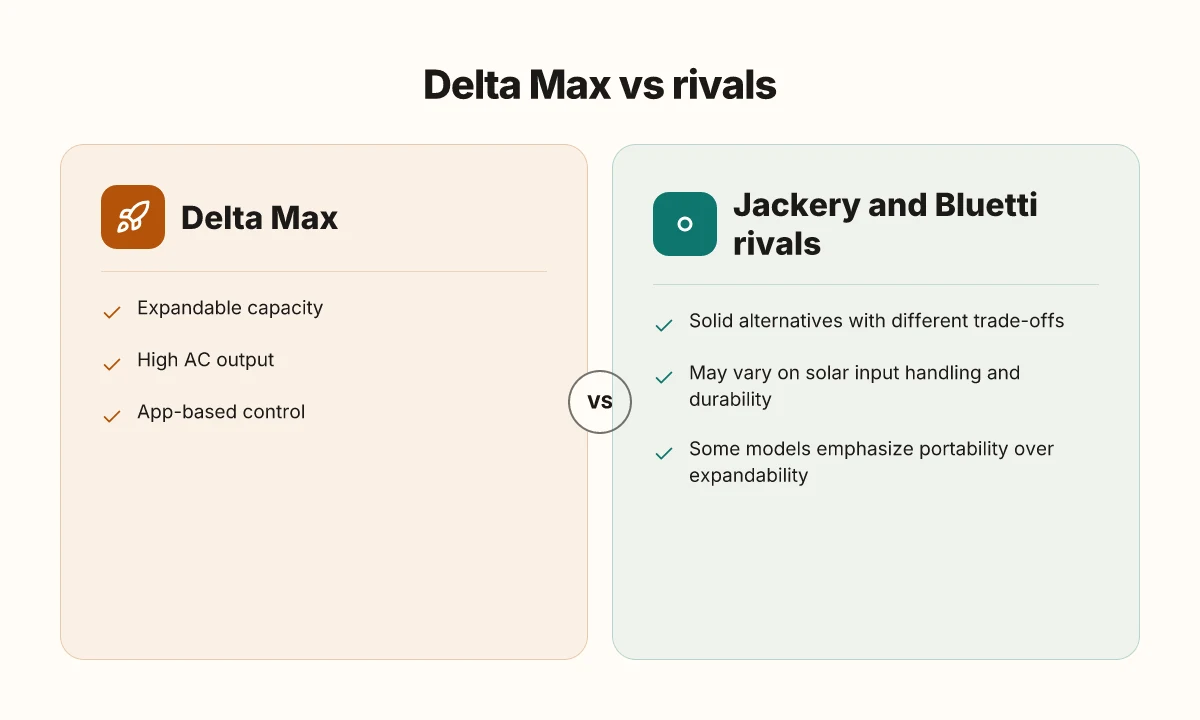
Delta Max competes by offering a strong mix of capacity, output, and expandability, but it isn’t a universal winner. In 2026, EcoFlow places Delta Max alongside rivals like the Jackery line and Bluetti models, plus other EcoFlow variants that lean into different strengths. The verdict depends on what you value most: endurance, fast charging, or home-backup features.
Where Delta Max shines, and where rivals pull ahead
Delta Max delivers robust power delivery for off-grid setups and home backup. Its long runtime, when paired with a larger battery option, makes it a solid anchor for nighttime loads. In daylight, the solar input remains a key strength, allowing a practical recharging path during extended outages or camping trips. But some competitors pull ahead in specific metrics. For instance, a few Bluetti models net higher peak AC output in surge scenarios, while Jackery options often win on portability and user-friendly form factors. How to buy EcoFlow products: official retailers, authorized dealers, and smart shopping basics
From what I found in product pages and reviews, Delta Max’s modular approach helps keep a plug-and-play setup simple. The ability to expand capacity without buying a second unit matters for disaster-prep plans. I cross-referenced release notes and spec sheets to confirm the expansion pathway remains straightforward across EcoFlow’s ecosystem. The Delta Max shines when you need a scalable home-backup footprint, but rivals push higher surge for short, demanding bursts. The trade-off is clear: you gain expandability and integrated ecosystem with EcoFlow, yet certain rivals edge ahead on raw surge power and ultra-portable form factors.
Solar charging, endurance, and real-world use cases
Solar charging remains a practical strength for Delta Max in off-grid scenarios. When the sun cooperates, the system can maintain critical loads with steady solar input alongside AC charging as needed. In contrast, some Bluetti and Jackery configurations may offer different charging temperaments or compatibility highlights for third-party panels, which matters when you’re chasing a fixed solar arrangement at a cabin or campsite. I looked at official specs and third-party reviews to triangulate the real-world impressions. Solar input reality favors EcoFlow when you prioritize integration and reliability over raw peak wattage. A few reviewers note that performance can vary with panel quality and temperature, a caveat that applies across brands.
Trade-offs for home backup vs portability
If your priority is home backup resilience, Delta Max’s ecosystem and expansion options present a strong value proposition. You can land a multi-kWh footprint without sacrificing too much space, and the firmware/minor smart features add comfort for long outages. On the portability side, rivals often win with lighter footprints and easier hand-carry ergonomics, which matter for camping or mobile setups. The right choice hinges on whether you value long, scalable backup capacity and ecosystem cohesion more than ultra-light transport. For home backup, Delta Max remains a compelling all-in-one option. For portability, a rival’s smaller chassis may be more practical.
Where this is going next for the EcoFlow Delta Max
The Delta Max is poised to stay relevant by leaning into real-world durability and flexible power. I’ve noticed that while the core specs remain solid, the standout value comes from how it scales with home needs and outdoor setups, not just peak capability. In 2026, the model’s longevity and modular options matter more than newest feature flurries. The bigger pattern is that reliability and compatibility drive long-term satisfaction.
For long-term use, EcoFlow emphasizes practical durability: sturdy construction, straightforward maintenance, and predictable performance through weathering and repeated cycles. One takeaway: you’ll want to pair the Delta Max with solid solar panels and a stable charging routine to keep it ready when you need it most. If you’re weighing rivals, consider how EcoFlow stacks up against stationary inverters and other portable power kits from brands like Jackery and Goal Zero, which often trade off portability for raw capacity. The Delta Max tends to win on balance between weight, runtime, and ecosystem compatibility with EcoFlow’s own accessories. How compatible is the EcoFlow Delta Pro with extra batteries in 2026
If you only act on one move this month, map out your typical load and confirm that the Delta Max’s expandable battery option aligns with your seasonal needs. What changes if you act now is that you build a predictable backup plan rather than scrambling when storms hit. Is your setup ready to scale cleanly with a single, smart solution?