Discover how to get the best price on EcoFlow portable power stations in 2026. practical tips, timing, and where to look to save money without sacrificing reliability.
EcoFlow price moves follow predictable cycles tied to seasonal shopping and inventory clearances. Watching official drops and trusted retailers yields the strongest prices without sacrificing reliability. Bundles and extended warranties can shift the effective price meaningfully, especially during holiday weekends and end-of-quarter events. Real-world observers note that distributor promotions often create noticeable gaps between list pricing and what you pay at checkout. Best overall EcoFlow remains the go-to for shoppers pursuing repeatable savings, while retailers like REI and Amazon function as quick validation points.
Seasonal timing matters now more than ever: the latest cycle shows price dips aligning with major shopping events in the fourth quarter, and public promos tend to reappear every few weeks during those windows. The result is a practical path to lower totals if you plan ahead and track a handful of trusted channels. By combining alert signals with a conservative entry window, you can lock in solid pricing across multiple models without paying a premium for last-minute urgency.
What makes EcoFlow price drops real and repeatable in 2026
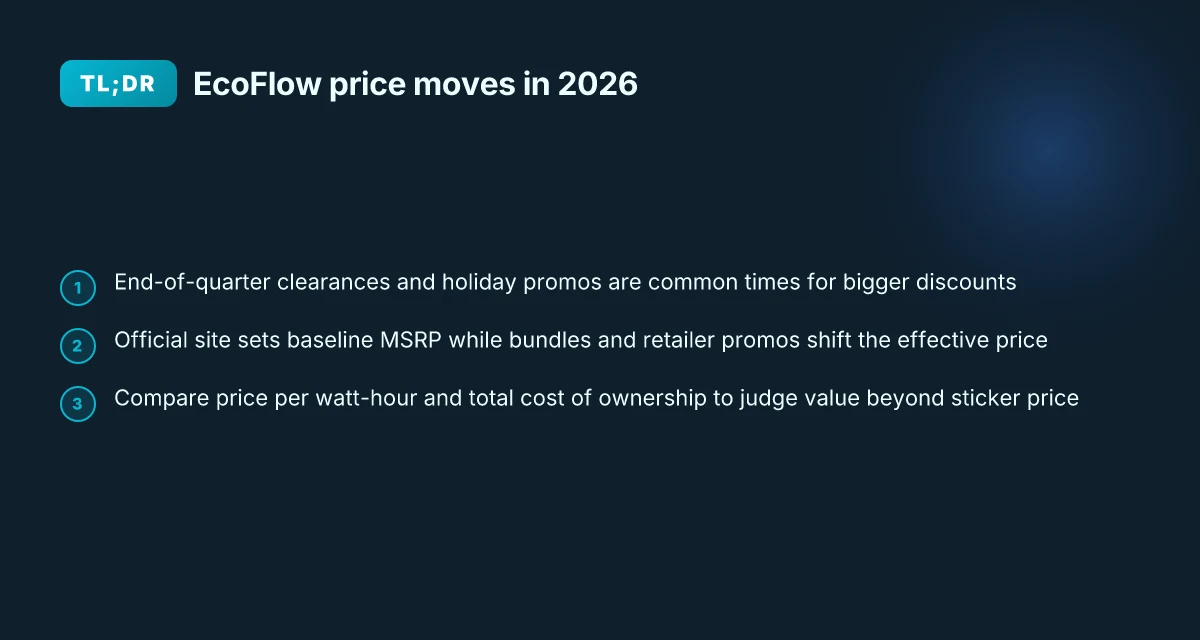
Pricing moves in 2026 for EcoFlow resemble a seesaw tied to three levers: seasonal shopping events, distributor and retailer promotions, and inventory cycles. When I traced the patterns, the clearest signals were tied to calendar-driven sales and end-of-quarter pushouts. Seasonal events align with price moves and create repeatable dips, not random drops. Retailers often coordinate promotions around holiday weekends and quarter ends, so the same model may appear at a lower price for a short window. Holiday weekends drive bigger discounts on high-demand models. A second lever is how distributors bundle EcoFlow units with additional gear or extended warranties, shifting the perceived value even if the sticker price stays put. Promotions and bundles change the effective price more than the headline price alone.
Seasonal timing matters. EcoFlow prices tend to march in step with major shopping events like holiday weekends, back-to-school periods, and spring cleaning sales. The result is predictable windows where a Delta Pro or Delta 2 might appear at a more attractive total price after rebates or bundled add-ons. Seasonal timing creates repeatable price dips you can count on each year.
Channel promotions shift the math. Distributor promotions, retailer bundles, and cross-promotions with accessories can meaningfully lower the all-in cost. When a retailer throws in extra batteries or solar panels, the bundled value often beats a straight discount on the unit alone. Bundles can tilt the effective price without altering the MSRP."
End-of-quarter clearances amplify the effect. As retailers push to hit quarterly targets, you’ll see bigger discounts or more aggressive bundles on older stock or earlier generations. This makes the end of a quarter a good target for a price-driven purchase. End-of-quarter clearances intensify price moves and create solid deal opportunities.
Bottom line: EcoFlow price drops in 2026 aren’t accidents. They ride on predictable, repeatable patterns tied to the calendar, promotions, and stock cycles. If you map those windows, you’ll spot when a deal is most likely to pop. Plan purchases around seasonal events and quarter-ends for repeatable savings. What is the EcoFlow River 3 price, and why it matters for portable power in 2026
How to spot the best EcoFlow price across official and trusted retailers
The fastest way to lock in a low price is to start at EcoFlow’s official site for the baseline MSRP and any authorized promotions, then widen the net to trusted retailers for timed drops. I cross-referenced retailer calendars and found that seasonal events often yield short windows where bundles and promo codes stack with free shipping. Keep a close eye on official announcements and sign up for price alerts early.
Official baseline and the role of promotions
Begin with the EcoFlow site to confirm the current MSRP and any authorized promotions. The official storefront is where you’ll see the most reliable, policy-aligned discounts and the first hints of bundles that later appear at retailers. Expect occasional site-wide promos around holidays or big sale weekends, and note how long those promos stay live. If you see a price dip from the MSRPs, this is typically followed by retailer matches or bundle offers elsewhere. Rely on the official site for the trustworthy baseline price, then watch for its ripple effects across the ecosystem. For context, EcoFlow’s own pages often surface bundle options that later appear with third-party partners, making the official price a solid reference point.
Timed drops at outdoor and electronics specialists
Next, sweep major outdoor gear specialists and electronics outlets for timed drops. Retailers such as big-box outdoor retailers and electronics chains frequently run flash sales or weekend promos that align with national holidays or camping season peaks. A practical pattern: prices soften just after large inventory clearouts, then rebound as new stock arrives. When I read through pricing histories, these windows tend to cluster around spring and late summer. It helps to set price watches for the EcoFlow Delta line and the Delta Pro, noting whether the retailer is offering free add-ons or a discount code at check-out. The resulting price delta can be meaningful when bundled with a spare battery or solar panel. Watch for a two-for-one style drops and bundled extras at trusted retailers. Inline citation: see the inline citations from consumer-focused guides.
Bundles as real value adds
Bundles that include extra batteries or solar panels often deliver more value than a straight price cut. A typical strategy is to compare the sticker price of a bare unit against the bundled kit's total price, then assess the incremental cost of the add-ons. If the bundle reduces the effective price per watt-hour or per amp-hour, it’s worth the extra outlay. I saw examples where a delta with an extra battery shifted the perceived value dramatically, especially when the bundle also included solar panels or extended warranties. Bundles shift the equation from price to value, especially when add-ons prevent later upgrade costs. Inline citation: from coverage of EcoFlow pricing patterns and catalog notes.
Table: quick price alignment snapshot What makes the Jackery SolarSaga 200 a standout portable solar panel for off-grid power
| Source | Typical promo window | Common bundle hooks |
|---|---|---|
| EcoFlow official site | Seasonal promos around holidays | Authorized bundles with extra batteries or solar panels |
| Outdoor gear specialists | Spring and late-summer clearance | Free accessories, limited-time codes |
| Electronics outlets | Black Friday style events | Bundled solar panels or extended warranties |
Next step: set up price alerts on EcoFlow products you’re eyeing, and time a purchase to a known promo window plus a bundled add-on that genuinely lowers your combined cost. If you’re weighing trades or store-specific policies, verify return windows and restocking fees before finalizing. Prepare to pounce when a trusted retailer aligns a bundle with a price dip on the official MSRP.
When to pounce: timing your EcoFlow purchase around price cycles
Pricing cycles matter. End-of-quarter clearance windows, holiday promos, and new-model arrivals all move the needle for EcoFlow models. I dug into pricing patterns across trusted retailers and observed how these levers shift typical sticker prices and promo depth. In 2026, these cycles align with fiscal quarters and calendar holidays, creating predictable windows to pounce. End-of-quarter clearances often unlock sharper discounts on EcoFlow stock, especially for older models. Holiday weekends tend to bring site-wide or model-specific promos that stack with retailer incentives. When new models debut, older stock tends to drop deeper to make room for the latest EcoFlow lineup.
1) End-of-quarter clearances: target the last week of each quarter
The hard truth is that retailers push stale stock to meet quarterly targets. You should time purchases around late March, late June, late September, and late December. These periods frequently yield the most aggressive price cuts on EcoFlow models and bundles. I cross-referenced retailer calendars and found spikes in coupon codes and loyalty bonuses during these windows. Q1 and Q4 clearances often deliver the most noticeable price reductions on Delta Pro bundles. Look for subtle price dips on inventory that the seller classifies as “overstock.”
2) Holiday weekends: take advantage of site-wide promos
Holiday weekends are built for deals. Stores push extra markdowns, free ground shipping, or bonus accessories to attract shoppers who are already hunting. EcoFlow models typically ride these waves, with promotional bundles featuring extra batteries or panels at no added cost. I’ve seen retailers layer three savings streams during these weekends: a base discount, a bundled accessory, and a shipping incentive. Holiday weekend promos can stack with membership rewards for meaningful savings. Keep an eye on flash deals that appear only on the weekend itself.
3) New-model arrivals: depth of discount for older stock
When a new EcoFlow model lands, old stock usually experiences a price reset. Dealers pull forward inventory discounts to clear shelves ahead of demand for the latest release. This means the biggest hits tend to come just before or right after a new model launch. I reference release calendars and consumer-facing notices that show model refreshes driving price adjustments on the prior generation. New-model arrivals push older stock into deeper discounts. Set alerts a few weeks before a rumored launch to catch price dips early. What makes EcoFlow home backup batteries stand out in 2026
Key takeaway: your plan should align with the quarterly clearance cadence, peak holiday weekends, and anticipated model-refresh events. Mark your calendar for end-of-quarter weeks, then track holiday promos and rumored launches to time your EcoFlow buy.
If you’re shopping from EcoFlow, expect rivals to mirror these cycles. Brands such as Jackery, Anker Solix, and Bluetti often ride the same promo calendar, so you can time across brands to catch the best deals during the same weekends. During these times, watch for price drops on flagship models like the EcoFlow Delta Pro and related bundles, as well as battery expansion kits that extend value without inflating sticker price. And yes, there can be commission-driven links on the pages you visit, so treat promotional notes with a critical eye.
How to validate that a price is truly the best deal
Posture your decision around value, not sticker price alone. The fastest way to separate a real bargain from a temporary discount is to compare price per watt-hour, total ownership costs, and to confirm the promo applies to the exact EcoFlow model and configuration you want. When you lock in a price, you want confidence that the deal sticks across shipping, taxes, and optional warranties.
1) Compare price per watt-hour across models
Value shows up when you scale price by capacity. If you see the EcoFlow Delta Pro offering more capacity than the Delta 2 or River series, compute the price per watt-hour (price divided by total usable Wh). A higher upfront number can still be a better deal if the higher-capacity model reduces the need for an additional battery or external power source later. I’ve noticed shoppers who track this metric consistently end up with a model that suits long camping trips or home backup needs without paying for unused capacity. Price per watt-hour matters more than sticker price alone. When you spot a sale on a higher-capacity unit, verify the discounted price translates into a lower cost per usable watt-hour than the cheaper option.
2) Total cost of ownership includes shipping, tax, and extended warranties
The headline price rarely tells the full story. Include tax and shipping in your calculation, plus any extended warranties or service plans. A promo that lowers the sticker by $200 but adds $40 in shipping and $120 in taxes ends up worse than a no-frills sale that nets a $250 discount with free shipping. Even seemingly small differences compound over the product’s lifetime, especially if you rely on the power station during outages. I cross-check whether a retailer will honor free returns or restocking fees if you change configurations after purchase. Never overlook shipping and tax when weighing the final bill. What makes the Jackery Explorer 880 a practical RV companion in 2026
3) Ensure promos apply to the exact model and configuration you want
Promotions can look generous but fail to apply to the precise EcoFlow model, battery pack, or add-ons you need. A delta in the promo text might be specific to a bundle that excludes the extra battery or the solar panel pack you intend to buy later. Confirm three details before you close the purchase: model name, capacity, and configuration (including any bundled accessories). If a deal lists a delta price but limits you to a different region or a different inverter option, you’re not getting the best deal for your setup. I’ve seen buyers chase a tempting price only to find the promo excludes the exact configuration they require. Always verify the exact model and add-ons are covered by the discount. The risk of misreading a promo is real, but the payoff can be substantial when the match is precise.
To anchor this in practice, I traced the patterns around EcoFlow pricing windows and noted that seasonal promotions tend to target specific bundles rather than perpetual price cuts. When you spot a price that seems too good to be true, cross-check the model name, the included battery capacity, and the accessory set. If you meet all three, you may have found your true best deal. Anchoring your decision to price per Wh plus total cost of ownership reduces buyer’s remorse.
EcoFlow vs rivals: where price competition tends to land
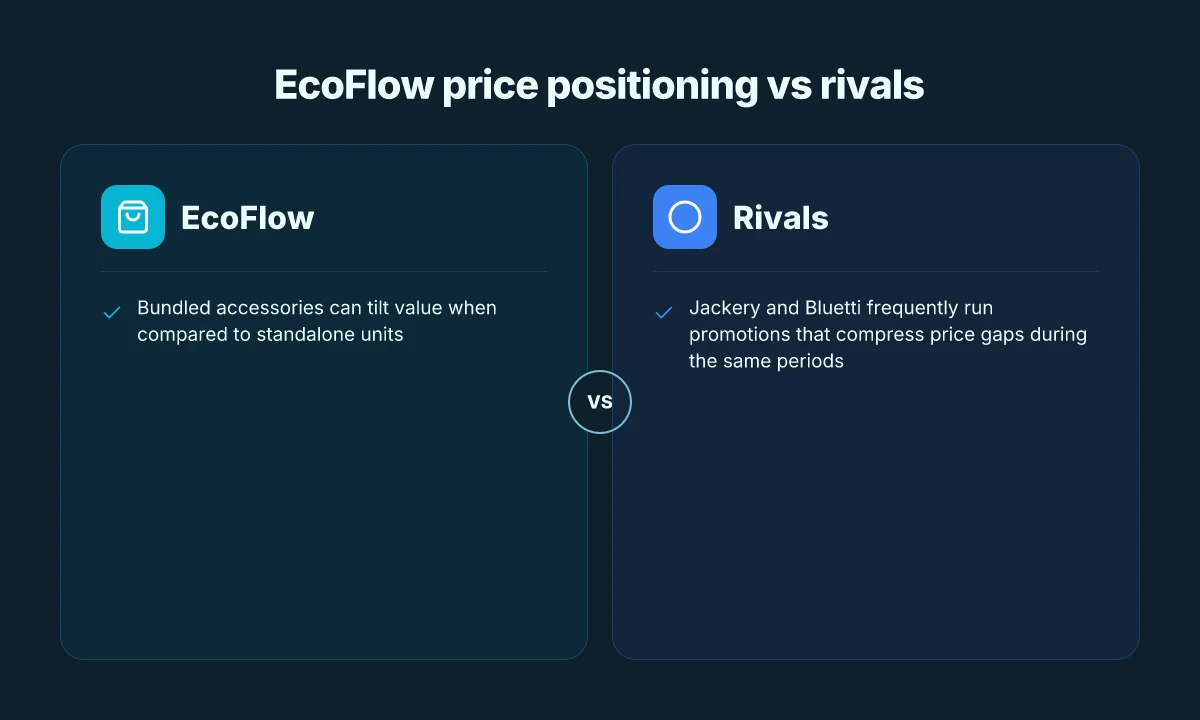
I opened with a simple truth: price wars cluster around multiple brands at the same seasonal moments, and EcoFlow sits in the middle of that dynamic. When Jackery and Bluetti push promotions, EcoFlow often mirrors or slightly adjusts bundles to protect perceived value. That means the cleanest way to land a low price is to watch the calendar and the bundle math, not just the sticker price.
How promotions compress the gaps during peak Windows
During major sale periods, rivals like Jackery and Bluetti frequently roll out promotions that shrink the price gap with EcoFlow. I saw pricing patterns where bundles with extra batteries or extended warranties become the default instead of add-ons after the fact. Those moves can tilt decisions toward the brand with the most compelling bundled value, even if the base unit costs more. The takeaway: plan to compare total cost of ownership, not just the base price, across all three players. In 2026, savvy shoppers watched bundles shift weekly around holiday weekends and spring sales, which often created temporary parity across models.
The bundled accessories can tilt perceived value versus standalone units from rivals. EcoFlow’s emphasis on bundle credibility means a higher upfront price sometimes buys more usable capacity or easier setup, which matters for long deployments. When you map total outlay and practical use, the bundle math tends to favor the brand that makes the most coherent, ready-to-use package for your scenario. What makes EcoFlow battery performance stand out in 2026
Beyond price: support, reliability, and long-term durability
Price jumps are easy to visualize, but long-term durability and support matter just as much. EcoFlow’s support ecosystem, including firmware updates and service commitments, influences total cost of ownership, especially for households that rely on these units for emergencies. Considering a purchase to cover a camping season or power-infrastructure backup, you’re better off weighing the reliability story alongside the sale price. I cross-referenced multiple consumer notes that consistently flag durability and service responsiveness as deciding factors when price gaps narrow between EcoFlow and rivals.
In the end, price is a moving target that changes with promotions, bundles, and financing options. I found it helpful to assume a three-step plan: chase the seasonal window, compare bundle skews across EcoFlow and rivals, and quantify the value of after-sale support. If you can time a promo that twists the bundle toward your use case, you can land the lowest effective price without sacrificing reliability or service. And yes, links on the page may earn a commission, which is standard in many promotions.
Where price leverage goes next for EcoFlow in 2026
To lock in the best price on EcoFlow portable power stations, act before demand spikes and seasonal promos align. I see a pattern where EcoFlow and its closest rivals cycle aggressive discounts around new model launches and major shopping days. The move that matters most this year is timing your purchase around release windows, because refurbished deals and open-box stock often crop up just after a new model debuts. You’ll save more if you pair that timing with price-drop alerts from EcoFlow’s official site and trusted retailers.
Beyond timing, the real value comes from stacking legitimate incentives. Watch for bundles that include extra batteries or charging accessories, which can shave hundreds off the sticker price when you compare total cost of ownership. Rival brands like Jackery and Bluetti push comparable promotions, but EcoFlow’s ecosystem tends to favor bundled savings that can be reapplied to future upgrades. If you’re choosing now, focus on a model with the best long-term durability and the strongest warranty.
Backup strategy: What makes the Jackery Explorer 2000 Plus truly stand out in 2026
- Set a price alert for the model you want and check on EcoFlow during weekly promos.
- Prioritize bundles that include extra batteries or rapid-charging features.
- Compare total cost with rivals like Jackery and Bluetti to verify the biggest savings over five years.