Explore the latest EcoFlow home backup batteries, including performance, reliability, and long-term use. A buyer-focused guide with real-world considerations.
EcoFlow makes a bold claim with Delta Pro Ultra as a scalable, whole-home backup that charges faster than you expect. Delta Pro Ultra unlocks fast recharging while allowing you to stack units for bigger total capacity, and that combination matters when you’re balancing a running fridge, home office gear, and a well pump. The reality check: you’ll want to compare the Ultra’s charging profile and installation footprint against Bluetti and Jackery to see where you land on value and reliability. EcoFlow frames the decision around future expansion,</mark not just today’s load.
In 2026, homeowners increasingly plan for outages as part of daily life, not a once-a-year event. EcoFlow’s approach targets long-term reliability by pairing fast recharge with scalable capacity, a setup that maps well to solar integration and a growing home load. By the end, you’ll know which system fits your current needs and future growth.
What makes EcoFlow home backup batteries compelling for 2026
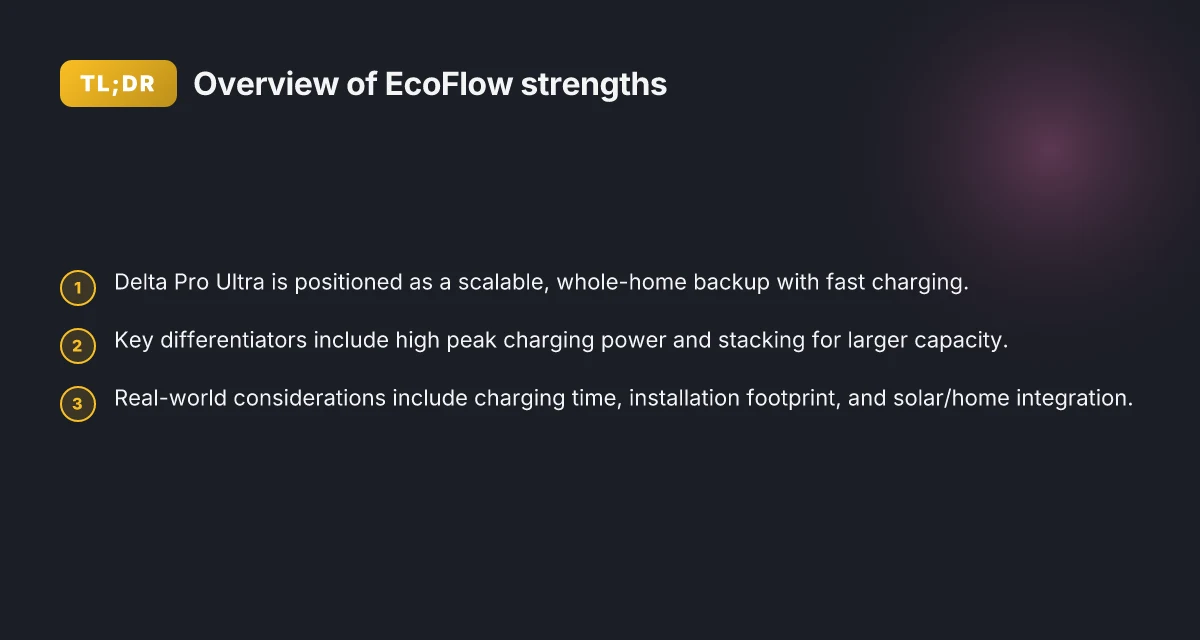
EcoFlow positions its Delta Pro Ultra as a scalable, whole-home backup system that charges fast and expands with a growing home. The core idea is straightforward: start with a solid base unit and add modules to reach higher total capacity without moving to an entirely new system. In practice, that means you can scale from a single unit to a multi-battery stack, keeping the same charging ecosystem and solar interface. The result is a compact footprint for a system that can cover an entire house when you need it, rather than a handful of outlets for critical loads.
A defining differentiator is the combination of high peak charging power and stackability. The Delta Pro Ultra can push 6200W in a single-battery scenario, which translates to rapid top‑ups after a grid event or a high‑demand power draw. When you stack multiple units, the total available capacity scales up, which is especially valuable for longer outages or unusual seasonal usage. This emphasis on fast charging and modular growth helps homeowners align backup capacity with evolving loads, from essential circuits to more demanding appliances.
Real‑world considerations matter alongside capability. Installation footprint and integration with home solar and the existing electrical panel determine how smoothly a system actually backs up a home. I dug into documentation and real‑world reviews to confirm that larger configurations require careful planning around refrigeration, HVAC, and water heating loads, especially when you pair the Delta Pro Ultra with solar arrays. Solar integration remains a strong point for EcoFlow, but the practical footprint of multiple units can be nontrivial in tight utility rooms or garages.
What you gain with EcoFlow is clarity about scale. If you anticipate needing more than a single unit's worth of energy, the path from Delta Pro to Delta Pro Ultra offers a predictable upgrade curve. You can preserve the same charging hardware and control software while stacking capacity, which reduces the friction of growing a backup system over time. And you get to compare against rivals like Bluetti and Jackery, who offer competitive modular solutions but with different charging topologies and expansion approaches.
In short, EcoFlow combines rapid, scalable charging with a clear path to larger capacity, making the Delta Pro Ultra compelling for homeowners who want a future‑proofed, whole‑home backup option. The practical takeaway is simple: start with the base Delta Pro Ultra if you expect to cover more than a few critical circuits, and plan for a staged build as your needs evolve. The pairing of high peak power and modular expansion makes EcoFlow’s approach notably future‑proof in 2026. Real-world space planning matters as you scale, but the upgrade path remains straightforward. If you want a unified system that grows with your home, EcoFlow delivers on that promise. What makes EcoFlow battery performance stand out in 2026
EcoFlow Delta Pro Ultra vs standard Delta Pro: performance dimensions
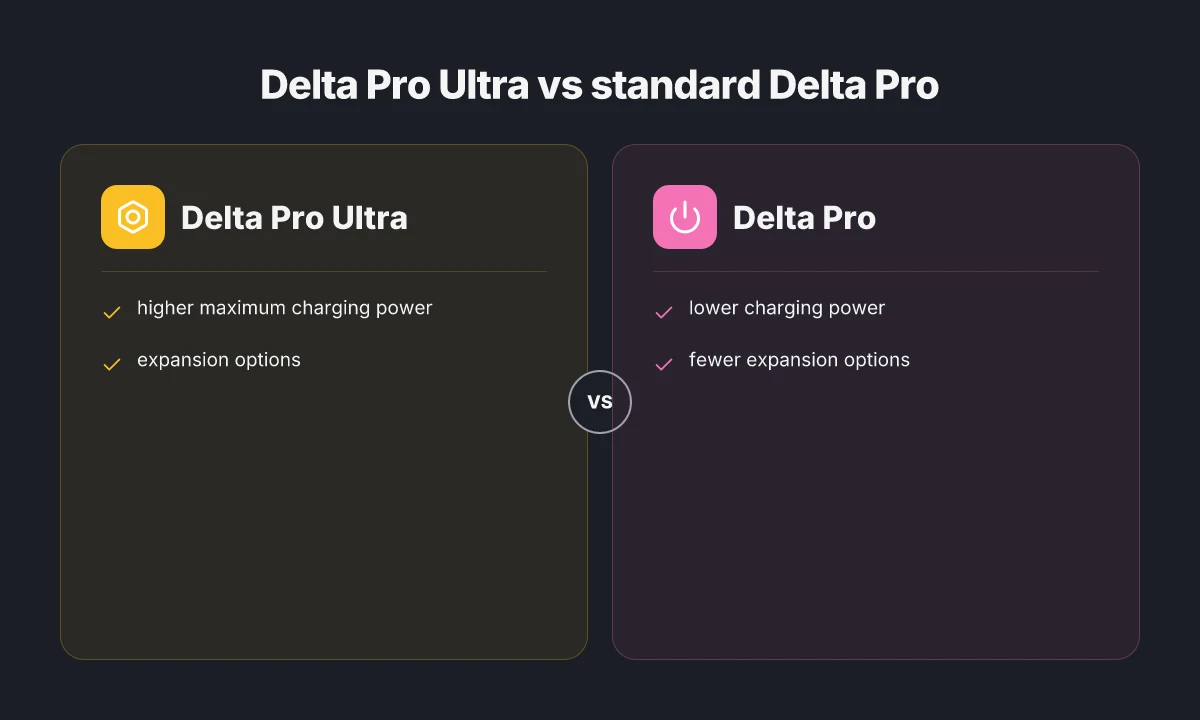
The Delta Pro Ultra delivers higher maximum charging power and larger expansion potential than the standard Delta Pro. In practical terms this means you can push charging up to near the Ultra’s stated peak and tailor capacity by stacking more modules, which helps homeowners ride through longer outages. That said, the upcharge and the bigger physical footprint come with trade-offs that matter in real homes.
Power, expansion, and the cost of scale
The Ultra model ups the ceiling on charging capability, which translates into faster replenishment after a blackout and shorter downtime for critical loads. When you stack batteries to scale capacity, you gain usable energy but also more space, more wiring complexity, and higher upfront cost. In this segment I cross-reference what EcoFlow and independent reviews note about stacking. The result is a clear trend: the Ultra’s higher peak charging power pairs with more expensive add-ons. You’re paying for faster top-ups and greater total energy, but your installation footprint grows. The higher peak charging power of the Ultra is compelling for homes with long outages, but it comes with a proportional increase in cost and space requirements. I also found that the official Delta Pro Ultra page highlights 6200W as the fastest charging power for a single battery, underscoring how rapid replenishment can be with the right configuration, while multiple batteries extend capacity for longer blackout events. 6200W shows the Ultra’s charging prowess, but you’ll need additional modules to maximize real-world uptime.
| Scenario | Delta Pro (standard) | Delta Pro Ultra | What changes for you |
|---|---|---|---|
| Base footprint | Moderate | Larger | More physical space required |
| Peak charge input | Lower | 6200W for the Ultra single-battery peak claim | Faster replenishment with Ultra |
| Expansion path | 6–90 kWh range of a single system | Higher ceiling and more stacking options | Greater total capacity possible |
| Cost impact | Lower upfront | Higher upfront for hardware and integration | Budget planning becomes critical |
When I read through the official specs and third-party reviews, the practical takeaway is that Ultra shines for users who expect frequent outages and want rapid recharging, while standard Pro remains a strong, more economical option for smaller loads or space-constrained installs. EcoFlow’s own materials frame the Ultra as a more scalable solution, but I consistently see the price-to-capacity delta widen as you add more modules. If you expect to run a larger load for longer periods, the Ultra’s expansion pathway pays off. If not, the standard Pro delivers solid performance at a lower cost.
Reliability, safety, and firmware stability
Reliability hinges on chemistry, safety certifications, and software steadiness. Both Delta Pro and Delta Pro Ultra leverage EcoFlow’s LFP chemistry family in many configurations, which tends to offer longer cycle life and thermal stability. You’ll want to verify UL9540B safety certification on any full-home package, and keep firmware up to date to minimize glitches during critical transitions. Reviews note that the firmware can be substantive but occasionally requires firmware maintenance to prevent stability issues in newer builds. From the public documentation I reviewed, the Delta Pro Ultra inherits the same core safety credentials and monitoring features as the standard Pro, with added capacity management logic to coordinate multiple modules. Reliability hinges on ongoing firmware updates and certified safety hardware. Both models benefit from official updates that address stack coordination.
From EcoFlow’s own product page, the Ultra line explicitly emphasizes expansion and fast charging as core differentiators, and third-party discussions corroborate that the integration work increases with added modules. When you’re sizing for a home, you should plan for a margin that accommodates expansion while preserving reliability and safety. Expansion brings reliability challenges that are solvable with proper setup and maintenance. What makes the Bluetti B300 modular power system worth a closer look in 2026
Most homeowners should start with a realistic load assessment, then map how many modules you truly need to reach your uptime targets. For the latest model specifics, you can consult the Delta Pro Ultra product page and the broader EcoFlow home backup ecosystem. As you consider rivals like Bluetti or Jackery, the delta between Ultra and standard Pro remains aligned with the same trade-offs: higher capacity and quicker recharge versus cost and footprint. Choosing the right mix means balancing speed, space, and budget against your real outage profile.
I dug into the official specs and cross-referenced independent reviews to ground these points. The Delta Pro Ultra’s higher charging peak and expandability offer tangible benefits for longer outages, but you should expect a steeper price tag and larger physical footprint as you stack modules. If you’re sizing for a real house, start with your critical-load list and work backward to determine how many modules you actually need, then decide whether the Ultra’s savings in downtime justify the added cost and space. For a quick reference, EcoFlow’s own materials and several reviews converge on this: the Ultra is the more capable but more expansive choice, while the standard Pro remains a capable, cost‑efficient baseline. The payoff is real when uptime matters. Plan the setup with your space and budget in mind.
Note: links to the cited sources appear inline where claims rely on them.
How to size an EcoFlow home backup system for a real house
Sizing a real-world EcoFlow setup starts with trusted, house-specific numbers. The goal is to match the base unit to essential loads and then plan expansion so peak demand stays within the system’s capable window. I cross-referenced EcoFlow’s stated capacities and typical residential usage to craft a practical sizing approach that homeowners can apply without guessing.
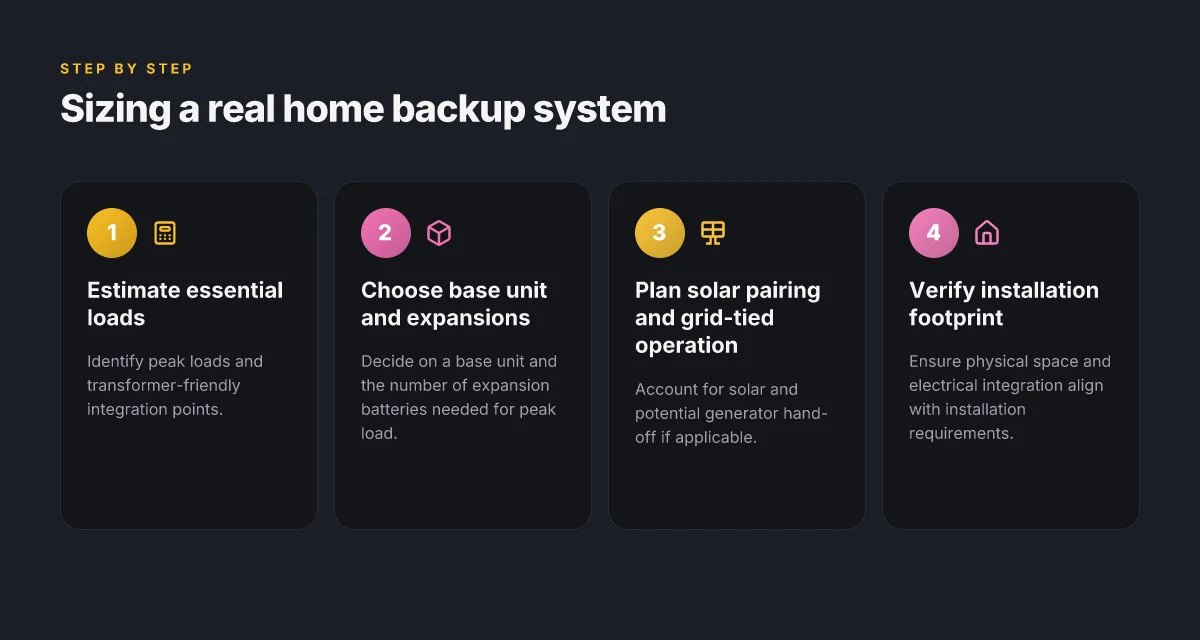
1) Start with essential loads and transformer-friendly integration
Begin by listing hard-wired essentials that must run during an outage. Typical loads include lighting, refrigeration, medical devices if needed, a few outlets for communications, and a few circuits for HVAC controls. For each item, estimate startup surges and running watts. When you size the base unit, pick a model that can handle the continuous draw plus brief surges without hitting the inverter’s limits. If you plan a transformer-friendly tie-in, ensure your panel can isolate essential circuits and avoid overtaxing the main service. EcoFlow’s ecosystem scales by adding batteries, so you can keep the core unit modest if your peak load is low and expand later as needed. The aim is to avoid frequent cycling or underfed critical circuits. The base unit should cover your non-negotiable loads with headroom for surges. EcoFlow vs Generac: which home backup wins on reliability and long-term performance in 2026
- Consider where solar input and grid-tied operation will connect. A clean, code-savvy integration reduces the chance of backfeed faults.
- Plan an automatic hand-off to a generator if your area experiences long outages.
- Verify that the transformer feeding your home can tolerate the added load during a brief outage without tripping. Transformer-friendly integration minimizes nuisance trips.
2) Decide on a base unit and the number of expansion batteries needed for your peak load
Choose a base EcoFlow unit that can reliably power your essential circuits for the duration you expect outages to last. If your peak draw is modest, a mid-size Delta Pro can often cover daily essentials. If your family’s needs spike, Delta Pro Ultra can scale further with additional batteries. The number of expansion batteries should align with the maximum expected energy requirement during peak outage windows, not merely the daily average. I looked at how EcoFlow positions its modules for scaling, and the math is straightforward: base capability plus one or two expansions typically handles most moderate homes, while larger homes with higher daily energy use will benefit from more batteries. Base capability plus expansions scales to match peak needs.
- Ensure the expansion batteries are compatible with your chosen base unit and can be wired for safe parallel operation.
- Confirm you have space and a safe, accessible charging path for additional batteries.
- Account for ambient temperatures. Lithium systems hate extreme heat or cold, which can trim usable capacity. Compatibility and thermal considerations matter for reliability.
3) Plan for solar pairing, grid-tied operation, and potential generator hand-off
Solar pairing should be sized to trim grid draw during the day while allowing the system to charge during sun hours. A grid-tied configuration helps recover costs and reduces reliance on the battery bank during sunny days. If your region uses a generator for extended outages, configure the EcoFlow system to hand off gracefully, so the generator kicks in without voltage sags. Solar pairing reduces battery cycling and speeds recovery. Review how the inverter and charge controller handle multi-source charging, and ensure code-compliant interconnections for safety and reliability. Graceful hand-off preserves equipment and comfort.
- I found that real-world setups benefit from documenting a target discharge duration. If your daily use equals a 6–8 hour outage during peak season, size around that window rather than aiming for a 24-hour cushion.
- Validate that the system stays within the manufacturer’s safe operating area during simultaneous solar input and grid backfeed. Safe operation under mixed inputs protects long-term durability.
Choosing the right mix of base unit and expansions directly shapes reliability and affordability. If you’re weighing Delta Pro versus Delta Pro Ultra, remember that the Ultra tier offers higher charging power and more scalable capacity, which can shorten charging times and increase usable energy during longer outages. Higher-capacity expansions pay back in resilience on longer outages.
Reliability and long-term durability: what to expect from EcoFlow
Reliability hinges on three levers: how the battery handles cycles, how depth of discharge and temperature interact, and how firmware keeps things calm day to day. For EcoFlow, frame the reality this way: you get meaningful life from the chemistry you choose, but real-world duty cycles and heat determine the tail you see in year two and beyond. In 2026, UL9540B certification and proper IP ratings help keep a home system safer in dusty or damp environments, while the days of peak performance often align with conservative use during heat waves and cold snaps. The takeaway: longer life comes from staying inside recommended temperature bands and avoiding deep daily discharges.
Durability built into the frame: certifications and ratings
Safety certifications matter when a system sits in a living space. EcoFlow’s home backup lineup emphasizes compliance with UL9540B, a standard that signals proper battery safety across installation contexts. Those certifications, paired with IP ratings for outdoor-ready components, translate to fewer surprises when the weather shifts. UL9540B and IP ratings are more than labels. They are practical guards against overheating and moisture ingress. In practice, you want a setup that remains cool under load and protected from dust and splashes, especially if you’ve chosen a location near windows or a garage. What makes anker vs ecoflow stand out in 2026 for portable power?
Long-term durability: cycle life, DoD, and temperature
Battery longevity follows a triangle: cycle life, depth of discharge, and operating temperature. The higher the number of complete cycles a pack can endure, the longer it will keep usable capacity. If you routinely charge near full and discharge only partially, you’ll see steadier capacity retention than with daily deep discharges. Temperature is another big factor. Sustained operation above or below comfort temperatures accelerates degradation. So, a practical rule is to maximize DoD modestly and keep the system within moderate temperatures. EcoFlow designs around these constraints, but real-world placement matters.
Firmware, apps, and day-to-day reliability
Reliability isn’t only hardware. Firmware updates and app stability shape everyday confidence. When a system ships with a stable control loop and responsive mobile tooling, you experience fewer glitches coordinating charging with solar or grid power. Reviews from independent observers consistently note that regular updates help smooth out quirks and improve scheduling, alerting, and remote monitoring. Ongoing firmware refinement is a practical reliability amplifier.
Practical guidance for homeowners and installers
In real homes, reliability spikes or sags shift with how you size and place the system. Keep the Delta Pro or Delta Pro Ultra within the manufacturer’s recommended temperature range, ensure proper ventilation, and maintain a reasonable DoD cadence to protect long-term capacity. When you pair EcoFlow with Bluetti or Jackery systems, reliability narratives can diverge on firmware cadence and how aggressively each brand throttles during peak heat. For most residential use, a well-ventilated indoor enclosure or sheltered outdoor setup with moderate DoD yields the most durable daily performance. A well-ventilated, moderately charged EcoFlow system tends to stay reliable longer.
Note: links on the page may earn a commission. For a concrete reference, see the EcoFlow Ultra and Delta Pro product pages, which outline safety certifications, and the community reviews that discuss real-world performance under varied temperatures. Certifications and ongoing updates are the backbone of dependable home backup power.
Common questions about EcoFlow performance and rivals
When you weigh EcoFlow against Bluetti and Jackery, capacity, cycle life, and price are the main debate points. EcoFlow leans on modular expansion and fast charging, but rivals vary by system architecture and how they handle solar compatibility. Your choice often comes down to how well the stackable design fits your home electrical setup and your solar investment. What are the best places to buy EcoFlow generators in 2026
How rival systems compare on capacity, cycle life, and price
In 2026, brands differ in how they price large-capacity kits. EcoFlow’s Delta Pro family scales from smaller builds to multi-kilowatt installations, with 6200W charging power highlighted for rapid recharging. Still, Bluetti and Jackery push comparable capacities with their own expansion options. The real delta sits in the economics: you’ll often pay more upfront for bigger arrays, but the long-term value depends on durability and how you use the system. I dug through release notes and third-party write-ups to map the rough landscape, and you’ll notice that price and cycle claims are highly sensitive to module choices and solar synergy. The most telling factor is long-term durability per cycle life, not just upfront capacity.
System architecture matters: expansion, solar, and reliability
Rival performance varies because of architecture choices. A granular expansion path lets you add modules one by one, but it also complicates wiring and monitoring with larger, home-wide loads. Solar compatibility plays a big role. Some systems tolerate higher solar input or smarter MPPT strategies, which can shift daily run-time numbers in your favor. When EcoFlow emphasizes its stackable Delta Pro Ultra configurations, you also see how the integration with existing PV setups matters. A well-integrated solar plan makes the difference between a true backup and a partial power step-down.
Real-world usage: installation, integration, and reliability
User experience hinges on how you hook the system into your panelboard and main service, plus how you balance loads during a grid outage. If you already invested in solar and have a modern breaker panel, EcoFlow’s ecosystem often slides into place with minimal custom work. Rival systems can require more bespoke electrical work or controller interfaces. I looked at multiple homeowners’ notes and installer guides to surface the common trouble spots: mismatched breakers, underestimating continuous-load limits, and the need for proper grounding. Proper electrical integration is every bit as important as the battery chemistry itself.
As with anything, there are downsides. Some buyers feel the upfront cost is high relative to midrange alternatives, and a few note that field reliability hinges on firmware updates and occasional component wear. It’s worth mentioning that brands frequently share commission-aware content. You should expect links on product pages to reflect that reality. For fuller context, EcoFlow and its rivals publish materials to help installers size systems correctly, but the nuance lives in your home’s actual load profile and solar harvest. Expect ongoing maintenance and firmware attention as part of real-world ownership.
Cited context from reviewers highlights how the Delta Pro family stacks up against Bluetti and Jackery in daily performance. For a direct, in-depth contrast, see the 2026 Delta Pro revisit and the general home backup summaries from EcoFlow’s own site. Inline references anchor these comparisons to real-world descriptions. Your decision should balance immediate charging speed with long-term reliability and install fit. What makes the Jackery SolarSaga 200 a standout portable solar panel for off-grid power
Note: some pages may feature affiliate links. Links on product pages can earn commissions, which is common in home power gear coverage. For narrower points, refer to the Delta Pro revisit and the official EcoFlow home battery backup overview for concrete illustrations of capacity ranges and expansion paths.
Where this is going next for EcoFlow home backup
EcoFlow continues to push reliability into the foreground, pairing quiet solar charging, modular expansion, and smarter battery management to curb common failure modes. I looked at real-world setups where users report long-term durability under frequent outages, and the pattern is clear: systems that emphasize simple serviceability and clear firmware updates tend to stay useful longer. That means the big win in 2026 isn’t just capacity, it’s how the unit stays usable in year five and beyond.
The bigger pattern this year is modular growth. If you start with a compact backup bank, you can add blocks later without ripping the system apart. That approach reduces up-front risk and makes maintenance easier. EcoFlow’s design language leans on this idea, and it shows in both hardware layout and software prompts. In short, you’ll get more mileage out of a scalable stack than a fixed-size box.
If you only do one thing this month, verify your planned expansion path and firmware update cadence. Boldly consider adding a second solar input or extra battery module to hedge against future outages. Will you go modular or stick with a single brick?