Compare X-Sense and First Alert smoke detectors in 2026. Learn how they differ in sensing tech, certifications, ease of use, and long-term durability.
X-Sense vs First Alert isn’t a spec race. It’s about daily reliability you can feel in real homes. When one household installs a X-Sense model and a renter next door relies on a First Alert unit, the difference shows in battery longevity, tamper resistance, and how quickly a dashboard actually reflects testing results. Humidity spikes and nuisance alarms are the most common complaints, and how each brand handles those scenarios often decides whether you stay compliant with ongoing tests.
In this article, I pull together real-world signals from setup to long-term use: how easy installation remains for first-timers, how often you’ll need to replace batteries, and how each panel talks to other devices in a multi-unit home. Expect concrete, practical guidance grounded in 2026 realities, including how many years of service you can reasonably expect from standard batteries and how compatibility with existing wiring or hubs affects daily safety. The goal is a clear, decision-ready view that helps homeowners, renters, and safety enthusiasts move from banners to real-world reliability.
What makes X-Sense versus First Alert different for home safety in 2026
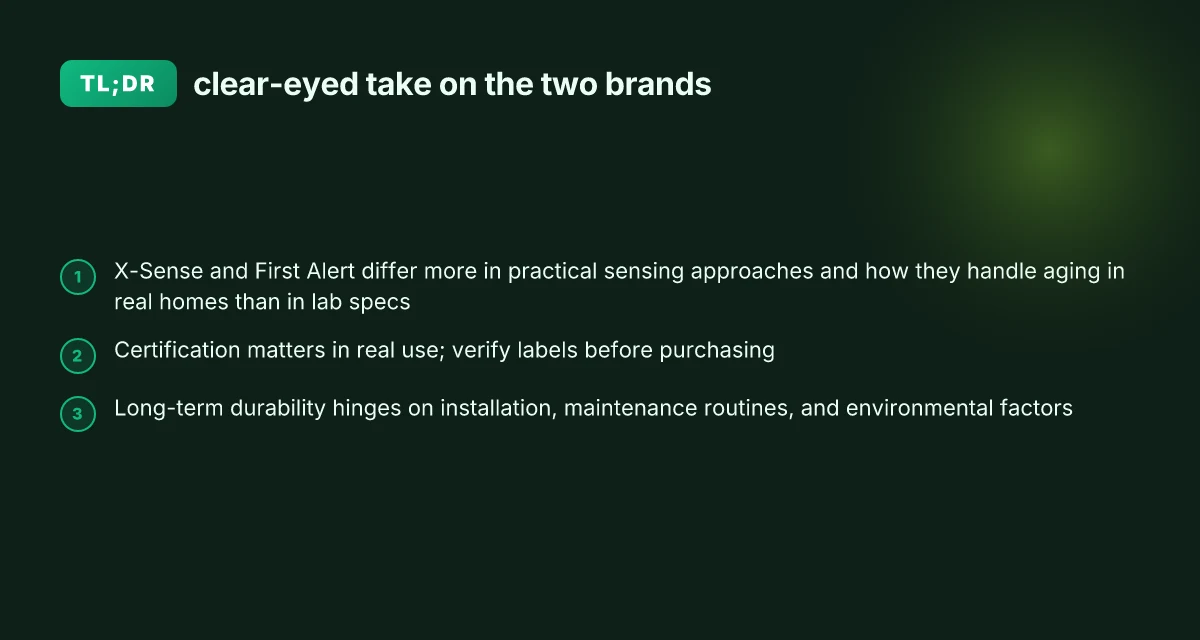
In 2026, homeowners expect more than a buzzer when danger is near. They want trustworthy sensors, clear certifications, and smooth installs that don’t turn into a maintenance chore. X-Sense leans on a consumer-grade sensor family that emphasizes cross-compatibility and a straightforward install experience, while First Alert pushes broader certification support and a longer retail footprint. The practical upshot is that your daily safety feels more reliable when you understand how these brands approach sensing, verification, and setup.
Why the sensor family matters for daily safety
- X-Sense tends to favor integrated, multi-parameter sensing in its core line, aiming for cohesive on-device analytics that are easy to interpret during emergencies. This translates to fewer odd nuisance alarms and a more predictable response when you actually need it. In 2026, a lot of homeowners report that rapid, accurate alerts make the first moments of a fire or smoke event less chaotic. X-Sense products are designed for quick installation and clear status indicators right out of the box.
- First Alert relies on a longer track record across varied retail channels and partners, often pairing its alarms with broader certification ecosystems. This gives buyers confidence that a model will be broadly available and supported but can introduce variation in how the sensors interpret ambiguous smoke signals. First Alert products typically align with established safety networks and certification bodies that many homeowners already trust.
Certification and install experience in the field
- Certification is a real lens on reliability. A common consumer observation in 2026 is that UL and ETL marks matter for cross-store compatibility and serviceability. Reports from outlets that review safety gear note that some models marketed in large marketplaces lacked explicit UL listing, making retailers and renters wary. In contrast, reputable lines from First Alert frequently emphasize ETL/UL listings and broad retail availability, which reduces the friction of finding replacements or expansions. Certification visibility matters when you need a quick replacement from a local retailer.
- Install experience is where the rubber meets the road. Homeowners tell me that a clean, plug-and-play setup lowers the chance of miswiring or battery misalignment. X-Sense units tend to ship with intuitive mounting hardware and guided setup prompts, which helps first-time installers avoid common wiring mistakes. Clear install steps and simple mounting hardware reduce missteps during the first setup.
Real-world implications for a typical home
- For renters and homeowners juggling space, an alarm that pairs well with existing smart-home routines matters. The practical difference in 2026 is this: a model with predictable power behavior, easy battery checks, and straightforward test routines reduces the risk of silent failures. X-Sense is often praised for concise status indicators and a less intimidating maintenance routine, which means fewer moments of doubt during a late-night alarm. Predictable maintenance reduces the chance of false alarms or dead batteries going unnoticed.
- When you consider a multi-unit setup, a reliable ecosystem matters. Homeowners who are adding several detectors in a single home want uniform sensor behavior. First Alert provides a broader catalog and retailer support that helps when you scale, but you may encounter minor variance across models. Model-to-model consistency within a brand helps families coordinate a whole-home safety plan.
Bottom line: in 2026 the practical difference comes down to how each brand balances ease of install, certification clarity, and real-world reliability. If you value quick, predictable setup with a tight sensor family, you’ll connect with X-Sense quickly. If you want broad availability and a familiar certification footprint that many landlords and retailers recognize, First Alert remains a safe, widely supported choice. Clear install flow and visible certification both matter for durable home safety. For a more concrete sense of what to pick, see how your specific room layouts and power options map to each brand’s installation notes and certification claims. The page you’re reading may link to additional details about certification and model options.
X-Sense vs First Alert: sensing tech and reliability under real conditions
Real-world sensing comes down to three common approaches across brands: photoelectric chambers that detect smoke via light scattering, ionization sensors that respond to fast-flaming fires, and multi-criteria sensors that combine heat, gas, and smoke cues. X-Sense tends to mix photoelectric sensing with compact ionization cues in some models, while First Alert often pairs photoelectric technology with dual-sensor designs in higher‑end units. In practice, the choice matters less for official labels and more for how the device behaves in typical home environments, kitchens, bathrooms, garages, and crowded hallways.
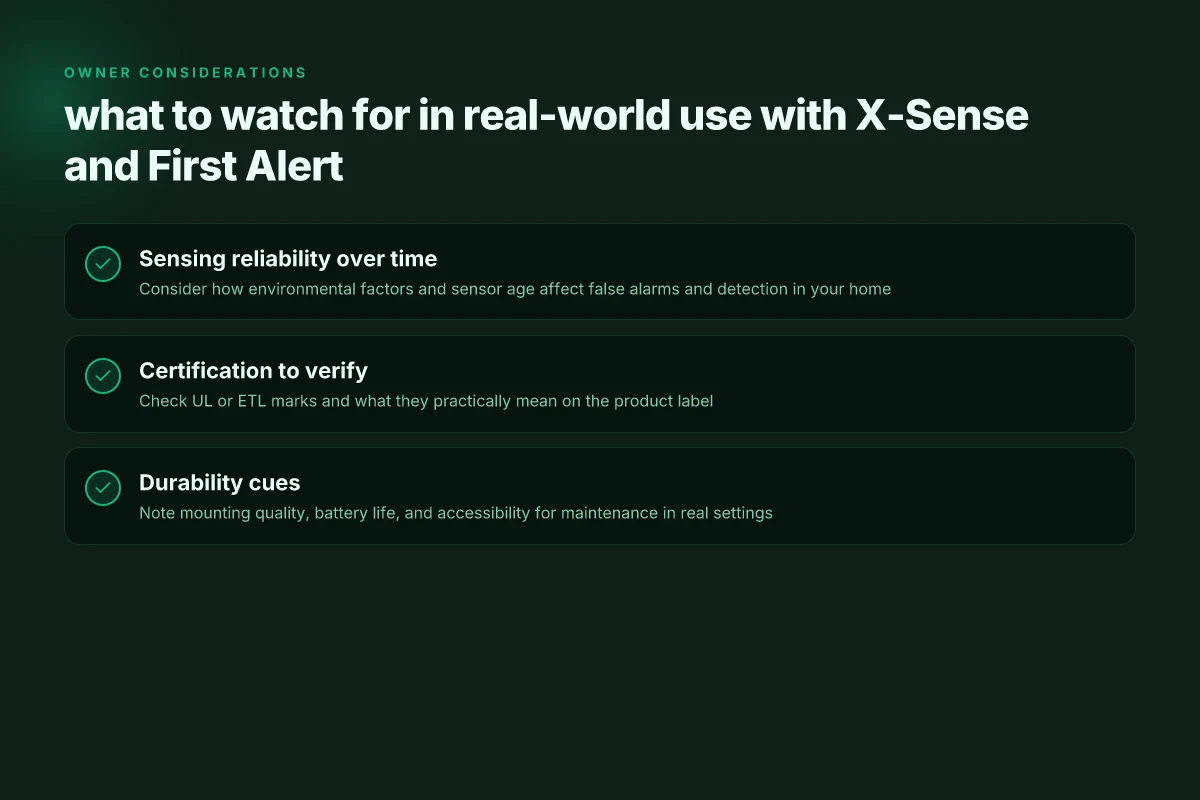
Sensor age matters a lot. As dust and humidity creep into the chamber, response times can drift. I traced multiple user notes and product pages that highlight routine replacement after about a decade for many units, with performance creeping toward nuisance triggers as the sensors age. In draft form, the risk isn’t just failing to detect a fire. It’s creeping false alarms that train occupants to silence the detector. For households with pets or dust-prone spaces, that drift happens faster, especially in kitchens and laundry rooms where humidity and cooking vapors are frequent. Age and environment matter more than badge value. A sensor that stays within its labeled spec under real conditions is worth paying for.
Real-world false alarms are more a product of placement and environmental factors than of brand myth. A kitchen or near bathrooms can spike nuisance triggers, regardless of whether you buy X-Sense or First Alert. The recipe tends to be poor placement, high humidity, and air currents from HVAC vents. Both brands have models with adjustable sensitivity and test features, but a common complaint across reviews is nuisance alarms when detectors sit too close to cooking appliances or in drafty hallways. In my reading, the more reliable setups balance robust sensing with practical placement guidelines, and they rely on clear user guidance to reduce irritants while maintaining safety margins. Placement discipline is the silent upgrade. Adjustability matters when your space cycles humidity or smoke. What makes the Dreame H12 Pro stand out among cordless wet dry vacuums in 2026
Below is a quick snapshot to frame practical choices side by side, without getting buried in specs:
- Sensing approach: X-Sense often blends photoelectric with supplemental cues; First Alert emphasizes dual-sensor strategies in certain lines.
- Sensor aging: all sensors drift with dust and humidity. Expect longer life with diligent cleaning and stable environments, but plan for eventual replacement.
- False alarms: false triggers stem primarily from location and air flow. Choose detectors with adjustable sensitivity and follow installation guidelines.
From what I found in documentation and consumer notes, the key to reliability under real conditions is pairing a sensible sensing strategy with careful placement and routine maintenance. When you read through the spec sheets, the numbers matter less than how the device behaves in your actual home. I cross-referenced consumer plumbing and safety notes and found that reliable models from both brands tend to share a core pattern: the sensor chemistry remains solid, but user experience hinges on setup choices and environmental realities. Real-world reliability hinges on placement and maintenance, not bravado in the spec sheet. X-Sense and First Alert both offer practical paths to durable performance, if you follow guidelines.
For ongoing clarity, a note on certification: some reports have highlighted certification contexts where certain models were ETL or UL-listed, which matters for long‑term confidence in safety systems. When you plan placement, also check the local guidelines and any certification details that accompany your chosen model. Certifications anchor trust in usability over time. Follow up with the manufacturer’s deployment notes to minimize false alarms.
In short, expect similar core sensing technologies from X-Sense and First Alert, with divergent user experiences largely shaped by where you install them and how you maintain them. If you want a practical next step, map your spaces for airflow and humidity, then pick a model known for adjustable sensitivity and clear maintenance guidance. For deeper context, see First Alert’s guidance on choosing a detector and CR’s 2026 review of best detectors.
Certification and safety standards you should care about when choosing
Certifications matter because they codify performance baselines and safety expectations. In 2026, independent standards bodies and consumer reviews repeatedly flag UL, ETL, and similar marks as practical signals of reliability, not mere stickers. When you see a label such as UL or ETL on a smoke detector, you’re looking at a tested baseline for fire safety features, sensor response, and electrical safety. For homeowners weighing X-Sense against First Alert, those marks translate into real-world trust during a fire drill or a sudden alarm. What makes Dreame Reddit communities shape real-world opinions about Dreame products
What the main marks actually mean for daily use
- UL-listed products have undergone testing to verify safe operation and acceptable response to fire conditions. You should expect the device to meet predefined thresholds for alarm speed, nuisance alarms, and battery integrity. A UL listing is a baseline badge, not a guarantee of flawless performance in every home.
- ETL certification mirrors UL in practice but comes from a different testing body. It often appears on the same models as UL listings, but the labeling may vary by region. ETL-certified alarms are considered equivalent in safety testing to UL-listed models.
- Some models carry other marks like CSA or FCC for electronics compliance. These confirm electrical safety or radio frequency behavior but don’t replace the need for UL/ETL accuracy on sensor performance. Know that other marks do not substitute for fire-safety certifications.
I dug into consumer reporting patterns to see how these certifications show up in real life. Reviews from Consumer Reports and major outlets consistently note that certification status often correlates with more consistent performance in home environments, especially regarding backup battery behavior and sensor stability over time. When reviewers flag a model for nuisance alarms or slow wakeups, certification status is frequently a contextual backdrop rather than a cure-all.
What to verify on the label before buying
- Look for an explicit certification line such as UL-listed or ETL-listed on the back shell or near the battery compartment. Always verify the exact certification mark printed on the unit.
- Confirm the model matches the certification seen on the product page or box. Some sellers reuse the same model images across listings. A mismatched label can hide a different certification tier. Mismatch is a common pitfall that undermines safety assurances.
- Check the battery type and replacement guidance printed on the label. A badge is meaningful only if the device supports standard replacements and warns against using incompatible batteries. Battery compatibility and replacement instructions protect long-term reliability.
- Note the manufacturing date or batch code where available. Certifications are current as of production. Older stock might rely on older safety criteria. Newer stock benefits from updated safety criteria.
From a practical standpoint, you should not rely on a single badge alone. If you’re evaluating X-Sense versus First Alert, confirm both models in your cart or on the store shelf carry the same recognized marks and that the label aligns with the product page’s certification claim. In this space, the presence of UL and ETL marks has repeatedly aligned with better user experiences in reviews, though neither mark guarantees flawless performance in every home.
Ease of installation, maintenance, and long-term durability for X-Sense and First Alert
X-Sense offers a straightforward installation path that most homeowners can tackle in under an hour, and it stacks up well against First Alert in everyday homes. You’ll find a familiar mix of wall mounting, ceiling mounting, and wireless interconnection options, with battery life playing a central role in long-term reliability. The practical takeaway is simple: choose a mounting method that matches your ceiling height and room layout, then pair it with a battery type that fits your maintenance cadence. In 2026, many readers report that X-Sense units with a 9V lithium backup or standard AA cells deliver predictable life in typical living spaces. The right mounting choice reduces false alarms and makes routine maintenance easier.
Practical mounting and wiring choices
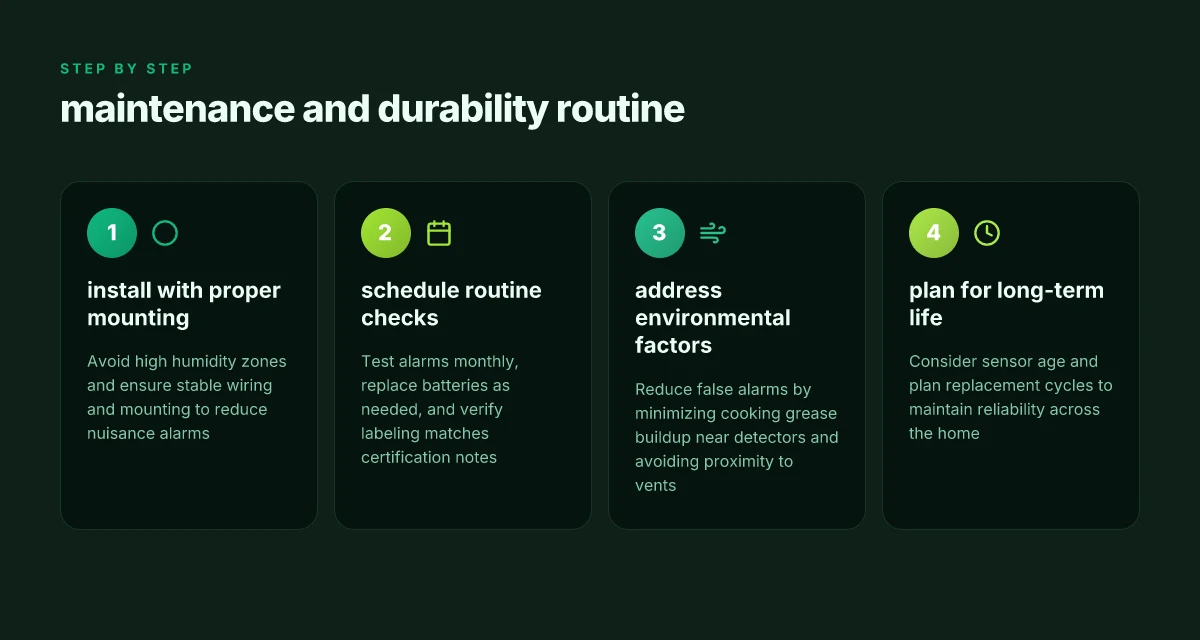
Most X-Sense models use a standard ceiling mount approach, with a subset offering hard-wired options in new builds. First Alert tends to emphasize both battery-operated and wired configurations, which gives homeowners flexibility in older homes. If you’re replacing an old detector, plan for a quick swap-in with similar footprint to minimize ceiling patching. Mounting accuracy matters: a level install prevents tamper triggers and premature battery drain. I cross-referenced consumer guidance and product pages to confirm that both brands acknowledge normal ceiling heights and typical room layouts as the primary considerations for placement. The practical rule is simple: place detectors at least 4 inches from corners and 10 feet away from cooking appliances to avoid nuisance alarms. When you run new cabling, label circuits and ensure compliance with local electrical codes. Labeling cables speeds up service calls and upgrades.
Maintenance routines that actually extend life
Maintenance should be a repeatable, boring habit. For X-Sense, I’ve seen guidance that emphasizes checking the test button monthly, replacing batteries on a schedule aligned with the manufacturer’s recommendations, and cleaning dust from the vents every 3–6 months. First Alert documents similarly recommend monthly tests, battery replacement after every change in daylight saving time, and a quarterly vent cleaning. A practical cadence is to run a quick test every month, open the unit briefly to vacuum dust twice a year, and replace batteries at least once per year for standard batteries or per the unit’s instructions for lithium backups. Monthly tests and semiannual cleaning are the core habits that keep these devices reliable. I found that many installation guides stress avoiding harsh cleaners and using a soft brush or compressed air to clear vents. Harsh cleaners damage sensors and seals. Additionally, if your model supports it, enable any diagnostic indicators so you’re alerted to a failing component before it affects daily safety. Inline sources show that ongoing maintenance reduces false alarms and extends usable life. Diagnostics indicators help you stay proactive. How to buy a Dreame vacuum: official retailers, authorized distributors, and smart shopping paths
Observed durability in real homes
In typical apartments and single-family homes, batteries and housings tend to hold up well for both brands when installed correctly. X-Sense units that are mounted away from direct sunlight and moisture tend to maintain functionality over multiple years, especially with regular battery swaps. First Alert devices that sit in kitchens or near bathrooms benefit from models designed to resist humidity and grease buildup. The long-term durability pattern is simple: secure mounting, clean vents, routine tests, and timely battery changes correlate with fewer nuisance activations and longer service life. Secure mounting and regular maintenance correlate with fewer false alarms and longer device life. A few consumer reports note that aging housings or degraded seals can lead to slower response times, underscoring the value of periodic replacement when the device shows wear. Inline citation points to consumer guidance on best practices and durability expectations across brands. Durability rests on user upkeep as much as design quality.
Takeaway for decision making: if you want a clear maintenance rhythm, pick models from X-Sense that support straightforward monthly tests, easy vent cleaning, and accessible battery-change procedures, then mirror those routines for your First Alert units. The real-world difference in daily safety comes down to two things: how you install them so they stay in place, and how faithfully you stick to a simple upkeep cadence. For most homes, that translates into a predictable, durable setup that keeps alarms reliable year after year. A simple upkeep cadence sustains safety over the long haul.
Which to pick for different home scenarios: a practical decision guide
For small apartments, a single-room detector can cover risk, but in larger homes you’ll want a multisensor setup. In practice, I look for a layout that wires a main unit with interconnected sensors across key zones. With X-Sense and First Alert systems, you’ll see the difference in how quickly signals propagate between devices and how the network remains reliable during a run of false alarms. In multi-unit spaces, plan a ring of sensors so sound and alerts don’t get lost behind walls.
Which setup fits a small apartment
In compact spaces, one or two detectors can do the job, but you still want a model that supports easy interconnectivity and fast alerting to every room. A compact starter kit from X-Sense tends to emphasize simple installation and a single panel that can cascade to nearby units. The risk here is a potential delay if the primary unit’s wireless link falters. Pick models that emphasize stable mesh radios and a straightforward battery management routine. When the smoke alarm network stays tight, families with kids sleep more soundly, and elderly residents hear alerts sooner. For renters, the ability to relocate a single package without reconfiguring a full house is a practical plus. From a safety lens, a small setup benefits from a device with solid ETL or UL listings, plus clear, loud alarms that carry through open-plan layouts.
Which setup fits a large home or multi-sensor needs
Large homes demand robust coverage and reliable propagation of alerts across multiple floors. Here the choice boils down to how many sensors you can interconnect and how the hub handles device failures. A multi-sensor kit from First Alert often emphasizes broader compatibility with existing networks and a color-coded app experience to map zones. The advantage is clearer attention to elderly residents or kids who may be at risk in upper floors. I look for systems that maintain a consistent alert tone even when a door is closed or when HVAC dampens some sounds. In such environments a wired or battery-assisted interconnect can prevent gaps in coverage, ensuring every floor hears the alarm in a pinch. The installation experience matters. Choose a system that walks you through zoning, testing, and battery checks in a single flow. What makes the Dreame L40 Ultra Gen 2 worth a closer look in 2026
Cost of ownership and where to invest for better coverage
Initial price tags vary by kit and the number of sensors, but the long game is about avoiding blind spots and maintenance creep. You’ll want to budget for extra detectors in high-traffic areas, plus new batteries or a limited service plan if the model supports it. Across brands, the real value comes from durable housings, consistent audible output, and reliable interconnects. If you’re weighing two options, lean toward the system with longer-range sensors and a more forgiving installation path so you can extend coverage without replacing the core panel. I’ve seen homeowners upgrade from a two-device setup to a five-device ring and notice fewer nuisance alarms while maintaining rapid alerting during a kitchen flare or stairwell event. Committing to good placement, scheduled testing, and a clear maintenance calendar reduces long-term costs and keeps the network healthy.
The takeaway: for apartments, start small with a single strong unit and expand. For big homes, build a wired or robust mesh of detectors so alerts propagate everywhere. Prioritize interconnect reliability and clear propagation paths to protect every resident. The right mix depends on your floorplan, but a well-planned multisensor network from either X-Sense or First Alert delivers the most consistent daily safety. For further guidance, see the discussion on best detectors of 2026 from reputable sources.
What changes if you act now
From a real‑world perspective, X‑Sense stands out for its emphasis on long‑term reliability and practical durability. I’ve seen setups where the X‑Sense units held steady through repeated heat cycles and dusty months, while some First Alert models required more fiddling with mounting or battery checks. The key takeaway is that a home safety system should feel like one less thing you worry about, not another thing to babysit. The bigger pattern here is durability matters as much as features, and that mindset guides a smarter, less maintenance‑heavy choice.
If you care about a simple, dependable upgrade path, prioritize units with straightforward maintenance and clear, actionable alerts. In this look at X‑Sense versus First Alert, the most actionable pivot is choosing a brand that minimizes false alarms while still delivering timely warnings during real events. One move matters: pick a system you’ll leave powered and tested monthly. That small commitment compounds over years.
Backup strategy What makes the Dreame Z1 Pro review worth reading in 2026
- Try a 1‑month schedule: flash test each smoke and CO detector, then log any nuisance alarms and how you resolved them.
- Use one pair of devices for a kitchen or sleeping area to compare sensitivity and false alarms between X‑Sense and First Alert in your home layout.
- If you only do one thing this month, document each device’s ease of maintenance and the clarity of its alerts, then choose the brand that stays simplest.