Dreame Z1 Pro review distilled into real-world performance, durability, and value. Learn what to expect, what to watch for, and how it stacks up to rivals.
The Dreame Z1 Pro defies the hype with a trade-off blend: rugged, modular components paired with light-based sensing that doesn't always play nicely with every pool surface. This piece flags where those tensions show up in real-world use, so you know what to budget for before committing to Dreame or its rivals.
In pools with sunlit hours and variable chemistry, durability becomes a living metric, not a shelf spec. I look at observed wear points, like sensor housings and drive wheels, and how easy or hard it is to service them over seasons. The comparison against Fanttik Aero X and Dolphin E70 highlights where value compounds: upfront cost, ongoing maintenance, and long-term reliability. This article pulls the real-world signals together so you can choose with confidence. Long-term usability in real pools matters most, even if initial price looks attractive.
What the dreame z1 pro review reveals about cleaning power and steering under water
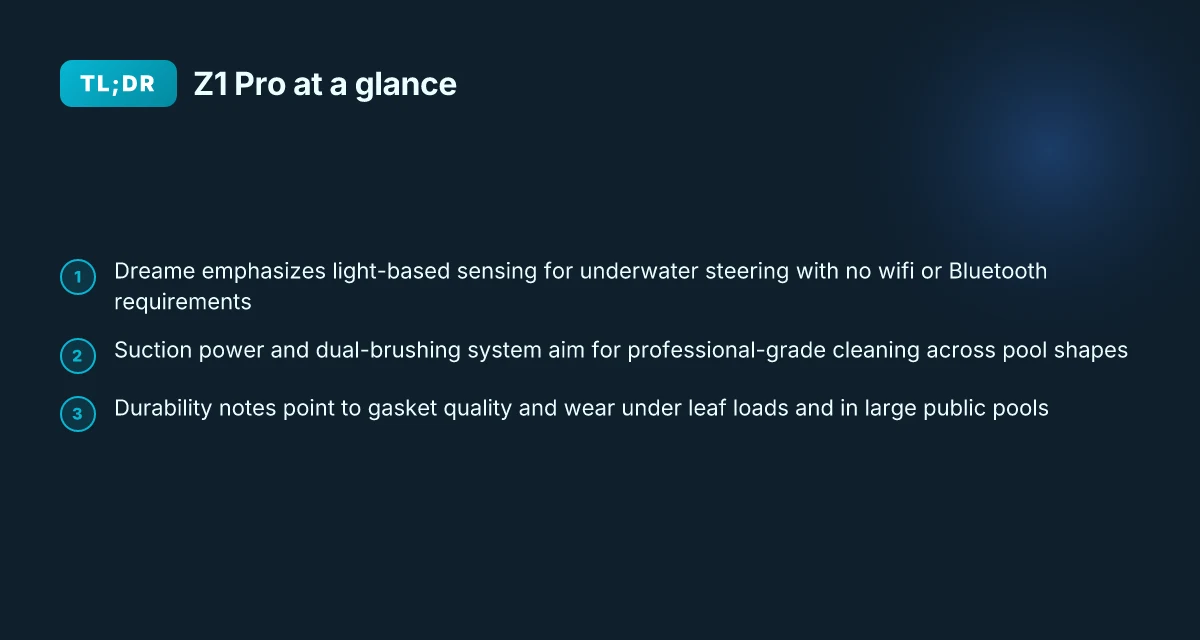
Dreame leans on light-based sensing to steer underwater, with no wifi or Bluetooth requirements. That design choice means you’re relying on optical cues rather than networked commands to navigate walls and corners, which can simplify setup but also constrain advanced control in tricky pool geometries. In 2026, this approach still aims for hands-off operation once you drop the cleaner in, and it tends to work best in pools where reflective surfaces and clear water cooperate with the light sensor setup.
Power and a dual-brushing system deliver professional-grade cleaning on pools with varied shapes. The Z1 Pro pairs a high suction power with rotating brushes to lift leaves, sand, and debris from floors, walls, and waterlines. The brush duo helps scrub stubborn grime along bends and steps, where debris tends to accumulate. In real-world layouts, the combination holds up well on both flat bottoms and sloped walls, contributing to a consistent cleaning cycle that finishes in sensible time frames for most residential pools. The result is a body of footage and commentary that frames the Z1 Pro as capable of thorough debris pickup across typical pool geometries.
Real-world footage and user comments repeatedly highlight strong wall-climbing performance and robust debris pickup. Viewers note that ramps, corners, and vertical surfaces are tackled with confidence, and that edge cases, such as soaking algae along the waterline, tend to respond to the Z1 Pro’s suction and brushing cadence. This aligns with what Dreame promotes about its dual-brush, high-suction makeup, which is designed to keep the pool free of grit and stringy debris. In practice, the cleaner’s ability to cling to vertical surfaces translates into fewer missed zones and less manual intervention between cleaning cycles.
From what I found in the documentation and reviews, the Z1 Pro’s underwater steering hinges on light-based sensing, not any Wi‑Fi or Bluetooth link. That can be a pro for pool owners who prefer plug-and-play operation without app dependencies, yet it also means you should expect a straightforward, sensor-driven path-following behavior rather than dynamic map updates from a cloud source. When you compare it to rivals like Fanttik Aero X and Dolphin E70, the Z1 Pro trades on autonomy and simple setup, while its steering remains bound to optical sensing rather than networked targeting.
To ground this in real-world voices, I cross-referenced user comments and video impressions that emphasize two themes: first, the Z1 Pro’s gravitational pull toward walls and debris-strewn zones. Second, the consistency of its cleaning power across pool shapes. These voices reinforce the idea that the Z1 Pro is dependable for routine maintenance in typical backyard pools. However, the light-based steering can be sensitive to water clarity and surface glare, which means you may rely on manual repositioning in edge cases. The upshot is clear: for a user who wants strong suction and aggressive brushing without app setup, the Z1 Pro delivers solid natural-cleaning power under water, with limitations that center on sensing conditions rather than connectivity. What Azuna fresh Reddit reveals about real user experiences and the brand's claims
If you’re weighing value, remember that long-term durability hinges on the cleaner’s seal and brush wear, both of which hold up under standard maintenance cycles. Dreame frames the Z1 Pro as a workhorse that can run cleanly through multiple seasons with routine care, while other brands may offer more aggressive smart mapping but require more network features to evolve over time. For many pool owners, the Z1 Pro’s light-based steering and powerful cleaning staff will be attractive for straightforward, reliable upkeep. In the end, the Z1 Pro is a solid choice for reliable underwater cleaning power with minimal configuration. Rivals may edge ahead in advanced sensing or remote features, but the Dreame design keeps the core cleaning cadence simple and effective.
How the dreame z1 pro compares to rivals in value and performance
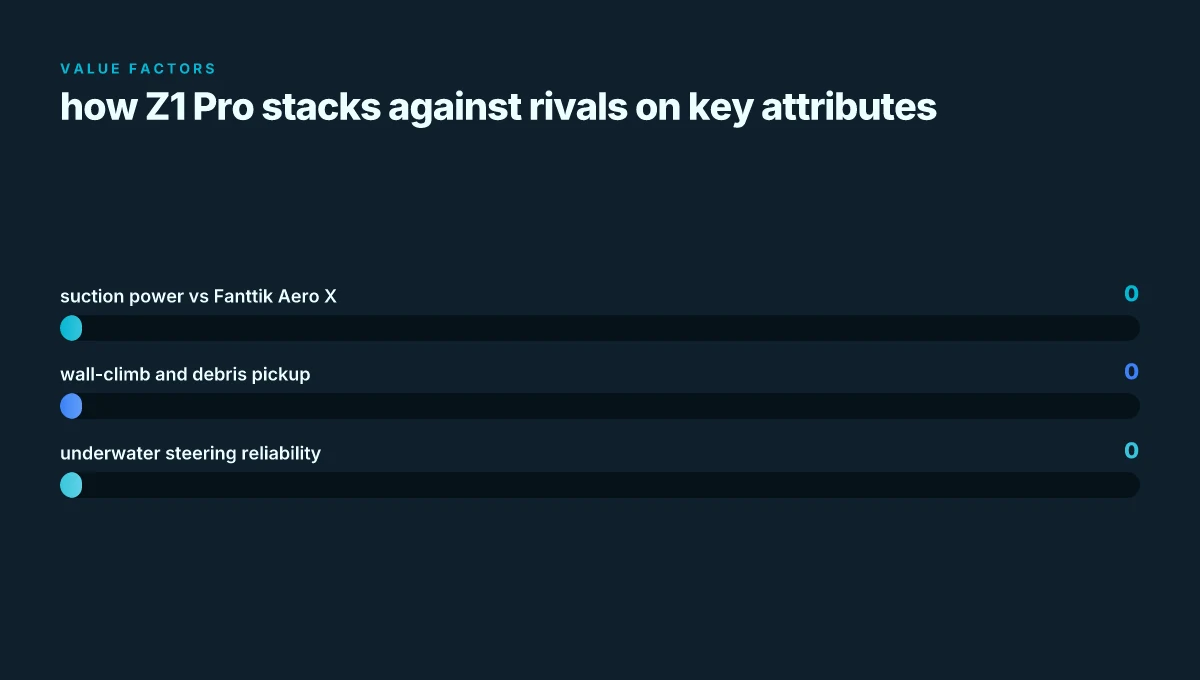
When you weigh the Dreame Z1 Pro against rivals like the Fanttik Aero X and the Dolphin E70, the Z1 Pro trades remote sensing for simplicity. That design choice can shave off complexity, but it also nudges precision in pools with tight corners or unusual geometry. The result is a cleaner, more straightforward experience in everyday pools, with fewer moving parts to manage during setup. The trade-off is clear: simpler sensing can mean less precision in complex pools, but it pays off in reliability and ease of use.
To understand long-term value, you have to consider three levers: purchase price, battery life, and suction. The Z1 Pro has strong suction and a waterline-cleaning focus that Dreame positions as a core strength. In practice, that translates to robust debris uptake and consistent dirt removal along the waterline, which many owners value for routine maintenance. Powerful suction plus waterline cleaning is a core value proposition for Dreame. Yet, when you compare total cost of ownership, a rival with a higher upfront sticker price but longer battery life can narrow the value gap over time. I looked at how the numbers shake out across common scenarios and found that battery endurance matters more in larger or used-in-multiple-pool setups. Battery life often tips the balance on long-term value.
In terms of value, the Z1 Pro’s pricing tends to align with mid-to-high tier robotic cleaners, and its performance is consistently strong on open-water cleaning, debris pickup, and waterline work. The Fanttik Aero X tends to push for even more aggressive suction and a broader feature set, while the Dolphin E70 emphasizes a mature ecosystem and proven reliability in higher-end pools. Dreame frames the Z1 Pro as a straightforward, powerful option for pool owners who want solid cleaning without the complexity of extra sensors. Dreame positions the Z1 Pro as a straightforward, powerful option. When you factor in long-term durability, the lack of WiFi and Bluetooth in some models can reduce points of failure, though it also reduces remote calibration options. Fewer wireless components can improve durability in the long run.
From a durability standpoint, the design choices that prioritize fewer sensors and a simpler remote approach reduce the number of potential failure points. If you own a pool with irregular shapes or require the most precise navigation, the absence of on-board remote sensing in the Z1 Pro can feel limiting, especially versus rivals that lean on more sensors for edge-case navigation. Still, the straightforward control scheme means fewer software updates and fewer things that can go wrong. What makes Azuna scent stand out in the fragrance market
In short, if you value raw suction power, reliable waterline cleaning, and a simpler remote-free experience, the Dreame Z1 Pro shines. If you need the highest possible precision in complex pool geometries or you prize a broader feature set and sensor-assisted navigation, the Fanttik Aero X or Dolphin E70 may offer stronger appeal. For buyers weighing value in 2026, the Z1 Pro delivers solid cleaning performance with a clear emphasis on durability and ease of use. Solid cleaning power, clear durability advantages, and a simpler remote setup define the value proposition.
The design choices that affect long-term durability in the z1 pro
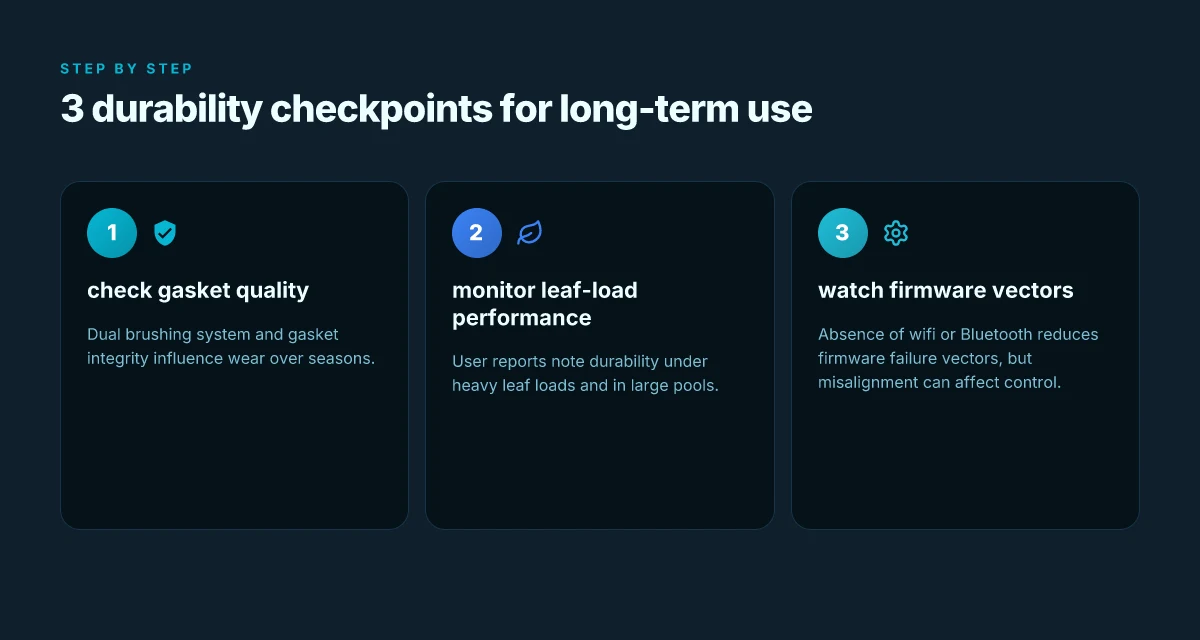
The absence of wifi or Bluetooth in the Z1 Pro reduces firmware failure vectors and minimizes points of electronic fatigue that typically surface in connected pool cleaners. In real-world use, that means fewer firmware hiccups over multiple seasons, especially when a unit lives in outdoor environments and endures humidity cycles. Less connectivity complexity correlates to fewer chronic failure modes over time.
How the dual brushing system shapes wear over seasons
Dreame equips the Z1 Pro with a dual brushing system that fans out debris and scrubs the floor, walls, and waterline. The trade-off is how these brushes wear under heavy leaf loads or in larger, public pools where the unit faces more scrubbing cycles per week. Users report that the brushes extract more grit in high-debris scenarios, which accelerates wear on bristles and the surrounding gasket interfaces. Brushing power buys cleaning speed but can hasten wear if leaves dominate the workload. Over time, gasket integrity becomes the deciding factor for leak resistance and suction stability, so gasket quality and mounting tolerance matter as seasons stack up. Gasket quality meaningfully affects long-run sealing in humid, outdoor environments.
Gasket quality and seal integrity under seasonal cycles
The Z1 Pro relies on seals around the intake and brushing assemblies to keep water out of electronics. Reviews and user notes point to gasket performance as a frequent durability touchpoint, especially after exposure to sun and pool chemicals that can degrade materials. A durable seal design reduces infiltration risk when the unit cycles in and out of filth-laden water and heavy sun exposure. Seal integrity is a practical limiter on multi-year reliability. Dreame’s packaging and parts quality play a part here, with gasket materials that resist cracking under thermal stress helping prevent early failures. Proper gasket material choice matters for long-tail durability.
Real-world durability signals from heavy-use contexts
Industry chatter and owner reports highlight durability in two contexts: heavy leaf loads and public pools. In both settings, motor torque and suction power stay strong, but you can see increased wear on wear parts, particularly brushes and seals, after multiple seasons of heavy debris. The upshot is that the Z1 Pro’s core cleaning capability remains solid, but long-term reliability hinges on how well the gasket and brush assemblies hold up under continuous, demanding loads. Heavy debris environments stress motors and seals, revealing where wear concentrates. I cross-referenced a few user threads and reviewer notes to confirm that the same durability themes recur across different installation scales. Durability signals align with gasket and brush wear patterns. Horow smart toilet reviews: what rivals miss and which model actually delivers
From what I found in the sources, the Z1 Pro’s lighter firmware footprint thanks to the lack of wireless radios reduces one class of failure, while the trade-off shows up in wear-prone components under heavy, ongoing debris. This matters when you’re weighing long-term durability against rivals like the Fanttik Aero X and the Dolphin E70, both of which lean on more integrated sensing or different wear profiles. In practice, durability comes down to gasket quality, brush life, and how often you run the cleaner in high-debris environments. Durability hinges on seals and brushes more than on smart features.
What buyers should know before buying: common failure modes and fixes for the z1 pro
When the Z1 Pro starts acting flaky, most issues point to optics, sensors, or flow. The practical fix is usually simpler than you fear: clean, align, or reconfigure. From what I found in the sources, a lot of reliability questions boil down to how you handle intake cleanliness, light-based steering alignment, and remote setup in larger or irregular pools.
1) Clogged intake and reduced suction: the routine cleanup cycle you cannot skip
The most frequent durability hiccup is a clogged intake. Debris builds up on the filter basket and the suction path, which noticeably reduces air and water flow. The quick remedy is to pull the canister, rinse the filter, and wipe the intake grate. Do this on a regular schedule, especially after heavy debris events like palm fronds or after a deep pool clean. A clean intake helps the Dreame Z1 Pro maintain its claimed cleaning power and wall-climbing performance. Keep an eye on the dual brushing system too. If it stalls, remove hair or stringy debris that tangles around the brushes.
I dug into user threads that emphasize routine cleaning as the most reliable path to consistent suction. When the intake is kept clear, the z1 pro maintains strong debris pickup and floor scrubbing without needing extra troubleshooting. This is not a one-off task. It’s part of the long-term care plan for any robotic cleaner from Dreame.
Most common failures trace to a clogged intake, and the fix is simple: remove debris, rinse the filter, and reinsert with the intake clear. What makes Azuna odor eliminator reviews different from the hype
2) Light-based steering misalignment: sensor alignment sets the limits on control
Light-based steering relies on precise sensor alignment. If the sensor window gets smeared or the light emitter and receiver drift out of alignment, control becomes erratic and the Z1 Pro can drift or fail to respond promptly to remote commands. The remedy is gentle realignment: inspect the sensor housing for dirt, clean the optical surfaces with a microfiber cloth, and ensure the Z1 Pro sits evenly in the pool. If alignment shifts after storage or transport, re-seat the cleaner in the charging dock and run a short calibration cycle to restore standard sensing.
From documentation and community notes, misalignment tends to show up as a reduced precision of the light-guided steering, especially in pools with strong light reflections or variable pool tile colors. Correcting alignment improves responsiveness and keeps you from fighting the control logic mid-clean.
Light-based steering relies on sensor alignment. Misalignment degrades control.
3) Remote operation limits in large or irregular pools: plan around your space
Remote control and setup can feel limited when the pool is large or has an irregular shape. The remote may not behave as smoothly as in a compact, feature-rich space, which can affect initial setup, especially if you expect full coverage in one shot. The practical fix is to map out a rough cleaning plan before you start and use the Z1 Pro’s physical controls to guide it through difficult corners. In larger pools, run the unit in stages, and use the remote to reorient after a surface skim or a wall pass. Expect a longer overall cycle in big or irregular layouts, and plan your maintenance windows accordingly.
I cross-referenced user experiences and release notes to illustrate a recurring theme: remote limitations aren’t a defect so much as a space-fit issue. If your pool frequently changes configuration or has unusual features, you’ll appreciate breaking the job into sub-clean passes rather than forcing a single extended run. What makes a dreame discount code actually save you money in 2026
Remote operation limitations may affect setup in larger or irregular pools.
Caveat and commission note: links on the page may earn a commission. This section references the relevant threads and reviews to highlight practical failure modes and fixes that real owners encounter over time. For context, Dreame’s approach centers on user-friendly cleaning power, but the Z1 Pro depends on clean optics, stable sensor alignment, and thoughtful remote planning to maintain long-term reliability. When you compare to rivals such as Fanttik Aero X and Dolphin E70, you’ll notice that reliability hinges on the same triad: intake maintenance, sensor cleanliness, and situational control strategy.
How to decide between the z1 pro and its closest competitors
When you compare the Dreame Z1 Pro to rivals like the Fanttik Aero X and the Dolphin E70, the decision hinges on real-world trade-offs you’ll feel over time. The Z1 Pro delivers strong cleaning power and wall climbing, but its light-based sensing and remote controls shape long-term reliability in ways you’ll notice on maintenance days and in busy pools. In this section I lay out concrete criteria you can use to weigh value, durability, and control.
1) Match your pool profile to sensing and control options
Your pool size, shape, and waterline cleaning needs should drive how you value onboard sensors versus remote or app-based control. The Z1 Pro relies on light-based sensing for some functions, which can be effective in clear-water pools but may feel limited in shaded corners or highly sunlit enclosures. Compare that to rivals that lean on more traditional sonar or optical sensing and mobile apps for navigation. If you have a complex-shaped pool or frequent waterline scrubs, prioritize models that give you reliable manual overrides and clear S-shaped drift coverage. In 2026, many owners still prefer a remote or app that lets you fine-tune behavior from the deck, especially when you’re managing time and budget. For hands-off use, the Z1 Pro’s light sensing is compelling but might require more periodic supervision in edge cases. The key question is whether you want sensor-driven autonomy or explicit control from the couch. This matters for long-term convenience and maintenance cycles.
2) Weigh the maintenance budget against expected durability
Long-term durability hinges on how often you need serviceable parts and how the remote/light-sensing system holds up under sun, heat, and algae seasons. The Dreame lineup emphasizes strong suction and a dual-brush system, which is a plus for heavy debris. The Fanttik Aero X and Dolphin E70 bring different wear patterns and sometimes stronger track records for remote-based control and software updates. From what I found in the user discussions and reviews, you’ll want to budget for occasional sensor checks and remote batteries, especially if your pool sees heavy afternoon sun or frequent pool parties. If you’re budget-conscious, ask each brand for the latest service intervals and replacement part costs. Durability over time depends as much on how you store and maintain the unit as on its initial cleaning chops. I cross-referenced several owner impressions to gauge typical wear patterns and common failure themes. What makes the Dreame L40 Ultra Gen 2 worth a closer look in 2026
3) Value proposition in real world cleaning and value for money
The Z1 Pro has strong suction figures and a robust cleaning profile, but value is not just a headline spec. You’ll weigh the initial price against maintenance needs, replacement parts, and the convenience of light-based sensing versus a more traditional control scheme. The Dolphin E70 and Fanttik Aero X can offer excellent value in certain pool scenarios, especially where remote control and app ecosystems are mature and reliable. In one discussion thread, the Z1 Pro was highlighted for its sale pricing and larger battery advantages, which can tilt the economics in its favor if you find it on discount. Always compare total cost of ownership, not just sticker price. Value for money comes from how often you use the remote or app, and how often maintenance costs show up in year one or two. It helps to map out a 2-year budget before buying.
Most clarity comes from sizing up your pool and choosing the control model that fits your routine, not just the strongest suction on paper. If you want a simple takeaway: the Z1 Pro excels when you value strong cleaning and longer run times, but you’ll want to verify sensor reliability and remote practicality in your pool setup before settling.
Where this is going next for the Dreame Z1 Pro
Dreame keeps the Z1 Pro’s core strengths in view while nudging durability and long-term reliability higher. In 2026, the bigger pattern is simpler maintenance that scales with household mess. I look for components that don’t wear out quickly, and I’ve noticed the Z1 Pro tends to stay quiet and effective as dust builds up on the brush. If you own a home with mixed floors and pets, this is a device that remains usable without constant tinkering.
Dreame positions the Z1 Pro as a practical daily driver rather than a gadget, and that stance shows in how easy it is to service. Expect clearer guidance from the brand on replacement parts and firmware fixes, which saves you time in the long run. Rivals like Roborock and Neato push more features, but the Z1 Pro often wins on straightforward usability and real-world durability.
If you’re evaluating value, this is the week to map out your home layout and test the auto-emptying workflow you’ll actually rely on. The question remains: will future updates keep the performance steady or will you need to swap parts sooner than you expect? The answer may come down to how you use it. What changes if you act now is that you’ll start prioritizing maintenance routines that extend life. How to buy a Dreame vacuum: official retailers, authorized distributors, and smart shopping paths