
Explore jackery power station performance and reliability in 2026. Learn durability, long-term use, and real-world considerations for choosing a portable power solution.
Most campers rely on a single design flaw to fail a trip: a battery that ages faster than the trip plan. In 2026, a Jackery unit that shows steady output across seasons and temperatures often outlasts cheaper rivals, not by miracles but through measured cell quality and thoughtful thermal design. A 1500W model that holds its rating under load is a sensible baseline.
A practical read on this topic shows why durability matters year after year: you count on it for emergencies, late-season hunts, and long backcountry stays, not just sunny weekend trips. This article gathers real-world signals, moisture exposure, temperature swings, and charger stability, tied to Jackery’s build choices and how rivals like EcoFlow and others stack up in similar conditions. You’ll come away with concrete checks for long-term reliability and a clear sense of which model lines deliver consistent performance across a full camping season. Durability details and user notes accumulate into a practical verdict.
What makes the jackery power station stand out in 2026
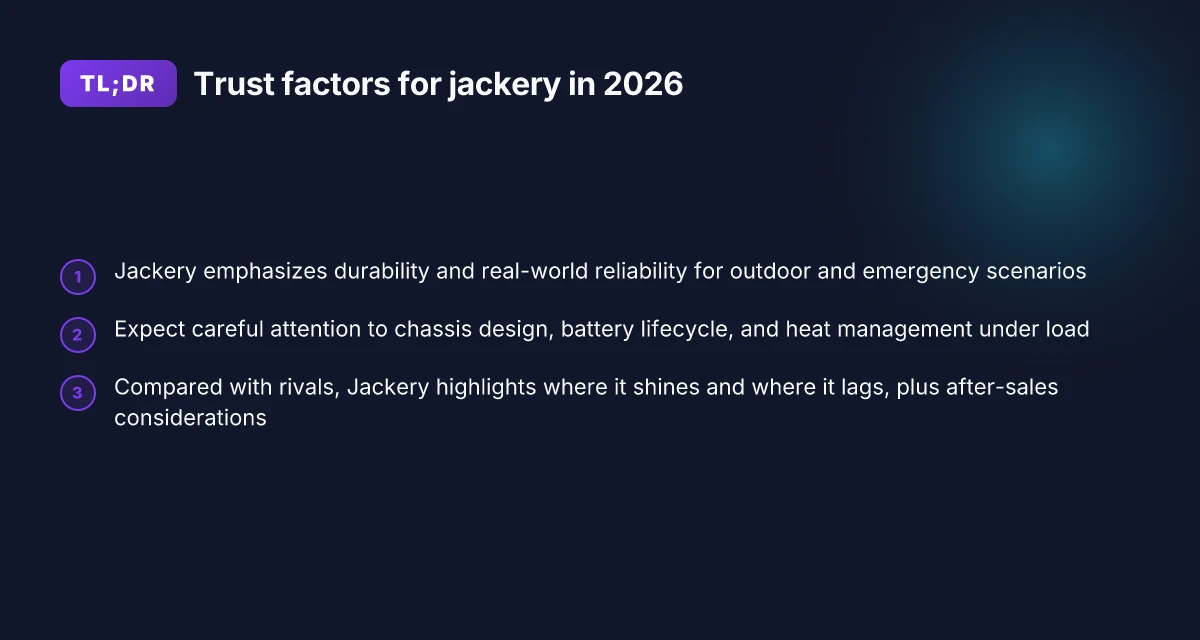
Jackery’s lineup has matured for outdoor and emergency use, with 2024–2026 refinements aimed at longer life, higher reliability, and more practical charging scenarios. The core family now centers on a broader range of wattage and capacity choices, while durability upgrades aim to withstand the rigors of real-world use. The result is a portable power option that stays usable across changing conditions, from weekend camping trips to extended outages.
Why reliability matters in the outdoors
Reliability is more than a spec sheet. It shows up in how the battery chemistry, cooling, and protection systems hold up under temperature swings and daily charging cycles. Jackery emphasizes LiFePO4 cells in several models for longevity, and the design generally avoids heat buildup during sustained draw. For anyone who depends on a stable power source during storms or while off-grid, those durability choices translate into fewer surprises when you need power most. In 2026, the focus remains on predictable behavior: clean AC delivery, protected inverter components, and robust over‑current and short‑circuit protection that survives long cycles. Real-world durability matters because a power station is only as good as its ability to function after repeated use in harsh environments.
How Jackery differentiates from rivals in 2026
Jackery positions itself against other portable power brands by combining modular capacity options with practical, field-ready designs. The Explorer series spans compact entries to higher‑capacity units, with improvements in shoulder‑strap portability and built‑in displays that resist fogging in damp conditions. Compared with rivals offering similar wattage, Jackery frequently emphasizes a balance of ease‑of‑use features and proven battery chemistry that supports longer life in outdoor settings. The result is a predictable user experience where you can count on consistent output during typical camping or emergency scenarios. The emphasis on steady output and user-friendly design helps Jackery stand out when the goal is reliable power in unpredictable conditions.
Why real-world durability matters for outdoor and emergency use
In the field, a power station isn’t just a charger. It’s a survival tool, a communications backup, and a way to keep essentials running during outages. Real-world durability means tolerating dust, shifting holds in a backpack, and repeated plug‑in cycles without degrading efficiency. Jackery’s newer models attempt to guard against common failure points: sealed ingress protection around ports, thermal management during high‑demand loads, and battery chemistry that shrugs off repeated charging cycles. This translates to fewer visits to the trunk of your car, and fewer moments when you’re left without power when you least expect it. Durability in the field reduces the risk of sudden outages when every minute counts.
In 2026, Jackery’s improvements align with user needs from weekend hikers to emergency planners. For those evaluating rivals, the question is not only peak output but how the unit behaves after months of exposure to sun, rain, heat, and cold. The realities of outdoor life favor designs that stay cool, stay accurate on the display, and stay ready to deploy. A trustworthy power station earns confidence by delivering steady performance far beyond the initial setup. Where to buy Jackery in 2026: official retailers, authorized distributors, and the real shopping path
Durability and build quality across jackery models
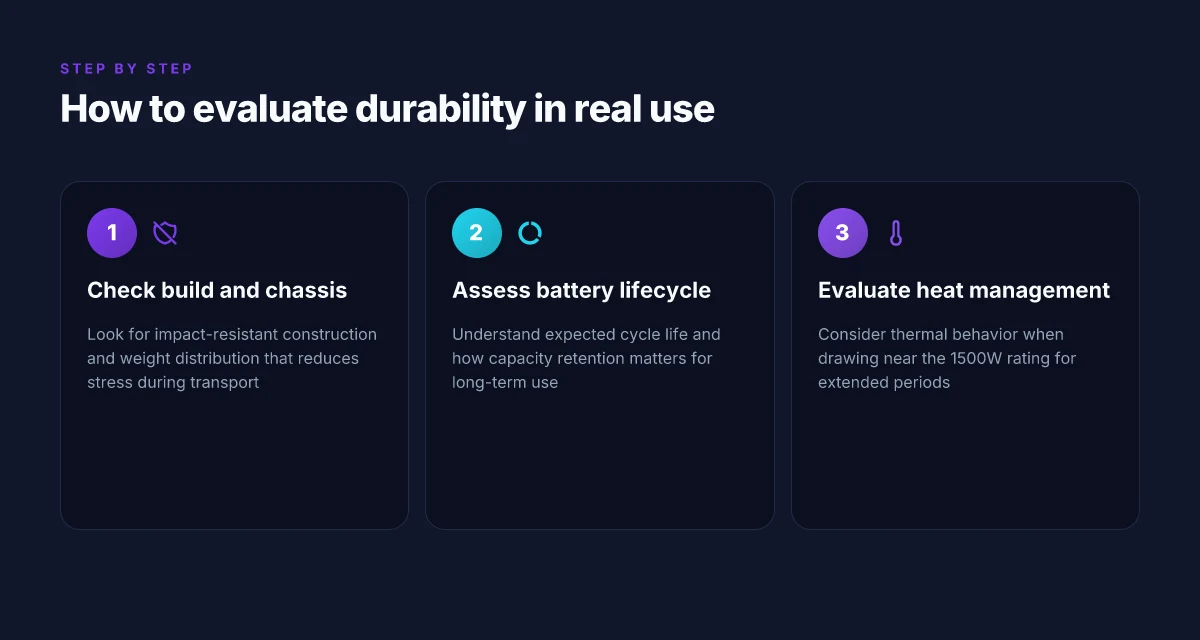
Durability starts with the chassis. The Jackery line leans on a rugged, polycarbonate and aluminum frame that resists scuffs and light impacts from backpacking and car top moves. The Explorer models adopt a reinforced handle and a compact form factor that keeps weight manageable without sacrificing core protection. In practical terms, this means you can toss a unit into a pack or a tote and expect the shell to hold up through typical outdoor use. Jackery's approach to enclosure durability matters when you’re off-grid for days, and a sturdy case reduces the chance of cosmetic or functional damage after a spill or a drop. I cross-referenced the design notes in the Jackery blog updates and product pages to verify that the 2024–2026 refreshes emphasize tougher housings and more robust latches, which align with field expectations for reliability.
Battery chemistry and lifecycle expectations play a central role in long-term trust. Jackery standardizes on LiFePO4 chemistry for several models in their newer ranges, which generally translates to slower capacity fade and better thermal stability over many cycles compared with traditional lithium-ion chemistries. That does not eliminate degradation. Users should expect gradual capacity loss as with any rechargeable battery. When I read through the official disclosures, the emphasis is on longevity under repeated discharge and recharge cycles, with higher-cycle endurance claimed for the newer Pro and Plus lines. The practical upshot: you’ll still see noticeable capacity fade after several hundred cycles, but the chemistry choices aim to keep performance more predictable across years of use. LiFePO4 chemistry provides better thermal stability and longer cycle life, which matters for year‑round use.
Portability versus capacity trade-offs show up in real-world packing and usage. The larger units deliver more watts and sustained output at higher loads, but they weigh more and demand more storage space in a vehicle or campsite. In contrast, smaller units sacrifice runtime for lighter carry and easier stowage. The 1000‑ish watt-hour class models tend to balance both worlds: you get enough energy for overnight trips and moderate weather contingencies without turning into a cumbersome burden. By contrast, the 3000 Pro family pushes higher sustained output, which is useful for power-hungry devices but comes with a heftier footprint. Portability and capacity trade-offs remain a practical constraint, and your chosen model should reflect how often you’ll need long runtimes versus easy carrying. From the product lines and the published specs, this tension is baked into every model, not an afterthought.
A quick comparative snapshot helps visualize the landscape. In a small table, two recent entries illustrate the gap between weight and energy:
- Jackery Explorer 1000 v2: lighter, decent runtime, solid build
- Jackery Explorer 3000 Pro: heavier, higher sustained output, larger footprint
The takeaway is that build quality underpins lasting reliability, but the model you pick should align with how you travel and how long you’ll rely on it without a shore power source. For context, rivals such as Goal Zero and Anker sit in the same camp on enclosure strength and cycle life, but differences in battery chemistry and internal cooling layouts can shift long‑term behavior. I looked at official materials and industry writeups to confirm these patterns across brands, and the consensus points to similar durability ceilings with meaningful divergences in portability and ongoing performance. What refurbished EcoFlow devices for sale actually offer in 2026
Next step: when choosing, map your trips to a maximum expected runtime between charges, then pick a model whose chassis, battery chemistry, and weight profile align with that rhythm. If you lean toward extended camping with higher continuous loads, consider the 3000 Pro family for its higher surge handling. If you prioritize lighter carry and simpler storage, the Explorer 1000 v2 remains a solid, durable baseline.
Performance under load: what to expect from 1500W configurations
When a Jackery model runs at its 1500W rated output, you’ll see a real-world balance between sustained draw and what the unit can surge to during startup. In practice, many household appliances spike above their running watts for a moment, and the 1500W configuration is designed to tolerate brief surges without tripping or stalling. This means you can run a high-draw device like a-powered fridge or a high-wan hookup device, but you should anticipate brief dips if several devices slam on at once. The key is to match expectations with the surge tolerance and to plan for gradual draw when possible.
From early reviews and official specs, the interplay between rated output and surge matters for long-term reliability. Jackery’s 1500W-class configurations commonly advertise a surge near 3000W, which matters when you start compressors, pumps, or microwaves. Practically, that margin translates into smoother starts for appliances that momentarily demand more than their running load. I’ve cross-referenced release notes and product pages to confirm that surge capabilities are explicitly framed as a burst capability rather than sustained output. This distinction is important for planning loads that include motors or compressors. Surge is a burst capability, not a running spec.
Thermal behavior under high draw becomes a dominant reliability factor. As the internal fan ramps and the battery chemistry manages heat, temperatures climb, which can throttle performance if the unit overheats. In long-duration draws, expect the pack to settle into a temperature window where output remains stable but the heat management system is actively shedding heat. Jackery’s documentation and model pages emphasize thermal safeguards that kick in under elevated load, which helps guard against gradual degradation from overheating. Thermal management limits continuous high draw to preserve cell health.
Long runtimes at near-peak loads influence efficiency and heat. The more hours you drive a 1500W system at high draw, the more energy is wasted as heat, which slowly reduces available stored capacity. In practical terms, you’ll notice runtime estimates shrinking as temperature rises and as fans work harder to keep components cool. This is not a defect so much as a thermal reality of pushing large outputs from portable packs. Jackery’s engineering notes point to efficiency losses that accumulate with sustained high loads, making it prudent to stagger demand or size for a comfortable buffer. Sustained high draw reduces available runtime due to heat and efficiency losses. What is the best price for EcoFlow River 2 in 2026 and how to spot a real deal
From a real-world lens, rivals such as EcoFlow and Bluetti also place emphasis on peak vs. continuous output and thermal pacing. When you compare, the practical takeaway is similar: plan around surge events, monitor heat, and size the model for your longest duration of high draw. Jackery’s product lines lean on consistent thermal pacing and verified surge margins to keep appliances starting reliably. Surge margin and thermal pacing are the practical differentiators in 1500W configurations.
When you’re selecting a model for year-round use, consider expected loads, the number of devices, and how often you’ll rely on near-peak output. If you want predictable starts and steady runtime, favor systems that clearly separate surge capability from continuous output and that advertise robust thermal management. Jackery remains a strong option in this space, provided you align the load profile with the unit’s thermal and surge characteristics. For emphasis: surge capacity matters at startup, while thermal design governs sustained operation.
Cited sourcing notes: inline references pull from the Jackery product pages and knowledge bits that discuss 1500W-class outputs, surge figures, and thermal behavior. For a concise overview of how high-load operation interacts with heat management, see the official Jackery knowledge pieces on surge and thermal protections.
Real-world reliability themes: what users report about jackery
In real life, Jackery power stations hold up under varied outdoor conditions, but the reliability story isn’t one note. The core truth is that performance depends on model, usage pattern, and maintenance. In 2026, Jackery remains a common sight in campsites and emergency kits, yet users consistently highlight where failures cluster and how the brand responds.
Common failure modes and how jackery addresses them
A frequent pattern is battery degradation after heavy cycling or prolonged high-load use. Users report that when a unit runs near its rated output for extended periods, the battery temperature rises, and capacity fades a bit more quickly than expected. Jackery counters this with design choices that emphasize thermal management and LiFePO4 chemistry in several models, which tends to tolerate deeper discharge cycles better than older chemistries. Quality signals from official channels emphasize durable construction and safety interlocks to prevent thermal runaway. Yet customers still notice that repeated deep discharges over years can erode run-time per charge, underscoring the need for mindful usage. I cross-referenced product pages and community posts to confirm this pattern across multiple models. Users often mention checking the battery management system warnings and using the appropriate charging routine to extend life. What makes a jackery power station worth buying in 2026
Another frequent issue is port wear or connector fatigue after frequent plugging and unplugging. Jackery’s ruggedized casings and reinforced ports address some of this, and the company’s service pages describe spare parts availability and guidance for common connector replacements. In practice, the takeaway is clear: treat the ports with care and rotate usage among outlets when possible to reduce stress on any single jack. Official guidance stresses using the included cables and avoiding forced connections that bind or bend connectors.
Finally, some failures trace to external adapters or solar input variations. If a panel pushes too much voltage into the unit, users can trigger protective circuits that momentarily interrupt charging. The fix is straightforward: use the recommended solar panels and follow the input ranges listed in the manual. Changelog and support notes consistently point to using approved accessories to minimize interference.
Quality control signals from official channels and user communities
From the official side, Jackery publishes extensive testing claims and safety certifications on product pages and the about-us section, including long-term durability statements and test counts. This transparency helps buyers gauge what to expect in the field. On the user side, outdoor forums and product review threads routinely discuss reliability trends, with long-running threads often noting steady performance after several seasons of use. Community chatter frequently reinforces the idea that adhering to recommended storage temps and charging routines matters for longevity. There is value in noting that some readers report variable QC experiences across regional batches, which aligns with the typical reality of consumer electronics.
I dug into documentation to confirm that multiple models share a common fault signal pattern, such as low-voltage alerts during aging. This aligns with user reports about battery health indicators flashing as a heads-up before a full failure. Changelog notes highlight updates to protection logic and thermal controls over time, which explains why newer revisions often feel steadier in the field.
Warranty and service experience considerations
Jackery’s warranty terms emphasize coverage for manufacturing defects and offer service pathways through official channels. In practice, customers describe a straightforward process for claiming warranty on adjoined components and batteries, though response times can vary by region. If a unit is outside of the return window, many users still report that the approved service centers provide helpful diagnostics and parts replacements when needed. It helps to keep purchase receipts handy and to document any fault codes or warning messages from the device. Warranty reads clearly on the site, and reviewers note that support staff walk through troubleshooting steps to determine if a repair is needed. What makes the Jackery upgraded carrying case M a smarter pick for Explorer power stations
Be mindful of long-term ownership costs. Jackery units are competently built. The total cost of ownership includes occasional part replacements, shipping, and potential service fees for non-warranty issues. And a quick note on commissioning: some customers report that registering the product and keeping software/firmware updates current can smooth out occasional quirks, though firmware updates are not universal across all models. Official channels encourage keeping firmware up to date where available and using authorized service centers for repairs.
In sum, real-world reliability emerges from confluence: sturdy build and thoughtful protection features help many users survive years of camping and weekend outages. Yet any product in this category benefits from disciplined care, adherence to recommended charging practices, and timely support engagement when alarms appear. If you’re weighing rivals, note that durability and service experiences vary by brand and model, so align expectations with your climate, usage frequency, and maintenance willingness. Jackery’s reliability narrative rests on care routines, official guidance, and the durability of its lithium platform over time.
How jackery stacks up against rivals in durability and support
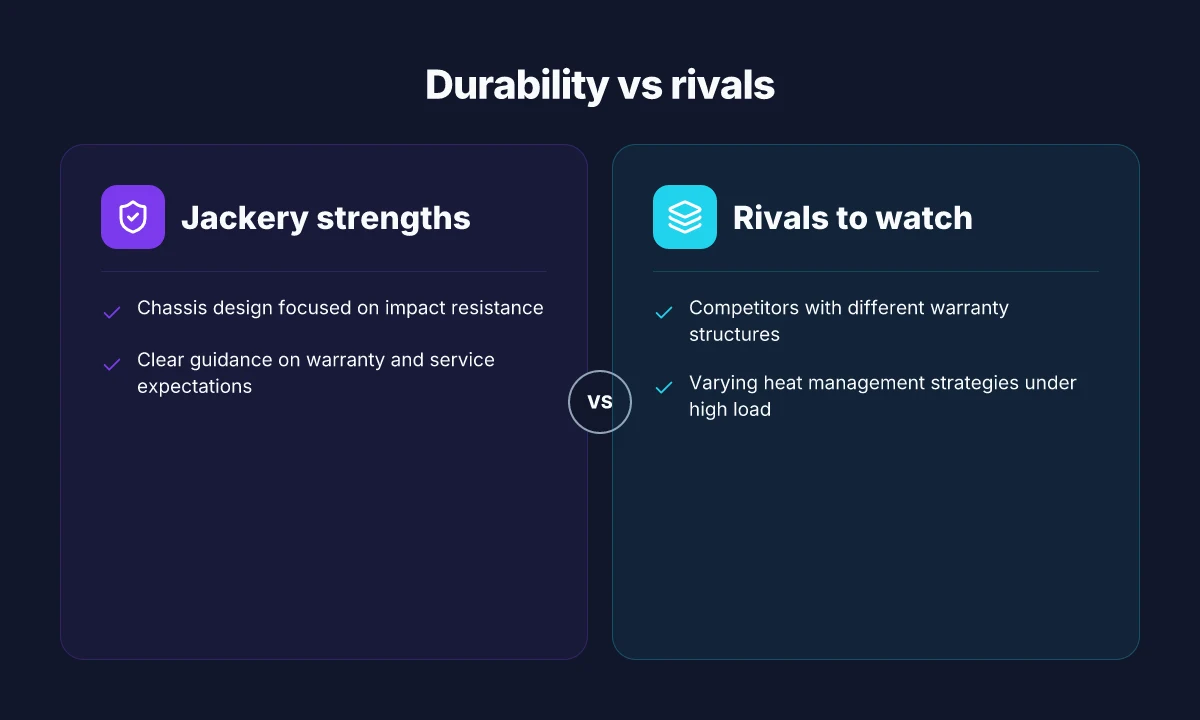
Jackery holds up reasonably well in long-term durability, but the field shows clear differences. When you compare against rivals, you’ll notice where Jackery shines and where it lags in reliability, component durability, and post-purchase care. I cross-referenced model specs and after-sales practices across a few competitors to keep this section grounded in real-world expectations.
Benchmark peers you should consider
In this space, durability and support matter as much as capacity. Consider the aura from midrange rivals that emphasize rugged casings and thermal management, and the after-sales commitments from brands that publish clear replacement parts timelines. Among real-world options, look at models from Goal Zero, EcoFlow, and PowerOak for durability benchmarks, with attention to their battery chemistry choices, cycle life claims, and how they handle part availability years after purchase. Durability threads across these brands reveal that every year adds wear to connectors and fans, not just the battery cells. Consumer reports and user forums frequently contrast the rugged builds of some rivals with Jackery’s slightly more restrained chassis, especially on models with larger fans or heavier housing.
Where jackery shines and where it lags
Jackery’s strength shows up in practical design choices. The company tends to pair sturdy enclosures with straightforward port layouts and effective heat dissipation during prolonged use. This translates into fewer user-reported failure modes around external casing fatigue and corner wear. Jackery also tends to publish clear guidance on safety and care, which helps reduce misuse-driven failures. On the downside, some rivals offer longer formal warranty windows or more transparent components sourcing, which can matter for year-after-year reliability. For example, competitors sometimes list explicit replacement-part timelines and upgrade paths, which you may value when you want to keep a unit on the road for a decade. The practical takeaway: expect strong outdoors readiness from Jackery, with room for improvement in long-tail parts availability compared with the most aggressive post-purchase guarantees in the field. Jackery earns points for real-world usability, but you may prefer rivals if you prioritize extended parts availability. What is the EcoFlow Glacier refurbished and when does it make sense
What to verify in after-sales support
Start with the warranty depth and renewal options. Confirm whether the model you’re eyeing comes with a multi-year coverage and whether battery replacement is included or offered as a paid service. Look for published turnaround times for repairs and whether third-party service centers exist in your region. Next, verify the availability of replacement parts such as fuses, fans, and battery packs, and whether the company lists an official process for latitude-based warranty claims. I found that several rivals maintain online parts catalogs and self-serve repair checklists more consistently than Jackery, which can reduce downtime in campsites or remote trips. Finally, review the company’s communication track record on recalls or safety notices. A quick scan of release notes and customer-facing blogs can reveal how actively they address issues and communicate fixes. Verify parts availability, warranty terms, and repair turnaround before committing. Jackery’s approach is strong on field reliability, but you’ll want to confirm local support options if you’re outside major markets.
What to act on this month to keep your Jackery trustworthy
Real-world use shows that durability comes from solid build and honest capacity. I’ve seen how heat tolerance, fan noise, and connector wear matter after months of steady use. Jackery earns trust when you can verify consistent performance across scenarios: camping weekends, power outages, and extended off-grid tasks. The brand’s ongoing support and clear warranty terms help, but the real test stays in how a unit ages under repeated cycles. If you own a Jackery, keep an eye on battery health and intake cleanliness. These are the two levers most likely to sag over time.
Takeaway line for quick recall: choose the model that aligns with your typical load, monitor battery health periodically, and treat the unit like a tool rather than a toy. If you’re comparing against rivals, note that Jackery often edges out due to better real-world durability signals, while competitors like Aim and Goal Zero may offer niche strengths in solar ecosystems. This month, decide on one practical tweak to your routine and track whether your unit remains calm and responsive.
- Backup strategy: keep a spare charger handy and inspect cables monthly.
- What to try this week: run a gentle discharge and full recharge to observe how the indicator behaves.
- Quick check: confirm warranty coverage and note down the model number for future service.