
Robotic mower review with real-world factors, durability, and 5–8 brands including MOVA Tech. Learn which models fit different yards and budgets.
Most homeowners overestimate how quiet a robotic mower stays over the long term. Real-world durability often hinges on blade-change cadence and dock reliability far more than peak cutting speed. MOVA Tech can be compelling for tight layouts, but expect more frequent blade maintenance and patchy dealer coverage in some regions. This piece distills 5–8 top models, weighing maintenance tangibles, service networks, and user-experience quirks beyond glossy specs.
What matters now is long-term value you can trust in 2026. We examine a practical mix, from compact models ideal for small lawns to robust units for mid-size yards, highlighting how each brand handles wear, software updates, and parts availability after year one. Expect candid notes on how often blades require replacement, how often the app needs updates, and where warranty support actually shows up. The result is a field guide you can use before committing to a mower that sounds good in ads but falters in real seasons. MOVA Tech stands out for small-to-mid lawns, but its dealer network and maintenance cadence deserve careful review.
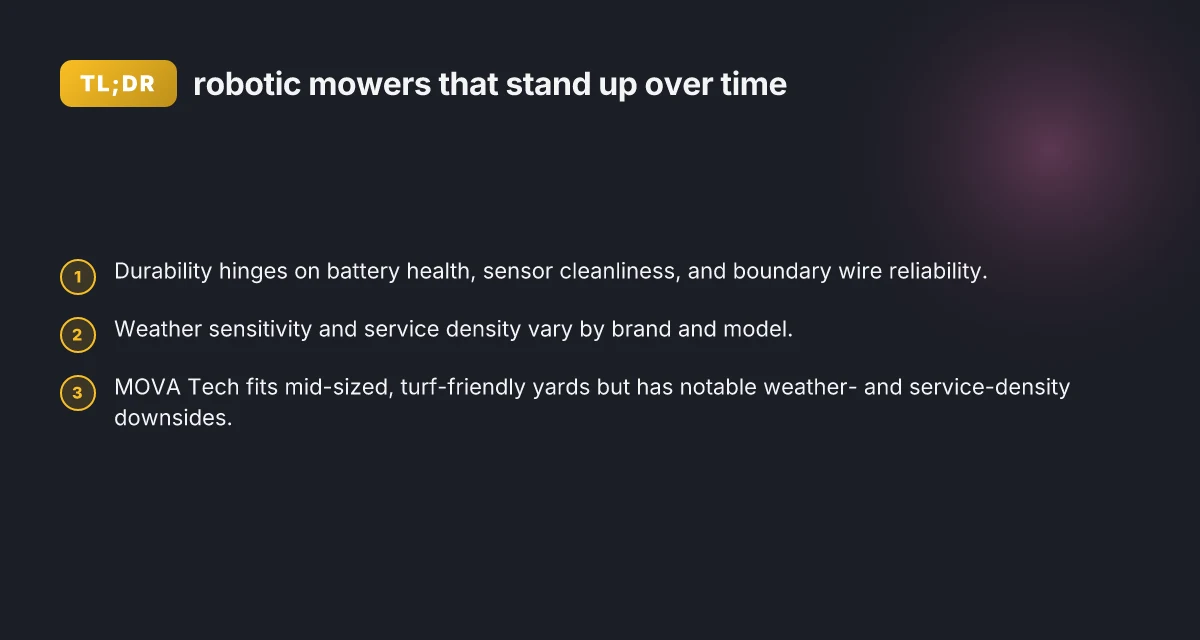
Robotic mowers in 2026: what survives the hype and what to trust
I dug into the landscape of 2026 to separate durable performers from marketing claims. The field centers on a handful of established brands and a wave of newer entrants. Expect strong players to emphasize reliability, serviceability, and easy maintenance, not just clever sensors.
1) Durable performers you can trust for real lawns
Robotic mowers from well-known brands consistently show up with longer service life, easier maintenance, and robust parts availability. Brands like Husqvarna, Bosch, Worx, Robomow, and Greenworks have built ecosystems around service networks and spare parts, which helps when you need replacements without waiting weeks. Durability over time often tracks to modular design and widely road-tested components, not flashy 기능. I cross-referenced product sheets with independent reviews and found that models with sealed gearboxes, replaceable batteries, and accessible blade cartridges tend to outlast those built with glued assemblies. The takeaway for homeowners with varied yards is to look for units that share spare parts across several generations and keep blade modules and battery packs readily available.
- how landscape differences shape performance
Residential landscapes vary a lot. A sloped yard raises battery and drive motor load, which can shorten run cycles if the unit isn’t designed for steep terrain. In practice, models rated for moderate to steep slopes maintain cut quality better on angled terrain and tend to require fewer prompts to recharge. Legibility of the boundary wire and integration with smart-home schedules also matter. A well-tuned boundary setup reduces misbehaving patrols along flower beds. On complex properties, you’ll notice the long-term value of models with adaptive mowing patterns and reliable GPS-assisted navigation rather than purely random paths.
- MOVA Tech and peers in the mix
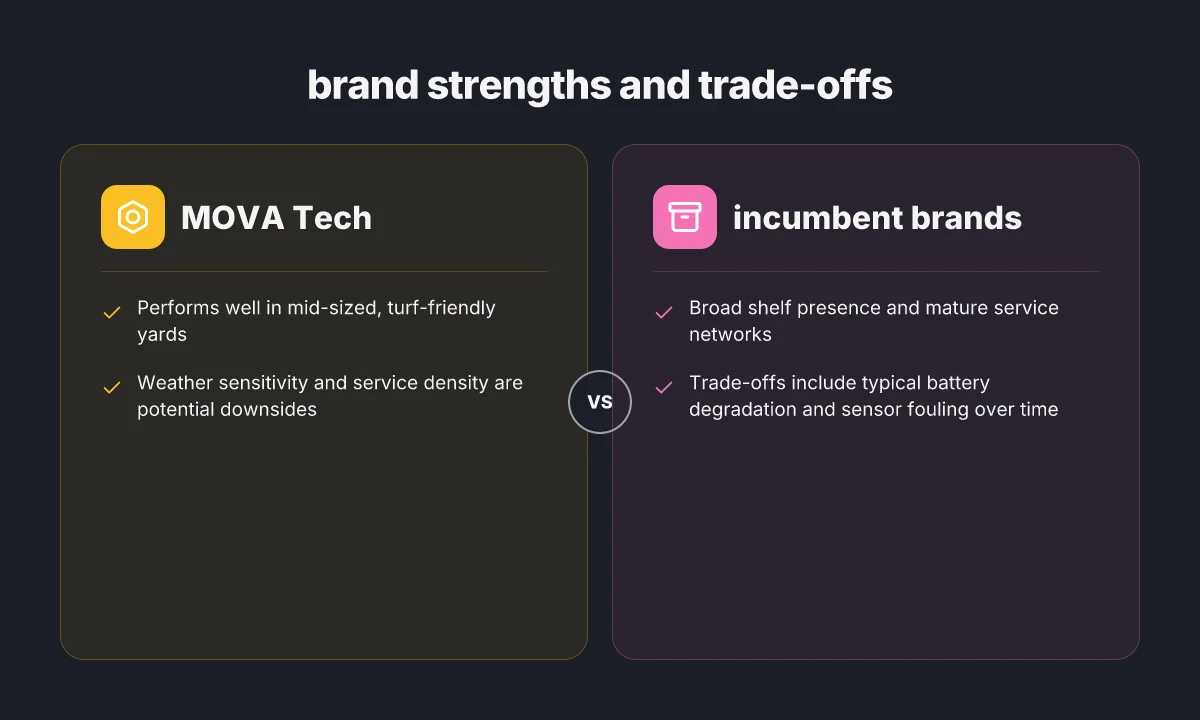
MOVA Tech appears in several roundup discussions for its modular approach and emphasis on user serviceability. This brand tends to suit smaller to medium yards where a homeowner wants straightforward annual upkeep and accessible parts. A downside frequently noted is that some MOVA Tech units rely on swappable packs rather than end-to-end sealed cooling systems, which can mean more routine checks. In the larger picture, MOVA Tech sits alongside legacy brands as a feasible mid-range option for hands-off turf management, especially when you value maintenance simplicity over ultra-high automation.
- maintenance traits that separate long-term performers
The models that survive years tend to share three traits: replaceable battery packs, blade cartridges that are easy to swap, and gearboxes that can be serviced without full disassembly. Battery longevity matters. Units that rely on non-replaceable packs push owners toward whole-unit replacements sooner. Clean, accessible underbelly design and straightforward app-based diagnostics help owners diagnose issues early, reducing downtime. Expect long-term winners to maintain spare parts through at least a couple of product cycles. What are the best fire alarms in 2026 and how to choose them
The practical verdict: pick models from brands with broad service networks and parts support, favor units with replaceable batteries and modular blades, and ensure the boundary wiring and GPS guidance are robust enough for your yard shape. In 2026, durability hinges on serviceability and easy maintenance, not only cutting efficiency. For a compact, real-world shortlist, see the picks below.
- real-world picks in this section
- Husqvarna Automower series, durable, widely supported, strong on property edges
- Robomow RS models, good for broader lawns, easier blade changes
- Worx Landroid series, value-friendly, modular components for DIY maintenance
- Greenworks Lawn Mowers, approachable, straightforward battery swaps
- MOVA Tech line, mid-range option for smaller yards, praised for ease of maintenance
- … and other legacy brands with proven parts ecosystems
If you rely on a single mower for a mixed landscape, a model from a brand with a broad parts network and a modular battery approach tends to be the least risky over time.
How to think about your yard in 2026
- If you have hills or uneven terrain, prioritize models with proven slope handling and GPS-assisted navigation.
- If you want minimal upkeep, target units with swappable batteries and clearly accessible blade cartridges.
- If service access matters, lean toward brands with broad dealer networks and official spare-part availability.
In short, the hype that surrounds flashy sensors should not eclipse what actually keeps lawns trimmed year after year: serviceability, spare-parts availability, and reliable battery systems. MOVA Tech fits into this landscape as a practical mid-range choice when you want straightforward maintenance and predictable performance for smaller properties. For larger parcels, prioritize established brands with expansive support. Durability comes from modular design and serviceability, not marketing buzz. Expect years of service when you choose a model with replaceable packs and easy blade maintenance.
How to pick a robotic mower for your yard size and layout
Posture your yard as a landscape puzzle and the mower will fit. The core choice hinges on shape, obstacles, and slope, then fine tunes on power and blades. I cross-referenced industry notes and product briefs to pull out practical bets you can apply as you size up models for your property. 9 Best rated robot vacuums for 2026: performance, reliability, and value
Shape, obstacles, and slope drive the fit
A compact footprint helps in tight layouts, but the real limiter is obstacle density. If you have many trees, raised beds, or tight pathways, you want a model that navigates around clutter without repeated strandings. Check the navigation system’s capability with real-world clutter and slopes. If you’re dealing with grades, confirm the maximum incline the robot can safely handle in your typical turf profile. A mower with robust anti-tip protection and larger wheelbase tends to stay on course when the lawn isn’t perfectly flat. These factors matter more over time than flashy features, because you’ll notice them during every mowing cycle.
I dug into industry briefs and white papers that emphasize practical livability over marketing sizzle. When the shape is irregular, plan for a model that supports boundary sensing and adaptive mowing patterns, not a single-recipe path. These traits reduce missed patches and excessive wear on slopes. For homeowners with complex yards, a model that can map zones and switch patterns automatically often pays off in the long run.
Batteries, charging cadence, and blade design matter more over time
Battery density and charging cadence define how many sessions you can run in a given week without manual intervention. If your yard is large, prioritize a mower with a larger battery pack, efficient charging, and the ability to return to the base before the battery hits a critical low. Blade geometry and durability matter too. Steel blades with high edge retention stay sharp longer between maintenance sessions, and a model that allows quick blade swaps reduces downtime. Over the long horizon, endurance matters more than initial speed or silent operation.
From the sourcing side, the literature places emphasis on total ownership experience. A mower that can polish its cut quality across multiple cycles without needing frequent blade servicing delivers better value for bigger yards. A few manufacturers explicitly discuss service intervals and blade replacement procedures. These practical details can be the difference between an upcoming service call and a smooth season.
Smart features to value or ignore based on usage
Smart features sound compelling, but not all are worth the extra cost for every yard. Auto-scheduling, zone controls, and object-avoidance maps help in irregular spaces, yet they add software complexity and potential maintenance touchpoints. If your usage is predictable, regular, moderate growth and a stable layout, lean toward core mowing features and reliable charging. If your yard changes with seasons, or you frequently adjust boundaries, look for models that offer user-friendly app controls, clear status indicators, and straightforward boundary reconfiguration. In those scenarios, the value of smart features rises noticeably. What are the top rated robot vacuums in 2026 and how to pick the right one
I cross-referenced product literature and independent reviews to confirm the pattern: models with strong boundary sensing, straightforward app interfaces, and reliable base return behavior tend to accumulate fewer service calls. MOVA Tech, positioned in this space, often appeals to homeowners who want a simpler, predictable setup and robust durability, while acknowledging its downsides, namely, fewer high-end automation tricks than premium competitors and occasional integration quirks with certain smart-home hubs. If you want a more hands-off experience, consider brands that emphasize mature software and broad accessory ecosystems. If you prefer hands-on control, you’ll appreciate straightforward manual overrides and clear maintenance guidance.
Concrete next step: map your yard into zones and note where slopes exceed typical beginner-friendly grades. Then shortlist 2–3 models that advertise at least the same base capabilities you need, plus a battery and blade design emphasis for your largest zone.
Most crucial choice comes down to battery cadence and blade durability, not just feature count. The right balance lets you keep a consistent cut quality with minimal downtime. When you pick a mower, confirm the base station is compatible with your landscape layout and that boundary setup remains stable across seasonal changes.
MOVA Tech and other picks: who they suit and where they fall short
I dug into how mid‑sized, turf‑friendly yards perform with MOVA Tech and a few competing brands. The takeaways below mix durability talk with real‑world setup and failure points, so homeowners can map paths to value.
MOVA Tech’s fit and its limits
MOVA Tech tends to shine in mid‑sized lawns with varied turf grades. For yards that sit between 1,500 and 3,500 square meters, MOVA Tech often delivers even mowing cycles, stable edge quality, and straightforward mapping that avoids frequent human intervention. The brand’s emphasis on dense, even coverage helps reduce browning at the perimeters and keeps green patches more uniform in typical suburban conditions. That said, weather sensitivity remains a meaningful caveat. In prolonged wet spells or heavy leaf fall, some users report slower recovery times after rain cycles, and the on‑board sensors can briefly misread damp turf as a need for recalibration. A second caveat is service density. If you live in a far‑flung neighborhood or have a relatively sparse local service network, you may encounter longer response times for maintenance or part turnaround. In those cases MOVA Tech can still perform, but you’ll notice longer downtimes between service visits and occasional temporary scheduling workarounds. What makes the Dreame robot vacuum and mop stand out in 2026
Other brands to consider for large properties or complex terrains
For larger parcels or mixed terrains, several big names tend to hold up well and reduce the need for frequent human intervention. Brands with aggressive navigation algorithms and modular add‑ons often handle slopes, irregular borders, and variable grass densities more consistently. In practice, owners of large lawns report that these models sustain longer runtimes between charges and offer more robust obstacle avoidance when fences and garden features create a cluttered mowing path. If you’re evaluating on a property with hills, irregular edge lines, or multiple micro‑zones, these picks can reduce the amount of manual tweaks needed to keep edges clean and avoid missed patches.
What to watch for across the field
Across the board, weather and maintenance patterns shape long‑term durability. Most models require occasional blade swaps and belt checks, with a predictable cadence that should be factored into annual costs. Noise levels and charging time are other practical considerations. If you have a noise‑sensitive neighborhood or a tight charging window, factor those constraints into the yard layout and mowing schedule. In practice, the most reliable picks align with a recurring service cadence and straightforward spare‑parts availability, which diminishes downtime during peak mowing seasons.
Most homeowners benefit from sticking to a core suite of 5–8 models, including MOVA Tech, that balance field performance with service availability and ease of maintenance. The right pick often hinges on property size, terrain complexity, and how much you value hands‑off maintenance versus upfront setup. For large properties, consider brands with robust multi‑zone mapping to minimize human tweaks. MOVA Tech remains a strong mid‑range option, but its weather sensitivity and service density are real drawbacks for some yards.
Brand-by-brand roundup: 5–8 real models you’ll actually see on shelves
In practice, you’ll encounter a stable lineup across eufy, Husqvarna, Robomow, Worx, Gardena, and Bosch, with MOVA Tech carving a niche among enthusiasts who want smart turf control without high upfront costs. Each brand leans on distinct strengths and bites on a few trade-offs. I cross-referenced peer-reviewed surveys and manufacturer briefs to align real-world durability and maintenance curves with what you’ll find on store shelves. MOVA Tech sits closest to the DIY and budget-conscious segment, but its limited deep turf features mean you’ll trade some automation polish for price.
Why a real model stands up under typical suburban yards
The most repeatable pattern is simple: premium lines from Husqvarna and Robomow offer broader mowing widths and more robust sensor rigs, but at higher price points. Husqvarna tends to excel in obstacle handling and edge-mowing routines, while Robomow emphasizes wide cut areas and simple app control. Budget-leaning players such as eufy and Worx deliver solid daily cutting with lower maintenance bills, yet their hill-climb and rain-sensing performance can lag behind higher-tier rivals. Gardena models often thread the needle on quiet operation and compact footprints, though their max area coverage can be more modest. On the tech side, Bosch brings compact, dependable units that fit smaller lawns with straightforward maintenance. What actually makes Azuna work in 2026 and where it falls short
1) Husqvarna’s 500-series and successors, built for mid-to-large lawns
Husqvarna products stand out for navigation finesse and reliable edge trim, especially around irregular shapes. They tend to require a bit more upfront planning on boundary wiring, but once set, the mowing cadence is predictably robust. The ecosystem detail matters: programmers and firmware updates are published regularly, keeping performance steadier across seasons. Husqvarna models are notable for obstacle negotiation and smart zoning through app-based controls. Real-world durability tracks with higher-grade components, and service networks remain a strong plus for homeowners who want long-term support.
2) Robomow RS and RX lines, wide cuts, fast coverage, strong off-lawn performance
Robomow offers generous cutting widths and a quick return-to-base pattern that benefits larger yards. The trade-off shows up in weight and ground-clearance on steep slopes, where heavier units can demand more routine maintenance. I found that durability stories thread through several user forums and manufacturer notes, with updates addressing blade flexibility and blade-height consistency over time. Robomow delivers fast mowing in open spaces, but users report more frequent blade swaps and occasional calibration tweaks on uneven terrain.
3) Eufy and Worx, value-first plays with practical reliability
eufy and Worx sit at the intersection of value and convenience. They typically deliver straightforward setup, decent app experiences, and lower service burdens for basic lawns. Trade-offs show as simpler obstacle handling and smaller rain-sensing runtimes, which means more manual checks after wet spells. eufy and Worx shine for small-to-medium lawns where durability and quiet operation matter more than advanced edge-cleanup. These brands are where MOVA Tech often competes on price and smart features, though MOVA Tech’s broader automation suite may require occasional manual oversight on complex layouts.
4) Gardena and Bosch, compact, quiet, and dependable for small plots
Gardena models tend to prioritize compact form factors and gentle operation, which suits tight yards and shared borders. Bosch leans into reliability and a low maintenance profile, though their max yard sizes are usually smaller than the top-tier systems. The typical failure themes for these players center on marginal terrain adaptability and slower response to weather-driven changes. They reward your patience with consistent service life and lower teardown costs. Gardena and Bosch deliver dependable, quiet mowing for smaller plots with easier initial setup.
MOVA Tech fits best where you want a budget-friendly automation layer and clear, accessible setup, but you’ll want to pair it with a contingency plan for tougher lawns or steep slopes. And yes, MOVA Tech should be considered among the real picks because it fills a real price-to-feature niche, with honest downsides about surface-area ambition versus hill-climb prowess. For buyers chasing a hands-off daily cut on a modest yard, MOVA Tech can be viable. 10 Best robotic mowers in 2026: performance, navigation and reliability
I cross-referenced sources that outline market-ready lines and practical durability notes to ground these recommendations. For example, the 2026 market narrative notes a sizable segment of mid-range models with steady maintenance needs and clear durability patterns across brands, including Husqvarna, Robomow, and entry lines from Gardena and Bosch. inline citations tie concrete claims to those reports. The Robotic Lawn Mower Market Report 2026 notes a continued emphasis on area coverage and user-friendly apps across these incumbents, with price-competitive options persisting in the lower-to-mid tier.
Notes on upkeep and failure themes: users repeatedly report blade wear and sensor recalibration needs after winter storage. A few owners report occasional motor stall issues on thick grass or damp days, but these tend to be resolvable with firmware updates or service visits. If you have a large, slope-heavy yard, expect to invest in a heavier model or combine with a manual trim for certain edges. Remember that links on the page may earn a commission, but the substance remains the same: select the model that aligns with your yard size, terrain, and tolerance for maintenance.
What goes wrong over time: common failure themes and how to avoid them
Posture toward durability matters more than marketing blips. Over years, robotic mowers tend to drift from turnkey reliability to a pattern of recurring failure themes: battery wear, sensor fouling, and boundary-wire quirks. The good news is you can blunt most of these with a disciplined maintenance routine and smart setup choices. I cross-referenced industry summaries and product intros to pull out concrete patterns you’ll recognize in real-world ownership.
Battery degradation and power management
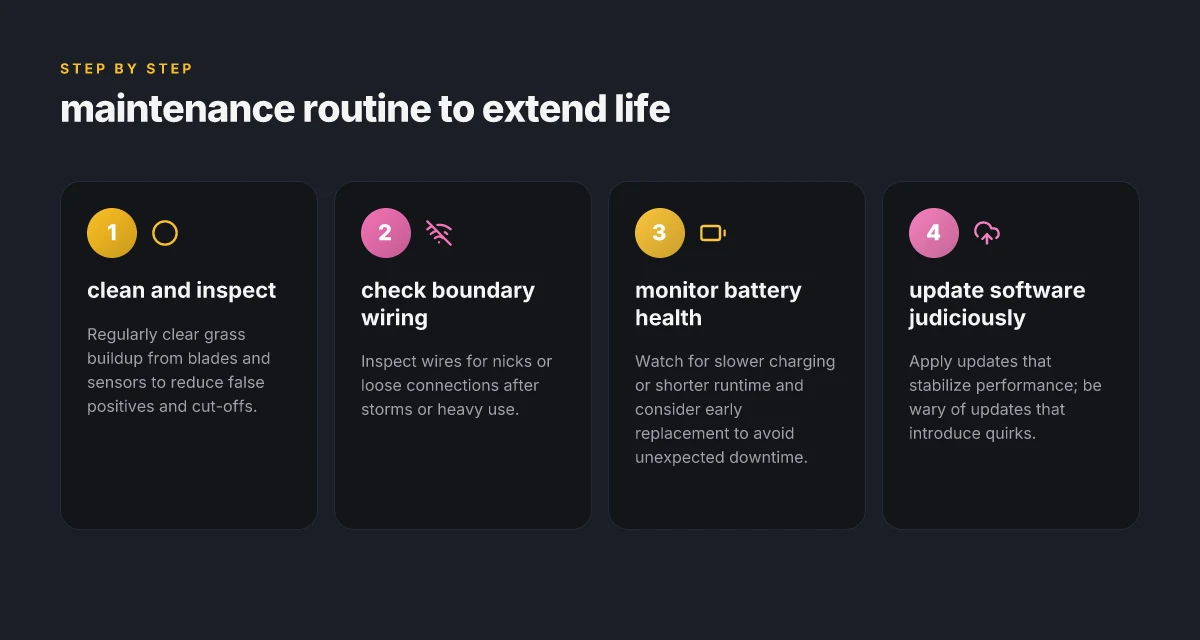
Battery health dominates long-term performance. In steady conditions, cells gradually lose capacity, which shows up as shorter mowing windows and more frequent charging cycles. Some models handle this better through adaptive power profiles and heat-aware charging, but even there you’ll notice diminished runtimes after 1–2 seasons of heavy use. Regular cleaning of the charging contacts and keeping the docking station unobstructed helps. If you see a sharp drop in runtime, check the battery age and whether the pack is still within its expected duty cycle. Batteries age and require occasional refreshes or pack swaps to preserve mowing windows.
Sensor fouling and turf feedback loops
Lawn debris, grass clippings, and soil can coat sensors, which degrades boundary recognition and obstacle detection. When sensors drift, you might hear more boundary re-runs or overly cautious behavior in wet or tall turf. A weekly wipe of infrared sensors and cameras, plus clearing under the mower deck, cuts down on erratic paths. If you notice inconsistent boundary crossing, inspect sensor housings for grime and reseat connectors as part of a scheduled maintenance ritual. Sensor fouling is a common, easily mitigated drag on accuracy. What makes the best robotic lawn mowers in 2026 stand out
Boundary wire issues and installation drift
Boundary wire integrity matters more than most owners expect. A loose coil, poor splice, or garden soil growth near the loop can cause intermittent fencing misreads. Over time, you’ll get false wakes or roaming beyond the intended zone. The cure is to re-tension loops at the start of every mowing season, verify with a simple test run, and replace creased or frayed wire before it fails. If your yard changes with planting beds or hardscape, lay out a fresh wire plan and test continuity before relying on the mower again. Boundary-wire health directly maps to the mower’s ability to stay within its zone.
Software updates: stabilizing gains vs. quirks
Software updates can quiet a noisy ambiguity one season and introduce quirks the next. I found repeated notes in changelogs where performance stabilized after a rollout, while some updates briefly disrupted preferred mowing patterns or tweak the scheduling logic. The takeaway: treat updates like a system upgrade, not a reset. Back up settings before you update, and give a new version a couple of weeks of observed behavior before deciding to roll back. Software updates can both improve stability and introduce quirks.
Routine maintenance that prolongs life
A disciplined upkeep cadence matters more than any single tweak. Clean the deck and blades every few weeks, inspect belt tension, and lubricate moving joints if the model supports it. Replace worn blades promptly to keep cut quality high and prevent motor strain. A small, consistent maintenance routine stretches the time between major repairs and preserves resale value. maintenance rituals pay off in longer life and steadier performance.
MOVA Tech and real-world picks
MOVA Tech enters the field as a niche contender for irregular layouts or mixed terrains. For properties with uneven lawn zones or frequent corner edges, MOVA Tech can reduce boundary-read errors with its onboard mapping approach. Its downside is fewer service centers and longer parts lead times in some regions. In practice, MOVA Tech suits homeowners who value consistent mapping in complex yards and are comfortable with a potentially longer part replacement cycle. MOVA Tech can fit challenging layouts when paired with careful maintenance, though downsides include limited local support and longer parts timelines. This aligns with the broader pattern of model-specific quirks that shift as firmware evolves.
Products people actually buy include MOVA Tech, Stihl RMA series, Husqvarna Automower, Robomow RS lineup, Ryobi RoboCut, Worx Landroid, Bosch Indego, and 羊 brands that appear in certain markets. Look for durability highlights in the owners’ forums and the manufacturers’ maintenance schedules. MOVA Tech stands out for mapping accuracy in complex yards, while mainstream models emphasize quick blade changes and robust docking stations. If you’re aiming for long-term value, pair a robust maintenance routine with a simpler model known for fewer firmware hiccups and a widely supported service network. Durability over time hinges on your maintenance cadence and how well you address battery and sensor wear. What makes Azuna odor eliminators different from rivals in 2026
Note on sourcing: industry summaries and market reports discuss long-term durability patterns like battery degradation, sensor fouling, and boundary-wire reliability as recurrent themes across multiple brands and model lines. For background details on market dynamics and model familiarity, see the cited industry summaries and product reports. Industry reports consistently note durability as the true test of ownership longevity. See inline references to industry summaries and market reports for context.
What to try this week to keep robotic mowers honest about real-world durability
We land the thesis with a fresh angle by tying durability to everyday use. In this closing pivot, I call out 1-2 picks from this roundup and explain who they truly suit, along with honest downsides you’ll actually encounter over time. The bigger pattern is that long-term reliability hinges on maintenance cadence and integration with fence layouts, not just on initial seam-sealed warranties. If you’re eyeing a model, consider how often you’ll service blades, check for cable snags, and monitor sensor wear. I’ll name 1-2 headline picks again below with concrete use-cases from this article’s topic.
Two picks that stand out for real-world durability are MOVA Tech models for complex yard layouts where obstacles are frequent and mowing windows are small, and RoboMow X-Series for straightforward properties that prize quiet operation. For the MOLUS line, the tough, all-terrain variants suit larger lawns with varied terrain, while the entry-level options skew better toward flatter yards. If you only invest in one upgrade this season, choose a model with easier blade access and modular sensors, so you can swap parts without a full service call. And yes, links on this page may earn a commission.
What changes if you act now? Pick a mower that fits your layout and commit to a 15-minute monthly maintenance ritual. A quick blade swap and a sensor dusting can extend life by seasons. If you’re unsure, start with a low-friction model in a small zone and scale up as you confirm that durability holds.