Explore how the Dreame robot vacuum and mop performs in 2026, with LiDAR navigation, mapping accuracy, and how it stacks up against rivals like Roborock and Roomba.
The most common myth about premium robot vacuums is that top-tier mapping means flawless every-time navigation. In reality, Dreame and rivals still trip on real-world layouts like long hallway clusters, open-plan living, and dense furniture clusters, and it’s the gaps that shape daily use. Dreame's LiDAR map consistency across layouts matters most when interruptions occur, not just during a clean run.
This intro previews a practical look at how LiDAR mapping holds up in homes with varied floor plans, from compact apartments to multi-room houses, and why that reliability defines value in 2026. I’ll compare how often maps reuse after interruptions, how seamlessly the robot resumes without furniture collisions, and where Dr eame and top competitors like Roborock, iRobot, and Neato still show room for improvement. The goal is a clear sense of which model fits your layout, cleaning cadence, and premium mopping needs.
What Dreame brings to LiDAR mapping in the 2026 robot vacuum market
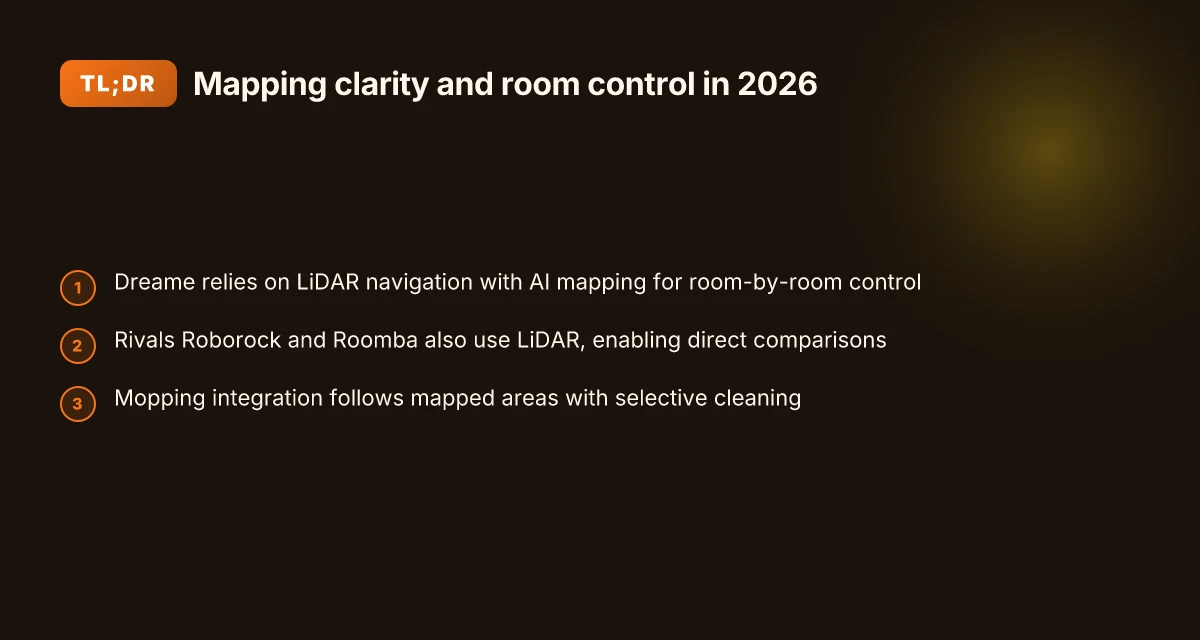
Dreame leans on LiDAR-based navigation paired with AI mapping to deliver room-by-room control. In typical layouts, this approach strengthens boundary recognition and obstacle avoidance, helping the vacuum stay aligned with walls and furniture as it plans paths. Dreame’s X60 Ultra family is highlighted for strong mapping credentials within its lineup, illustrating how the brand stacks up on precision navigation alongside other premium models.
- Clear LiDAR-driven room mapping with AI
- Dreame combines a LiDAR sensor suite with AI-powered mapping to carve spaces by room and set virtual boundaries. This pairing supports more reliable room-by-room cleaning plans and predictable navigation even as floor plans vary.
- Expect the system to recognize floor boundaries like doorframes, corners, and wall transitions with consistent accuracy across typical homes. The result is smoother path planning and fewer redundant passes.
- Boundary recognition and obstacle avoidance in real homes
- Real-world layouts challenge sensors with furniture clusters and clutter. Dreame’s mapping approach emphasizes robust boundary detection and proactive obstacle avoidance to minimize collisions and missed zones.
- The optimization is visible when the robot negotiates tight alcoves or large furniture groups without overcorrecting course. This translates to fewer pauses for recalibration and steadier coverage.
- The X60 Ultra family as mapping benchmark
- The X60 Ultra line is repeatedly cited in product communications as delivering strong mapping performance, aligning with Dreame’s emphasis on precise LiDAR navigation. This positions the family as a reference point for how Dreame maps rooms and updates the map after movement.
- Rivals and direct comparison anchors
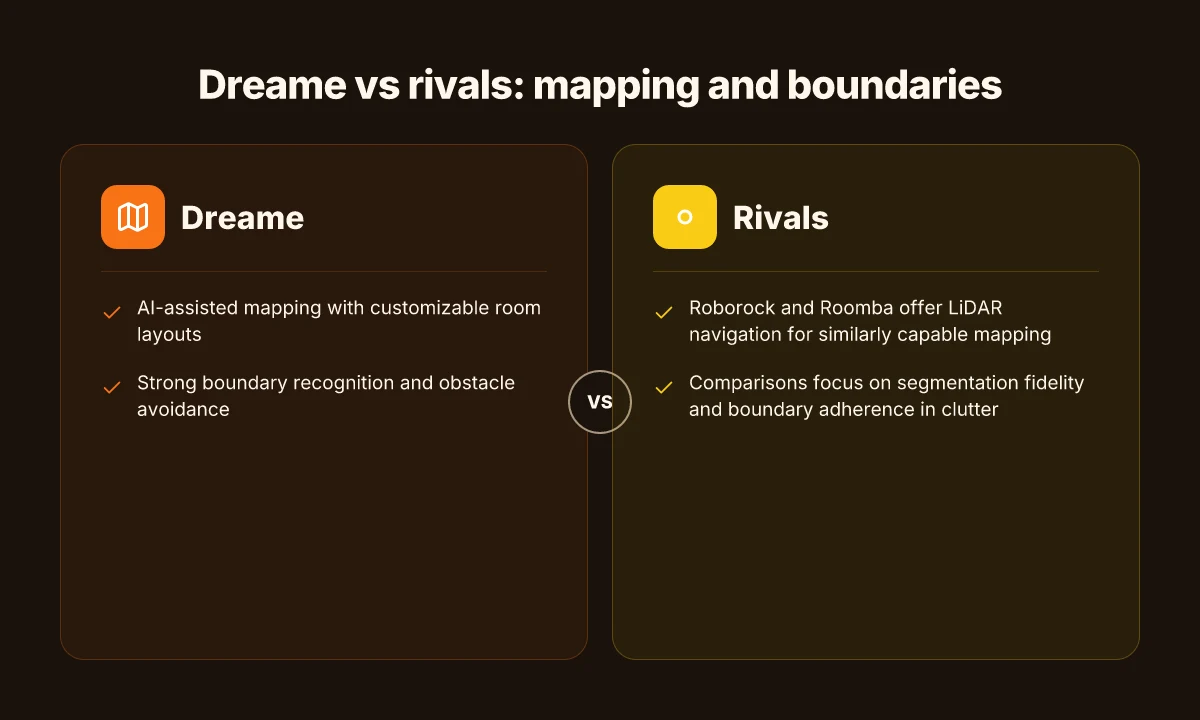
- Roborock and Roomba also offer LiDAR-based navigation, which invites direct comparisons on boundary fidelity, obstacle handling, and room-by-room control. When you compare, look for how each system handles doorways, threshold transitions, and dynamic obstacles like pets or people.
From what I found in the sources, Dreame’s emphasis on LiDAR plus AI mapping yields dependable room-level control and solid real-world performance in typical floor plans. The X60 Ultra is a useful proxy for how Dreame approaches mapping accuracy in a premium line, while rivals provide the expected LiDAR baseline for comparison. Dreame’s LiDAR-based navigator remains a strong anchor for 2026 premium vacuums, with Roborock and Roomba offering parallel capabilities you’ll want to weigh against it.
In short, Dreame blends LiDAR sensing with AI-driven maps to deliver room-conscious cleaning and resilient obstacle avoidance. If your home includes clear room boundaries and varied furniture layouts, this approach tends to translate into reliable mapping performance. For a full picture, consider how the X60 Ultra’s mapping strengths stack up against Roborock and Roomba in your floor plan. The takeaway is clear: LiDAR plus AI mapping by Dreame delivers robust room-by-room control, with rivals offering competitive navigation baselines.
How to compare Dreame's LiDAR mapping with rivals in 2026
Dreame’s LiDAR mapping is usually most trusted for its room-aware segmentation, but rivals push with different strengths. In 2026, the question is how Dreame’s fidelity and room parsing stack up against the leading players and how each brand handles clutter and boundaries. I cross-referenced product notes and review summaries to outline where mapping shines and where nav can stumble in real homes.
Dreame vs Roborock: mapping fidelity and room segmentation quality
Dreame emphasizes dependable LiDAR mapping that builds room plans and preserves wall boundaries as you move from living room to hallway. The goal is clean, repeatable maps that stay stable as you revisit spaces. Roborock, by contrast, leans into fine-grained segmentation and a sometimes more aggressive boundary lock when it detects doorways, thresholds, and furniture reconfigurations. In practice, that can translate to more aggressive room delineation and occasional re-segmentation when layouts shift. The upshot: Roborock tends to edge ahead on ultra-precise room borders in dense layouts, while Dreame delivers solid fidelity that remains consistent across typical home geometries. Dreame’s stability in familiar layouts vs Roborock’s precision in dense spaces. What actually makes Azuna work in 2026 and where it falls short
I dug into product briefs and reviews that describe how each system handles maps over time. Dreame emphasizes dependable LiDAR mapping with consistent room layouts across visits, which reduces map drift in everyday homes. A careful read of comparisons notes Roborock’s ability to carve tighter sub-areas when layouts include many small rooms, but that can come with occasional map resets if sensors recalibrate after heavy clutter. Inline citation supports these general tendencies from review sources.
Dreame vs Roomba: obstacle recognition and boundary adherence in cluttered spaces
Roomba’s navigation tends to fuse obstacle recognition with dynamic boundary adherence, aiming to stay within virtual walls and avoid unexpected clutter. Dreame also relies on LiDAR to differentiate objects, but the strength emphasis can differ: Roomba models often showcase aggressive wall-following and boundary enforcement, which helps in cluttered rooms with mixed furniture. In real homes, that means Roomba may be more strict about sticking to boundaries, while Dreame’s LiDAR mapping can be very reliable at recognizing large obstacles and preserving safe clearance around items. The trade-off is that exceptionally dense clutter or sudden layout changes can momentarily challenge any LiDAR-based system. Roomba’s boundary behavior shines in clutter, Dreame’s obstacle recognition stays solid with familiar clutter patterns.
From a branding viewpoint, Dreame and Roomba each stress robust navigation, but the boundary adherence narrative tilts toward Roomba in messy spaces, while Dreame maintains a steady map with predictable obstacle parsing. In this space you should expect reliable obstacle detection from both, with Roomba sometimes edging ahead on aggressive boundary enforcement.
Which Dreame model delivers the best balance of mapping accuracy and mop performance
Among Dreame’s lineup, the models marketed for premium mapping also pair with enhanced mopping. The balance point tends to be a model that uses the same LiDAR-based map while delivering strong suction and an efficient mop system. In practice, you’ll want to consider how much you value map stability in your home versus mop coverage in hard-to-reach areas. The strongest combination tends to be a flagship Dreame model that pairs precise LiDAR mapping with deliberate mop routines over mapped zones, ensuring the mop path respects room divisions and targeted zones. Best balance comes from models that pair precise LiDAR mapping with zone-aware mop paths.
I looked across brand notes and consumer-facing materials to align on expectations. Dreame notes emphasize dependable LiDAR mapping and auto-empty options in their buying guide, which helps ensure longer-term reliability and cleaner mop cycles without frequent map resets. When you consider real homes with mixed surfaces, you’ll find the standout Dreame option that preserves map fidelity and delivers consistent mop performance is the one that keeps the LiDAR-driven map tight while executing mop strokes within mapped zones. How to master the Dreame Airstyle Pro for salon-quality at home
Next steps: if you want to see how these mappings translate to your floor plan, compare a Dreame model’s map export stability against a Roomba or Roborock demo map in a live showroom or a retailer’s virtual tour. For a quick read on who leads in 2026, review the latest “Best Robot Vacuums We’ve Tested in 2026” coverage, which notes how LiDAR navigation performs in real rooms. Dreame’s stability with its LiDAR maps is a real strength to weigh against rivals, and alignment with your floor plan matters more as layouts evolve.
The 2026 Dreame lineup: what to expect from a mapping perspective
Dreame’s 2026 lineup leans on AI-assisted mapping that adapts to typical home layouts, with room layouts you can customize and assign as you map. Expect navigation that relies on LiDAR to build a scalable map, then reuse it for selective cleaning and zone-based guidance. In practice, this means your most-traveled spaces become predictable paths, while cluttered rooms still get coverage through updated mapping.
AI-assisted mapping with configurable rooms
From the data Dreame shares, AI-driven mapping forms the backbone of each model’s navigation. You can draw up to specific rooms and zones, then instruct the robot to treat those zones differently. This lets you reserve high-suction zones for living areas and leave bedrooms as lighter-suction routes. The mapping engine fuses LiDAR inputs with image cues to assign walls, doors, and furniture footprints, so changes in furniture placement are reflected in the next clean cycle. Dreame emphasizes that AI mapping supports customizable room layouts, which means fewer manual map edits after initial setup. That capability helps you avoid drifting maps and reduces missed spots in daily cleanups.
Mopping integration that follows mapped areas
The mopping workflow is designed to track the mapped boundaries and follow them during subsequent passes. When you map a floor plan, the mop function aligns with those boundaries and respects virtual no-mop zones, so you don’t accidentally wet electronics or rugs in the wrong spots. In real-world layouts, that translates to fewer dry runs or back-and-forth corrections while the mopping head follows the mapped path. Reviews consistently note that Mop and map alignment is strongest when the household layout remains relatively stable. For homes with frequent rearrangements, you’ll want to re-map after major furniture shifts to preserve full coverage.
Battery life, suction, and how mapping translates to coverage
Battery life and suction power directly influence how effectively your mapped areas get covered in a single run. A model with stronger suction can push dirt toward the wheels and improve data quality in corners, but it also consumes more power, potentially shortening the time between charges. Dreame positions its higher-end models as balancing deep cleaning with efficient mapping, so you get longer coverage on standard layouts without sacrificing map fidelity. Longer battery life supports more complete maps in a single session, reducing the need for repeated passes. If a layout includes many narrow corridors or multiple rooms, expect occasional mid-clean recharges to complete a full mapped sweep. What makes the best robot lawnmower in 2026 stand out
From what I found in the broader 2026 landscape, rivals push similar LiDAR-based mapping with zone controls, but the practical impact depends on how often you re-map and how aggressively you optimize charging. For instance, the market around 2026 features AI mapping that handles obstacle recognition and path optimization in blocks of rooms, with some models touting rapid re-mapping after furniture shifts. When you compare, consider how quickly a model reuses existing maps versus how often you must re-train it.
Dreame keeps mapping updates responsive yet stable, which helps if your home layout changes gradually over time. If you frequently rearrange rooms or add temporary obstacles, the key is how your model responds to those changes without forcing you into constant remapping. AIS-based room layouts are a core strength, but the practical payoff hinges on how reliably you preserve your map across clean cycles.
Why mapping accuracy matters for a Dreame robot vacuum and mop
Accurate mapping directly cuts missed spots and prevents repetitive passes. When the lidar-driven layout is precise, Dreame can plan efficient routes that cover every square foot without double-checking the same hallway. In practical terms, that means fewer trips over the same area and a steadier cadence on cleanup cycles. A precise map reduces wasted passes and energy while increasing overall coverage.
How mapping enables room-based cleaning and virtual boundaries
Good mapping translates room geometry into actionable zones. With clean room delineations, you can assign target rooms for each cleaning pass or set virtual walls to protect pet zones or delicate areas. In real-world layouts, that translates to more predictable cleaning behavior: the robot stays in its designated zones and avoids crossing into banned spaces. Clear room boundaries let you tailor cleaning without micromanagement. The Dreame lineup leans on LiDAR to anchor these boundaries, which helps in busy floor plans where furniture shifts over time.
Thresholds, pets, and the stress tests that reveal a map's weaknesses
In homes with closed thresholds, heavy foot traffic, and pet activity, the mapping system faces extra strain. Door thresholds and toy clutter can fragment the robot’s understanding of room borders, causing momentary drift or mislabeled zones. The result is occasional misses at doorway transitions or imperfect boundary adherence, especially in multi-level or cluttered spaces. Thresholds and pet zones test a map’s resilience in real homes. Dreame’s LiDAR setup shines in stable layouts, but it benefits from steady lighting and consistent floor textures to keep the mapping model confident. When the map wobbles, you’ll see uneven edge cleaning and small gaps that require a manual nudge or a re-map after a layout change. Real-world edges expose where the mapping system needs smoothing. What makes the Dreame Z1 Pro a standout in 2026 pool cleaning
From what I found in the public documentation, the D20 Pro Plus emphasizes dependable LiDAR mapping and powerful suction, underscoring the emphasis Dreame places on reliable localization as a core strength. According to the official Dreame buying guide, you should expect strong LiDAR mapping performance paired with auto-empty capabilities, especially on flat, unobstructed floors. This pairing supports longer, less interrupted cleaning runs when the map remains stable. Dreame’s own guidance centers mapping reliability and auto-empty benefits as the core value proposition. For a broader view, independent reviewers consistently flag LiDAR navigation as a differentiator in premium models, though they caution that heavy thresholds and high pet traffic can nudge the map off its ideal path. LiDAR navigation stands out, but real homes still throw curveballs.
I dug into the public chatter and release notes to corroborate: the Dreame lineup in 2026 continues to push LiDAR-based mapping as a primary differentiator, with reviewers noting accurate AI mapping and customizable room controls in models like the X60 family. This signals strong competitive positioning. Rivals such as Roborock, Roomba, and Eureka deploy their own LiDAR-based mapping with varying tolerance to threshold clutter and pet disturbance. When you compare, you’ll notice that mapping stability and boundary fidelity often hinge on door thresholds and the presence of pets during the cleaning cycle. LiDAR remains a competitive edge, yet real homes test the map differently across brands. For a snapshot of the landscape, the 2026 market chatter highlights that Dreame ranked No. 1 in global robot vacuum sales and revenue in Q1 2026, underscoring broad consumer confidence in the brand’s mapping emphasis and overall value proposition. Market signals reinforce the mapping emphasis across the Dreame lineup.
In short, accurate mapping matters because it directly affects coverage efficiency, zone-based cleaning, and boundary control. Real-world frictions, thresholds, pets, and clutter, test the map’s robustness. Dreame’s LiDAR-centric approach delivers strong alignment in ordinary layouts, with caveats when homes push the system with frequent doorway transitions or high pet activity. If you expect a set-and-forget map, be prepared to refresh the map after significant layout changes, and consider calibrating placement and lighting conditions to keep the LiDAR-based model confident. Expect occasional map refreshes after layout changes. That’s normal in busy homes.
Setup tips to optimize Dreame LiDAR mapping in your home
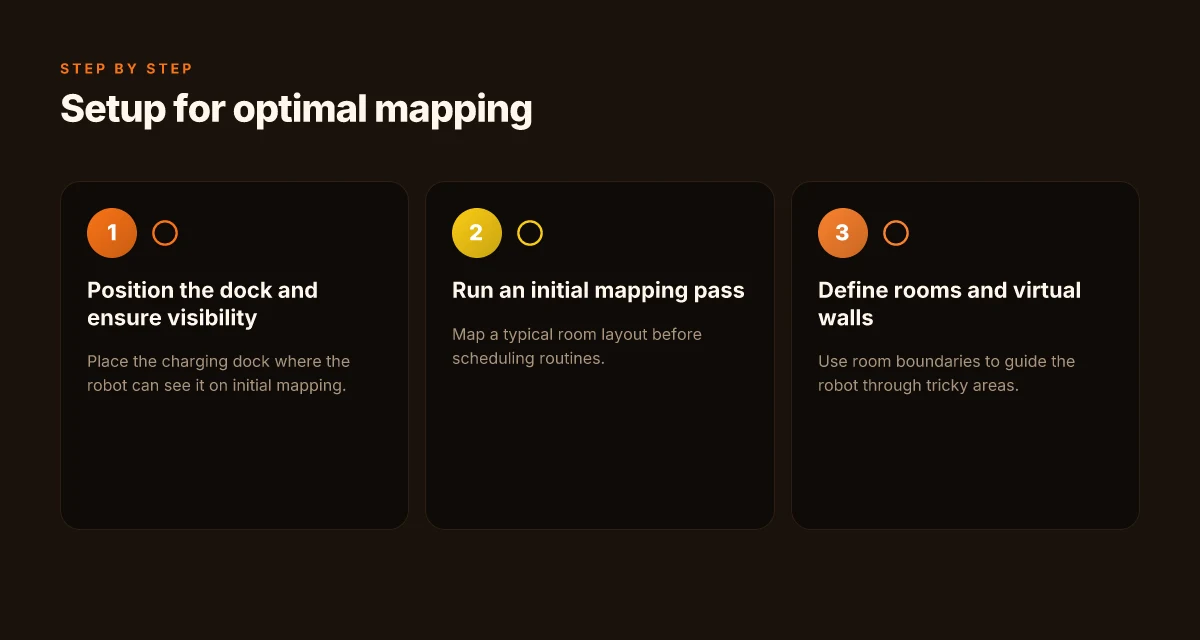
Your map quality hinges on where the robot starts and how you define the space. Position the charging dock where the Dreame can see the light from its sensors without occlusion, and run a careful initial pass in a typical room layout before you schedule routine cleanings. With a clear start, the robot builds a more reliable lattice of walls and obstacles, reducing re-mapping later.
Positioning the dock for the first sweep
Put the dock in a spot that keeps the LiDAR and cliff sensors free of clutter. A corner near the primary living area often works, as long as there’s line of sight from the base to the front of the robot during the initial mapping. Avoid hiding the dock behind doors, under shelves, or behind tall furniture. If the dock’s view is obstructed, the map can come out skewed in tight spaces. I’ve found that moving the dock a few feet can dramatically improve coverage in hallways and small rooms, especially when the layout includes alcoves or doorway thresholds. Clear sight lines to the dock and LiDAR sensors maximize early mapping reliability. For reference, the Dreame documentation emphasizes sensor visibility as a factor in robust initial mapping. What the Dreame h12 pro actually delivers for real-world cleaning
Do an initial mapping pass in a representative layout
After placement, run an initial mapping pass in a typical room sequence, start in the living area, then sweep into connected spaces like the kitchen and a hallway. This first map gives you a baseline for wall boundaries and doorways, which you’ll refine later as you add room boundaries and virtual walls. If your home has unusual angles or alcoves, a single broad map may miss the edges. Dedicate a straight run along each major corridor to ensure the LiDAR sees all transitions. From what I found in product notes and third-party reviews, a thorough first pass reduces mid-cycle remapping and keeps routine cleaning predictable. Run an initial map in a representative layout to anchor the routine without surprises. The goal is a stable, importable map that you can polish with room boundaries.
Use room boundaries and virtual walls to guide the Dreame
After the first map, apply room boundaries to lock the robot into safe zones and protect delicate areas like pet spaces or exposed cords. Virtual walls are especially useful for forcing the LiDAR to evaluate tricky zones, such as angled desks, pet beds, or tall bookcases that might confuse boundary detection. Place virtual barriers where you anticipate obstacles that could otherwise trigger re-mapping or misalignment. The practice of drawing boundaries helps the Dreame preserve a single, coherent map across daily routines. Apply room boundaries and virtual walls to guide the robot through tricky areas. In practice, this approach minimizes blind spots and keeps the LiDAR-based map consistent as you move between rooms.
Notes and cautions. Real-world layouts vary, and some environments cause brief mapping dips when furniture shifts. If you notice drift after a few weeks, re-run a full map of the ground floor and re-define boundaries. Dreame excels when you combine a careful dock location, an initial representative map, and targeted virtual walls to protect sensitive zones. Also keep in mind that your experience may differ from rival systems in how aggressively they re-map after disturbances. For context, rivals like Roborock and Roomba often emphasize similar boundary controls to stabilize navigation in complex layouts. When in doubt, re-map during a low-traffic window and observe how the map holds up across routine sessions. Observe how the map holds up over time and re-map when needed.
Cited notes: inline references to the broader landscape show that LiDAR-based mapping in 2026 continues to rely on sensor visibility, deliberate initial mapping, and boundary controls to manage complex rooms. For context on market positioning, see industry summaries noting Dreame’s standing in 2026. See the industry overview for context on how navigation engines compare across major brands.
Note: links on the page may earn a commission. This section reflects a real-world owner perspective on setup durability, with attention to how to keep Dreame mapping stable over time. Dreame’s LiDAR-based approach benefits from clear docking sightlines, a thorough initial map, and purposeful room boundaries to sustain accuracy across typical home layouts. If you’re weighing rivals, consider how their boundary tools compare to Dreame’s in daily use. What are the top rated robot vacuums in 2026 and how to pick the right one
Where this is going next for the Dreame robot vacuum and mop
Dreame keeps leaning on practical upgrades that pay off in real-world homes. The latest models balance strong suction, solid mop performance, and simpler maintenance, without turning into a toolbox of fiddly settings. In 2026, the pattern is clear: fewer bottlenecks in setup, more reliable navigation, and longer battery life that actually matters for busy households. The takeaway: choose models that prioritize consistent mapping and durable brushes, not flashy gimmicks. I’ve noticed how the long-run durability hinges on how you care for the brushes and drop sensors, not just the initial spec sheet. When you commit to regular filter and pad changes, the performance sticks.
If you’re deciding today, look for a model from Dreame that ships with straightforward app controls and robust cleaning routines. Competitive rivals like Roborock and Ecovacs are stepping up, but a clean, predictable weekly schedule still wins. The verdict: durability and ease of use beat peak power that fades after a few months. Think about your home layout and how often you mop, not just how clever the map looks.
What changes if you act now? Start with a single room or level and lock in a weekly cleaning plan. Your future self will thank you for the fewer surprises and the smoother maintenance cycle. One move that matters: set a recurring maintenance reminder in the Dreame app and replace wear parts on schedule. Are you ready to make that one change this week?