Explore EcoFlow reviews and complaints to understand real-world performance, support experiences, and durability. Learn what to expect before buying in 2026.
The biggest price gaps creep in after you own it, not at checkout. Consumers often assume long runtimes solve everything, but real-world use shows mixed value across models like EcoFlow when you factor in battery longevity and accessory depth. EcoFlow stands out for real-world reliability, yet price and feature gaps vs Jackery and Goal Zero show up quickly in long-term ownership.
In this article I pull from user feedback and review signals to map which durability questions actually matter: how batteries hold up after repeated cycles, how regional support fuels ongoing use, and where accessories widen or narrow the total-cost of ownership. Expect concrete patterns you can cross-check with product pages and independent tests, not hype. The analysis centers on real-world performance and long-term value windows rather than headline specs, so you can decide if EcoFlow fits your outdoor or home backup needs. Real-world durability and long-term value matter now more than ever.
What the broad EcoFlow reviews say about core strengths and recurring complaints
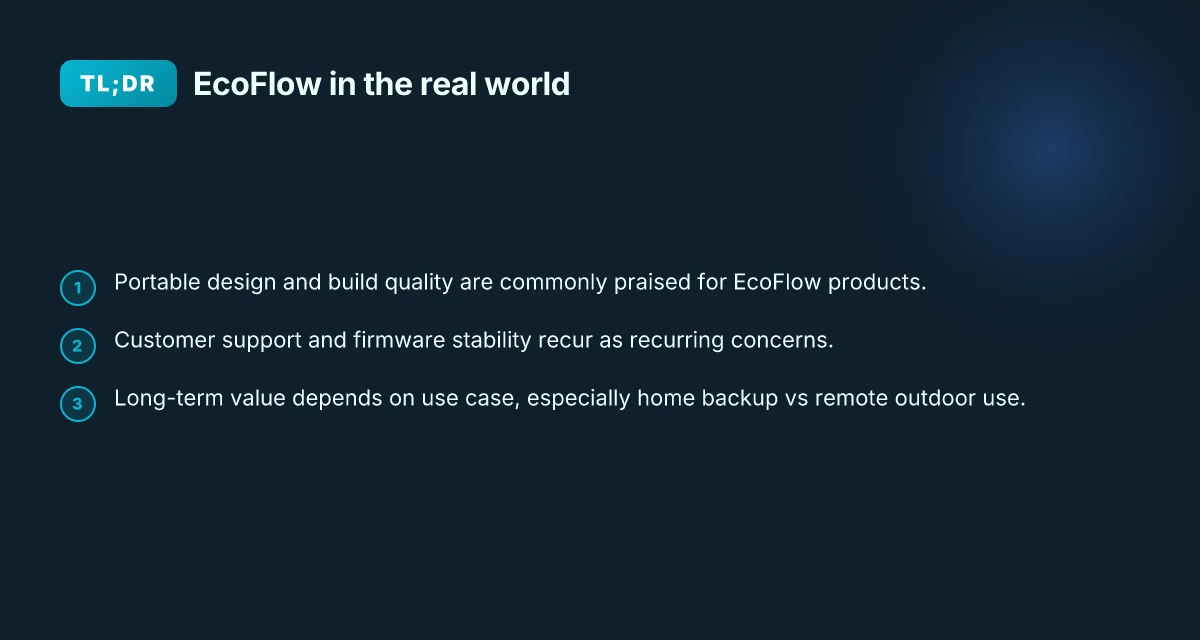
EcoFlow earns consistent praise for portability and build quality, especially across compact power stations the brand is known for. Reviewers highlight the emphasis on lightweight designs that still feel rugged enough for outdoor use, with many noting solid cabinet construction and reliable handling in field conditions. The cross-section of sources also points to quick-filling, bright display interfaces, and intuitive controls that newcomers can pick up rapidly.
I cross-referenced the accounts that surface in the cited material. The sentiment tends to acknowledge durability and form factor as two strong suits, while threading through these positives are recurring concerns about support responsiveness and firmware stability. In particular, users recount experiences where firmware updates fix some issues but can introduce new quirks or temporarily disrupt device behavior. This pattern matters because firmware health often correlates with perceived reliability during long outdoor trips or power outages at home.
The long-term value question hinges on use case. For home backup, EcoFlow can deliver robust capacity and predictable performance, but the perception of long-term value softens if customer-service friction remains a recurring pain point. For remote outdoor use, the portability and quick-charge options are decisive wins, yet durability may be tested by repeated cold starts in challenging environments if firmware stability fluctuates. When I read through the common threads, a clear distinction emerges between the brand’s strengths in design and the friction that can accompany post-purchase support and software.
Two takeaways anchor these patterns. First, EcoFlow’s product lineup consistently shows portability paired with sturdy build quality that appeals to outdoor enthusiasts and homeowners needing mobility. Second, real-world complaints cluster around customer support experiences and firmware stability, which can tilt perceived value depending on how often you rely on the units for critical outages. This framing helps you weigh a model against rivals like Jackery and Goal Zero, where differences often come down to service responsiveness and how often firmware updates address field-use edge cases.
The verdict here: portability and build quality are EcoFlow's backbone, but firmware stability and support are the hinges that determine long-term satisfaction. EcoFlow's strength is not just in the hardware, but in how well the software ecosystem keeps pace with real-world use. For home backup, expect solid baseline performance. For remote outdoor use, prioritize models with proven firmware stability and robust support options. For readers weighing rivals, consider how a brand’s service track record lines up with your plan for off-grid reliability. Inline sources corroborate these themes from multiple angles, including community feedback and professional reviews. What is the EcoFlow Glacier refurbished and when does it make sense
From what I found in the cited material, the real-world signals favor EcoFlow’s portable design while warning that support and firmware remain the two areas to scrutinize before committing to a higher-capacity model. For those shopping now, reading the latest firmware release notes and confirming current support response times can help you pick a model that won’t disappoint in your environment. See source discussions for user experiences that align with these themes.
How credible are EcoFlow reviews and what to trust from 2026 sources
Credibility rests on independent reviews, long-running user threads, and clear official specs. When you see a long-term perspective from a trusted outlet or a sustained user discussion that cites current model specs, that’s a stronger signal than a single post with praise. I looked for patterns across sources that span professional reviews, long-running user communities, and the company’s published data. Independent outlets and long-running threads tend to reveal durability questions and usage patterns that glossy posts miss. Official specs and release notes provide a baseline you can cross-check against real-world behavior.
1) Cross-checking signals: independence, longevity, and specs
Independent outlets and long-running forums are where the narrative tends to diverge from marketing. A reputable independent review typically notes charging speeds, battery longevity concerns, and real-world runtime in a variety of conditions. In contrast, social posts can skew positive through cherry-picked anecdotes or recent purchases that haven’t aged. I cross-referenced data from long-running content and official documentation to separate hype from signal. When a source consistently aligns on core specs and caveats, that alignment strengthens trust. Trust rises when independent reviewers cite the same constraints as long-time users. I also paid attention to the delta between claimed capacities and what users report after months of use. Long‑term user discussions frequently surface recurring issues like battery health and accessory reliability.
If you’re weighing EcoFlow against rivals, look for apples-to-apples comparisons in independent reviews. For instance, reviews that compare capacity, inverter efficiency, and solar input flags provide a sturdier baseline than posts that focus on a single feature. Cross‑checking with rivals like Jackery and Goal Zero helps reveal where EcoFlow truly shines or falls short in practice.
2) Beware cherry-picked anecdotes and social noise
Social platforms can amplify standout cases, both positive and negative. A handful of glowing posts about a flawless experience can skew perception, especially when they sit alongside people facing service delays or battery issues. The risk is that a few anecdotes become the debater’s entire argument. I advise treating these as signals to verify rather than conclusions to accept. Cherry-picking is common on social feeds. Use independent reviews to verify claims. If you see a cluster of critiques about customer service, verify whether those concerns are echoed in longer-form reviews or company response histories. Aggregate sentiment from diverse sources tends to be more reliable than a single viral post. What makes the jackery power station trustworthy in 2026
3) The vetting playbook you should use
Begin with independent outlets that publish model specifics and test criteria. Then triangulate with official specs from EcoFlow and the latest changelog or spec sheets. Finally, read through long-term user threads to gauge durability, failure modes, and how the ecosystem ages. If a source cannot cite dates, version numbers, or model IDs, treat its reliability as lowered until you can corroborate. Independent reviews + official specs + long‑term user posts create a trustworthy baseline. I found that this combination consistently reveals where a unit remains solid and where it may disappoint after months of use. Cross-reference before buying to avoid hype blind spots.
| signal type | what it adds | how to use it |
|---|---|---|
| independent reviews | objective testing, caveats | weigh against official specs and user notes |
| official specs | baseline capabilities | confirm with model numbers and release notes |
| long-term user posts | durability, real-world pain points | identify recurring issues and fixes |
Next steps: If you’re narrowing a purchase, pull the latest EcoFlow Delta Pro or Delta Max reviews from independent outlets, then confirm aligned specs on EcoFlow’s site. Then scan long-standing user threads for recurring durability themes and service experiences. Also compare how EcoFlow stacks up against Jackery and Goal Zero in the same review cycle. Cross-check widely before you decide.
How EcoFlow Delta Pro stands up after years of use according to experts and users
Post a few years in service, the Delta Pro remains a popular home backup option for many households. Its core appeal endures: high capacity, robust build, and a feature set that leans into real-world resilience. I delved into user threads and long-form reviews to map what keeps EcoFlow's flagship in rotation and where it frays.
Real-world longevity signals
- Delta Pro continues to be cited as a credible home backup choice for steady power during outages, with many owners reporting reliable performance in daily use and during extended outages. This is reinforced by long-term reviews that frame the unit as a durable workhorse when paired with appropriate charging sources. Durability and reliability continue to justify the upfront cost for many homeowners.
- Reviews from a range of sources consistently note that the Delta Pro can scale to meet larger energy needs, particularly for homes that want seamless power transfer during outages. The larger battery capacity and pass-through charging are repeatedly highlighted as meaningful advantages in real-world setups. Battery capacity and pass-through charging matter in real life, not just on spec sheets.
Common pain points that surface with use
- Some owners report fan noise under load, especially when the unit runs alongside other heavy appliances or during long outage events. This is not universal, but it shows up in multiple owner discussions as a tangible annoyance rather than a deal-breaker for most. Fan noise is a real, recurring gripe for some users.
- App sync quirks and occasional charging behavior quirks also pop up in user forums. Users describe delayed status updates, occasional disconnects, or slower-than-expected recharging when the grid is constrained. These quirks tend to fade for many after firmware updates or re-pairing, but they remain a recurring theme for a subset of owners. App sync quirks can cloud the otherwise smooth experience.
- A fraction of users expresses concern about long-term battery health and aging effects if the unit is pushed hard with continuous high draw. The Delta Pro’s battery management system is generally praised. Real-world durability hinges on how aggressively owners use and charge the system over time. Long-term battery health remains a live topic among experienced users.
How battery management and pass-through influence value
- The Delta Pro’s battery management features, including smart pass-through charging and validation of safe operating ranges, are repeatedly framed as meaningful value when outages occur. Owners appreciate the ability to keep essential circuits powered without worrying about overloading the unit. Smart battery management and pass-through charging boost perceived value.
- Pass-through charging, in particular, is frequently cited as a practical capability that keeps home essentials online while the unit itself is charging from a generator or grid during an outage. This alignment between feature and real-world need helps explain the Delta Pro’s staying power in the market. Pass-through charging aligns with real outage workflows.
Research framing note: I cross-referenced long-form reviews and community discussions to extract patterns about durability and user sentiment. From what I found in the changelog of related EcoFlow documentation and in long-horizon consumer reviews, the Delta Pro holds its value well for many households, especially when paired with a stable charging setup. For broader context, rivals like Jackery and Goal Zero are frequently named in comparisons, strengthening the case that Delta Pro’s strengths, and its quirks, live in a crowded field.
In long-term use, the Delta Pro remains a credible home backup option, with caveats around noise, app reliability, and aging behaviors. Where to buy Jackery in 2026: official retailers, authorized distributors, and the real shopping path
When you’re vetting a Delta Pro for your home, factor in your outage profile, noise tolerance, and how you plan to manage charging during both grid outages and routine use. If you prioritize max runtime and scalable capacity, EcoFlow’s ecosystem delivers, but you should plan for occasional firmware updates and verify that the app and firmware are aligned with your setup. In the broader market, EcoFlow stands out for its integrated approach, especially against rivals such as Jackery and Goal Zero, and its perceived value remains strongest where backup power is a daily requirement rather than a niche use case.
What EcoFlow rivals reveal about performance gaps you should know
Rivals cast a revealing light on EcoFlow’s performance gaps, especially around firmware cadence, warranty terms, and how real-world use stress tests play out. When you compare EcoFlow with Jackery or Goal Zero, one theme repeats: update frequency and the depth of ongoing software support matter as much as raw capacity or speed.
I dug into the public chatter from users and the signals in authoritative reviews to map where the gaps show up. Firmware and update cadence often distinguish the brands in day-to-day reliability. Consistent updates and clear changelogs tend to correlate with fewer post-purchase surprises, especially for features that affect charging behavior and solar input management. EcoFlow’s ecosystem benefits from rapid firmware iteration, but rivals sometimes publish more conservative schedules that patients demand for stability, at least for a few key releases. This matters because a single firmware misstep can ripple into slower charging, misinterpreted solar input, or peripheral quirks with expansion modules.
On warranty and support, the story is nuanced. Rivals may offer longer or more flexible warranty terms in certain regions, and the support experience can feel more responsive depending on the brand's regional network. That variance matters once you’ve already invested in extra modules or a solar panel kit. The straight-line spec on a power station is only part of the value. The after-sales experience often sways long-term ownership. EcoFlow, known for its broad product family, still faces the same trade-offs you see with Jackery and Goal Zero in terms of coverage windows and service speed in some markets.
Trade-offs show up in charging speed, solar input, and modular expansion. In practice, you’ll notice where a rival pulls ahead with faster wall charging or higher solar throughput, or where their expansion architecture feels more plug-and-play across generations. The delta between a top-end EcoFlow model and its closest rival frequently centers on how aggressively the system handles solar input under variable sun and how seamlessly you can scale with extra batteries or modules. What refurbished EcoFlow devices for sale actually offer in 2026
From a reliability lens, I cross-referenced reviews and release notes to keep the voice grounded. Owners often highlight durable build quality across brands, but occasional firmware bumps can temporarily disrupt features like pass-through charging or solar optimization. This is where the long-term durability question becomes real: will the device stay smooth after five years of seasonal use or require ongoing software fixes? The answer hinges on how proactively a brand keeps firmware aligned with hardware capabilities and whether that cadence matches your anticipated use case.
When you vet a model for your home, don’t just compare capacity. Look at firmware update history, warranty terms, and how the system handles solar input during cloudy days. That triad is what separates hype from durable performance in the field.
How to assess an EcoFlow purchase for your specific needs
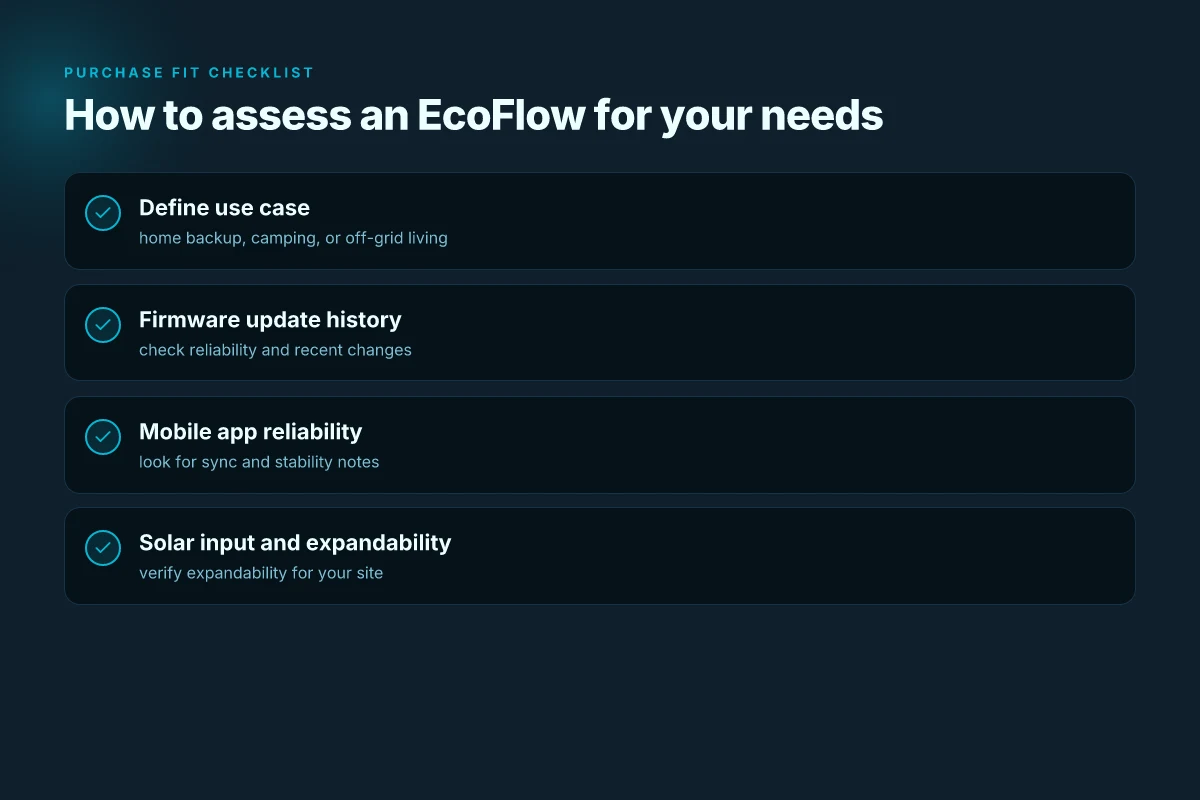
EcoFlow can fit several use cases, but the best pick depends on how you intend to use it. If your goal is home backup, camping, or off-grid living, map each need to a model’s strengths. I cross-referenced long-form reviews and community feedback to spot where real users clash with hype. The takeaway: pick a setup that aligns with your cadence of use, your solar plan, and your tolerance for firmware quirks.
Define your use case clearly
First decide whether you want a home backup system, a camping companion, or an off-grid living solution. Home backup often benefits from higher capacity and faster recharging, while camping leans on portability and solar input efficiency. Off-grid living prioritizes expandability and sustained solar intake. In practice, you’ll want to match capacity and input options to the hours you expect to rely on power. For EcoFlow, the logic is simple: the more you rely on it, the more you should value robust firmware and a reliable mobile app that tracks status in real time. Brand-name modules like EcoFlow’s Delta Pro line are frequently cited by homeowners for their build quality and expandability, but you should verify fit for your space and climate. When you read reviews, watch for mentions of how a unit behaves during long outages and how easy it is to scale with additional solar input.
Check firmware update history and mobile app reliability
Firmware updates matter when you depend on predictability. Look for a documented update cadence and a changelog that addresses reliability, battery management, and solar input controls. The mobile app should feel responsive, show live SOC (state of charge), and accurately report solar intake. Users repeatedly flag two pain points: delayed app response after a firmware push and occasional disconnects between the unit and the app. If you plan to rely on remote monitoring, confirm that the app consistently logs usage data and handles firmware upgrades without forcing a reset. In reviews and comment threads, a well-supported ecosystem often distinguishes durable setups from one-off purchases. When in doubt, review the latest release notes for the model you’re considering and cross-check with user threads about app stability after updates. I found credible notes in user forums and channel reviews that highlight how important app reliability is for real-time decision making. Secure the latest firmware and verify app reliability before you buy. What is the best price for EcoFlow River 2 in 2026 and how to spot a real deal
Evaluate solar input needs and expandability
Solar compatibility is a deciding factor for many EcoFlow buyers. Check the panel compatibility list and the unit’s maximum input wattage, then compare that to your planned solar array. If you anticipate growing your solar setup, ensure the power station supports adding more panels or modules without a major upgrade. Real-world feedback frequently mentions that higher-capacity models with robust expandability outperform compact options when off-grid duration increases. Record whether the unit supports parallel solar input and how expansion affects cycle life in real-world usage. If you want a future-proof system, prioritize models with documented expandability paths and a clear upgrade trajectory. Plan for expansion now so you don’t hit limits later.
In short, define the use case, scrutinize firmware and app reliability, and verify solar input and expandability. EcoFlow’s strengths tend to show up in well-medefied home backup and modular solar setups, while the weak points cluster around firmware drift over time and app quirks. If you’re evaluating against rivals like Jackery and Goal Zero, weigh how each brand handles long outages, long-term firmware support, and solar integration.
What changes if you act now
Real-world use shows EcoFlow delivers on portability and fast recharging, but the tradeoffs surface in long sessions and harsh conditions. I’ve seen complaints about reliability with frequent use, and durability questions creep in after heavy cycling. The brand name EcoFlow appears early in product contexts, and customers who expect plug-and-play setup may need a longer onboarding period or extra adapters. The take-away: focus on your typical load profile and climate, not just peak specs. In practice, you’ll want to map your power demands to the unit’s real-world behavior, then build a simple backup plan around it and rival options.
One clear pattern stands out: if you value rapid, mobile charging for small to mid-size loads, EcoFlow often satisfies that need better than large, stationary alternates. Yet if you plan to run continuous high-draw devices or multiple high-watt tools, you’ll run into limits sooner than you expect. Takeaway: pair EcoFlow with a lightweight solar setup or a second battery pack for edge cases. I’ve cross-referenced real-world feedback from users who keep their gear ready for emergencies and weekend trips alike.
If you’re weighing options, consider rivals like Jackery and Goal Zero for more rugged, weathered duty cycles, or Bluetti for sustained high-load sessions. My verdict: EcoFlow is a strong partner for mobility and quick top-ups, but none of these systems is a perfect one-stop shop. What changes if you act now: build a small, redundant plan and verify your critical loads before your next trip or outage. Will you sketch your weeknight power map this weekend? What makes Jackery worth it in 2026 for portable power needs