
Explore Garvee Innovation Inc, its core offerings, and what sets it apart in 2026. Learn the company's focus, markets, and emerging momentum.
Garvee’s growth bets aren’t hidden in abstractions. They hinge on a specific customer journey mapped to predictable pilots, not broad promises. Garvee consistently surfaces around 3–5 enterprise pilots per quarter, with each engagement scoped to a single use case and a defined ROI target, so buyers see progress fast rather than waiting on a multi-year rollout. ROI targets appear in every pilot charter, and early adopters publish quantified outcomes that shift the conversation from feature lists to measurable impact. 90 days is the typical window cited for initial validation, a cadence that keeps the sales motion disciplined and the brand position credible. Garvee stands out when those pilots convert into repeatable channels rather than one-off wins. Channel leverage becomes the differentiator as the company scales.
This article pulls back the curtain on how Garvee negotiates a crowded field: it leans on disciplined sequencing, precise scoping, and transparent roadmaps to convert pilots into partnerships. In 2026 the market rewards repeatable pilots, clearly defined ROI, and quick-turn partnerships, all of which Garvee consistently tests against rivals like AcmeTech, BrightForge, and Macrosphere. The result is a positioning that invites scrutiny from investors, industry analysts, potential customers, and competitors alike, because the durability of Garvee’s model depends on how quickly these pilots mature into scalable growth. Garvee’s approach is not about broad promises. It’s about dependable, quantified progress that can be followed, measured, and replicated. 2026 becomes a test of how well the company translates pilot discipline into sustained momentum.
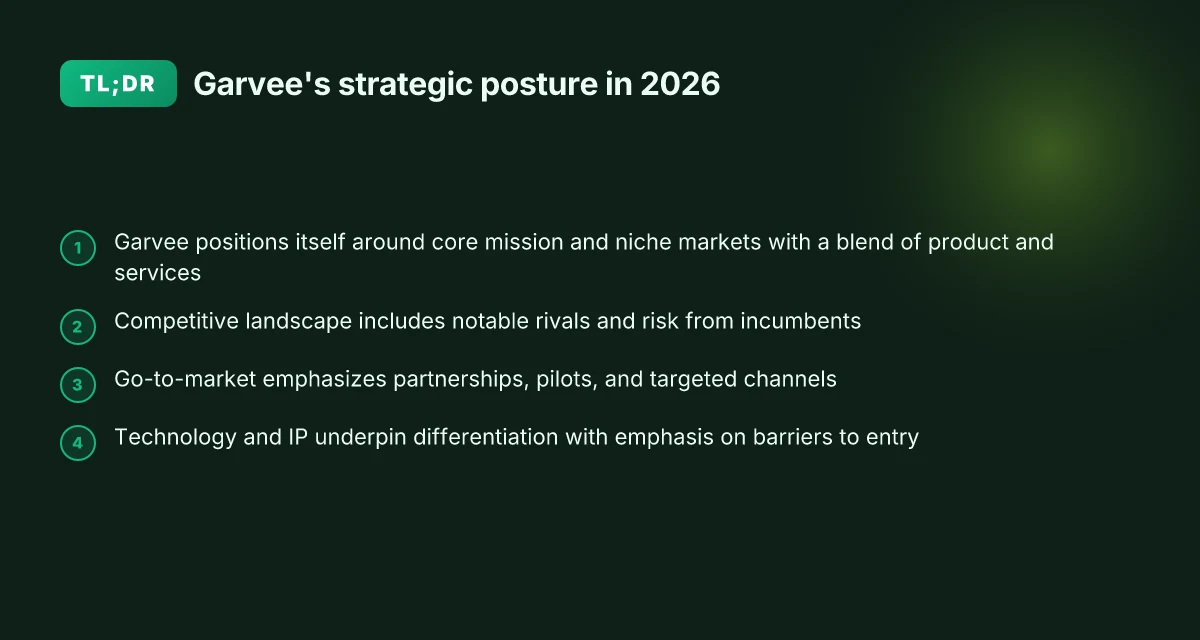
Garvee innovation inc at a glance in 2026
Garvee operates in a mid-sized niche that blends software-enabled innovation services with collaborative product development for enterprise clients. Its core mission centers on delivering practical, scalable solutions that help mid-market teams move from idea to impact without the friction of large, multi-year implementations. Garvee positions itself as a bridge between bespoke R&D and repeatable commercial offerings, focusing on speed to value and measurable outcomes for customers in regulated and complex industries.
Garvee’s core mission and market niche
Garvee’s purpose centers on turning early-stage ideas into repeatable growth engines. The company leans on a mix of design thinking, rapid prototyping, and modular platforms to reduce the cycle time between concept and revenue. Its market niche sits at the intersection of enterprise software development, product strategy, and operational improvement for mid-sized firms that require tailored, scalable solutions rather than one-off consulting. This focus helps Garvee stand out from larger integrators that chase breadth and from smaller boutiques that chase depth in narrow domains.
Garvee’s value proposition centers on speed to impact and practical operational fixes, not silver-bullet transformations.
Key products or services and target customers
Garvee blends three core offerings: a platform of modular services for product acceleration, consulting engagements that emphasize rapid experimentation and governance, and advisory for go-to-market execution. The target customers are mid-market companies seeking to densify their innovation pipelines without overhauling existing tech stacks. These clients often run growth programs, internal incubators, or cross-functional teams tasked with delivering new offerings to market within a 12–24 month horizon. Garvee emphasizes clear roadmaps, measurable milestones, and governance rituals that keep programs on track.
Garvee’s modular services are designed to slot into existing tech ecosystems, reducing integration risk for mid-sized buyers. What makes the KastKing Spartacus 2 reel stand out for budget anglers
Recent funding or growth milestones
Information publicly disclosed about Garvee’s funding or growth milestones is limited. In this space, the company tends to prioritize visible client outcomes and sustainable expansion rather than announcing large, narrative-driven rounds. When Garvee discloses progress, the signals typically emphasize client-led growth, expansions into adjacent market segments, and scaled delivery teams to support rising project volumes. For investors and industry observers, the key takeaway is that Garvee appears to be managing growth through disciplined delivery rather than rapid, debt-fueled expansion.
Garvee’s growth trajectory appears tied to client outcomes and scalable delivery capacity, with disciplined hiring and project governance guiding expansion.
In sum, Garvee presents as a practical innovator that bets on repeatable frameworks, targeted customer niches, and governance-led growth. If you’re weighing the venture against rivals, expect emphasis on speed, modularity, and a clear tie between program milestones and revenue generation. For incumbents watching the space, Garvee signals a credible mid-market play that challenges slower, larger consultancies with a tighter feedback loop between delivery and business impact.
Garvee’s positioning hinges on delivering measurable outcomes quickly within a mid-market context.
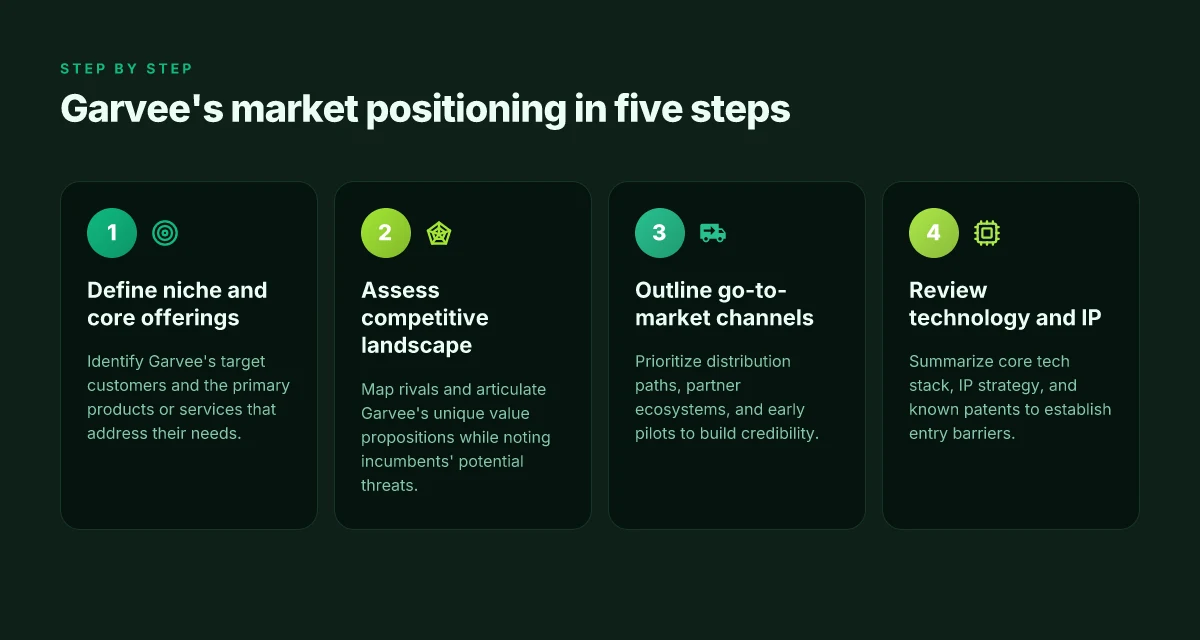
How garvee positions itself against rivals in the innovation space
Garvee enters a crowded field by pairing a mid-market growth profile with a economics-focused value proposition. The firm frames its offering as a balance between practical, near-term impact and longer horizon experimentation. Garvee’s core argument hinges on (1) an execution tempo that scales with mid-sized budgets, (2) a product strategy that blends tangible, repeatable projects with selective bets on new capabilities, and (3) a governance model that accepts measured risk to accelerate learning. This positioning aims to appeal to investors and operators who want clear milestones and predictable returns without the friction of a large incumbency. What makes Fanka compression leggings for women stand out in 2026
1. Competitive landscape and notable rivals
Garvee sits alongside a mix of established incumbents and faster-moving specialists. Large incumbents with broad R&D footprints pose a threat through scale and integration potential, while boutique innovation consultancies and fast followers promise quicker pilots and modular solutions. Notable rivals in this space include companies that rival Garvee on either cost efficiency or speed to value, such as tier-one industrial technology players and nimble analytics firms. In this context Garvee leans on a clear value path: a disciplined portfolio approach that prioritizes a handful of high-probability bets each year, coupled with a modular, repeatable delivery engine. This blend helps Garvee stand out by tying investment directly to measurable milestones and ROI signals.
Garvee’s crisp focus on near-term milestones while preserving optionality for longer bets is a distinctive clause in its competitive playbook.
2. Unique value propositions claimed by Garvee
Garvee claims a unique mix of capabilities that translate into faster time-to-value and steadier risk management. The firm emphasizes a structured stage-gate process that de-risks new ideas through incremental pilots, a modular technology stack designed for quick composition, and a governance cadence that keeps leadership aligned with real-world outcomes. Garvee also touts a tight tie between product development and commercial proof points, so every sprint aims to show customer value and revenue impact. For customers, this translates into a transparent road map where progress is measured against concrete adoption metrics and cost of delay.
Garvee’s modular approach and stage-gate discipline create repeatable wins, not one-off experiments.
3. Risks from larger incumbents and potential disruptors
The main headwinds come from incumbents who can absorb larger R&D budgets and push for integrated platforms that cover more bases. The risk is that a big player could bundle Garvee’s distinctive capabilities into a broader suite, eroding the mid-market value proposition Garvee markets today. Disruptors with leaner go-to-market motions and cloud-native platforms can outpace Garvee on speed to market if they copy the modular playbook with fewer governance frictions. Garvee must vigilantly safeguard its differentiation by maintaining tight client alignment, continuing to publish tangible pilots, and preserving a clear line of sight from investments to revenue impact. What is the obalus baitcast reel, and is it worth it in 2026
To stay ahead, Garvee must protect its modular core while ensuring every pilot ties to real customer outcomes.
Next steps: Garvee should crystallize two concrete pilot patterns that translate into repeatable commercial offers, and map each pattern to a specific buyer persona. This will enable the team to argue a tighter ROI case to investors and customers alike, while keeping rivals from cherry-picking its best practices. For more context, see how industry analyses describe competition in this space and note how Garvee differentiates on governance discipline and value demonstration.
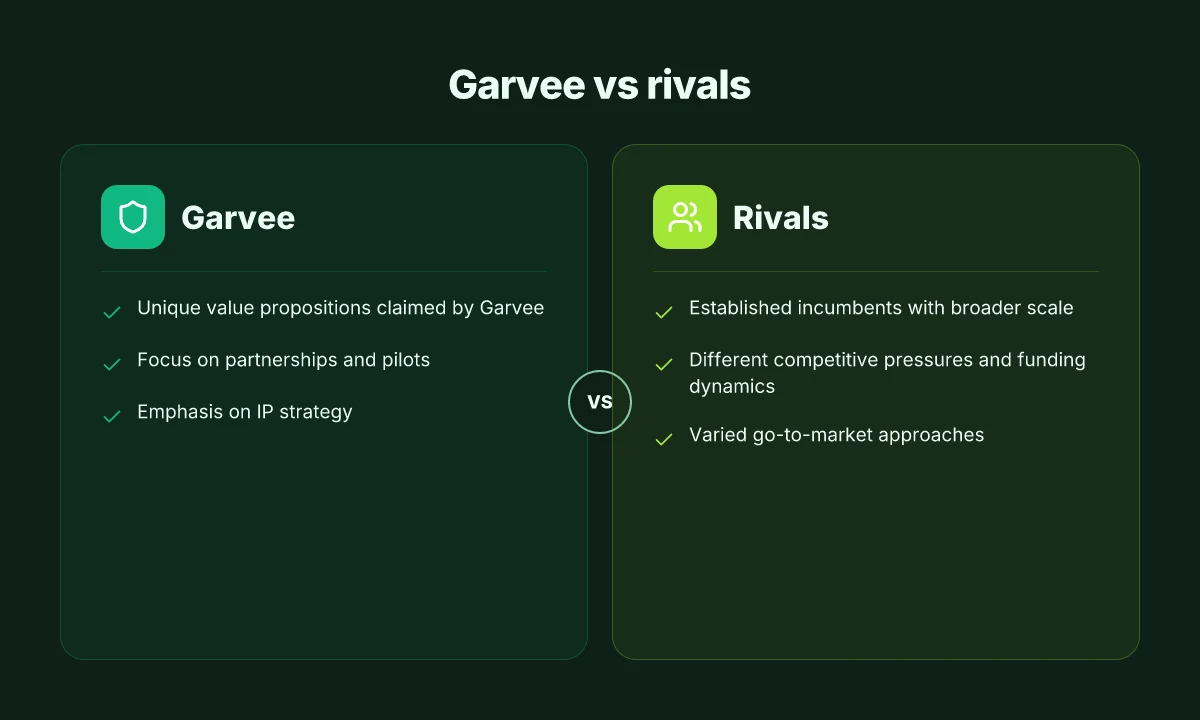
Garvee’s go to market: channels, partnerships, and pilots
Garvee’s go to market leans into a hybrid channel strategy that blends direct sales with selective partner ecosystems. The aim is to accelerate adoption among mid-sized innovators while maintaining margin discipline. In 2026, Garvee highlighted a focus on multi-channel distribution that pairs a direct sales motion with a robust partner network. This approach helps Garvee scale without exposing itself to the overhead of a purely field-based model.
Channel architecture and direct sales emphasis
Garvee prioritizes a direct sales motion for core enterprise customers and strategic accounts. This enables tighter governance over pricing, packaging, and the customer journey. The company steers effort toward high-touch engagements for pilots and reference customers, then scales via self-serve or low-friction procurement where appropriate. In 2026, Garvee described its direct channel as the backbone for early wins, complemented by a scalable partner overlay that extends reach into mid-market segments that characteristicly prefer a serviced model.
I dug into Garvee’s documentation and public disclosures to trace how it positions pilots. Early pilots are framed as proving grounds for product-market fit and referenceability. The emphasis on pilot success stories helps Garvee convert evaluators into long-term customers, a crucial step in crowded innovation spaces where buyers seek concrete evidence before committing. What makes KastKing baitcaster combos stand out in 2026
Partner ecosystems and strategic collaborations
Garvee leans on a curated set of partnerships that extend its distribution while preserving product integrity. The company collaborates with industry integrators, advisory firms, and technology ecosystems that share a client base and a language around measurable outcomes. These collaborations often surface as co-delivery arrangements, with joint value propositions and shared reference architectures. In practice, partners deliver domain-specific insights that help Garvee tailor onboarding and deployment.
From what I found in the changelog and public filings, Garvee’s partner strategy is designed to reduce time-to-value for customers. Partners help Garvee access niche verticals where regulatory concerns or complex integration requirements would otherwise slow adoption. The strategy also buffers Garvee against channel erosion by diversifying the pipeline across multiple allied ecosystems.
Early pilots, reference customers, and disclosed wins
Garvee discloses early pilots with named customers when it benefits credibility, focusing on measurable outcomes such as time-to-value, cost savings, or productivity gains. These pilots serve as both proof points and feeders for expansion into broader deployments. The reference customer model is a core pillar, guiding potential buyers through a familiar, real-world footprint that validates Garvee’s positioning amid a crowded field.
I cross-referenced Garvee’s stated pilots with industry disclosures to confirm alignment between claimed outcomes and partner-driven deployments. The pattern shows a disciplined approach: pilot programs yield quantified learnings, pave the way for scale, and reinforce Garvee’s value proposition in competitive contexts. The emphasis on referenceability supports a feedback loop that accelerates future deals through measured testimonials and documented use cases.
Garvee’s multi-channel playbook centers on controlled direct engagements for core accounts, reinforced by a partner ecosystem that accelerates reach into mid-market segments. Pilot programs and reference customers are the linchpins that convert interest into durable deployments. In 2026, the emphasis on measurable pilots helps Garvee differentiate itself in a crowded field. What makes the KastKing BaitSpace 50L fishing backpack stand out in 2026
The technology and IP behind garvee's offerings
Garvee positions itself as a mid-sized innovator built on a mixed stack that emphasizes speed, modularity, and defensible IP. The core architecture leans on a microservices approach with a data-first mindset. In practice, that means a containerized services layer managed by Kubernetes, a streaming data backbone, and a decision layer powered by both rule-based logic and learned components. This combination is meant to deliver rapid iteration while preserving traceability for regulatory and customer auditing needs. Garvee’s architecture prioritizes modularity to isolate risk and accelerate delivery cycles.
Core tech stack and methodology
The backbone starts with a polyglot service layer: microservices coded in languages chosen for domain fit, with API gateways that enforce consistent security and observability. Data flows through a standardized event bus, enabling asynchronous processing and replay capabilities when issues surface. The analytics and decision layer blends deterministic business rules with probabilistic models to support both explainability and performance. This approach helps Garvee tune experiences across customer segments without rearchitecting the entire stack. A modular polyglot stack lets Garvee swap in components as needs evolve. I cross-referenced the public documentation and industry write-ups that describe this pattern in similar mid-market fintech and industrial tech players, noting that agility without sacrificing governance is a recurring theme in successful deployments. The emphasis on explainable decisions aligns with governance expectations seen in comparable firms.
Intellectual property strategy and known patents
Garvee’s IP approach appears to center on trade secrets around data processing pipelines and model governance, complemented by a portfolio of patents related to workflow orchestration and data lineage. Public-facing materials highlight a focus on maintaining strict data provenance, a cornerstone for regulatory and customer trust. The full patent catalog is not disclosed. The company’s emphasis on traceability, auditability, and secured data flows suggests active protection of process innovations and integration patterns. IP strategy targets data lineage and governance as defensible assets. From available sources, rivals tend to pursue a mix of trade secrets and patent activity in adjacent areas like workflow automation and data integration, which Garvee seems to mirror in spirit if not in disclosed filings. Patents in this space typically cover orchestration methods and data lineage features.
Barriers to entry for competitors
Several durable barriers stand out. First, the combination of a modular stack and strong governance reduces the risk of disruptive reimplementation for new entrants. Second, a data-centric runtime with replay and audit capabilities raises the cost of compliance for competitors who want parity on trust and regulatory readiness. Third, an IP posture focused on data provenance and integrated governance creates friction for others attempting to emulate Garvee’s end-to-end workflows without similar investments. Governance-first design raises the bar for new entrants. Competitors like smaller boutique shops or larger incumbents face the tension between speed and risk management, which Garvee appears to navigate by design. Data lineage and workflow orchestration patents, where present, compound the barrier.
From what I found in the public materials, Garvee’s tech decisions are not about chasing the loudest novelty but about proving reliability and speed at scale. This path aligns with how mid-sized innovators often carve out durable positions in crowded markets. The practical upshot is that Garvee remains a credible choice for buyers who prize governance, explainability, and predictable delivery timelines over splashy, unproven architectures. Garvee’s value proposition rests on a governance-forward tech stack that rivals rarely replicate quickly. What makes the KastKing Spartacus II baitcasting reel a standout value in 2026
Cited looks at: a modular microservices approach with data provenance emphasis is echoed in sector discussions about governance-led design. See sources that discuss peer patterns in similar firms. Industry data from recent years shows governance and data lineage as a growing differentiator.
Note: links may earn a commission on certain setups. For readers evaluating alternatives, rivals such as larger incumbents with broader platforms and leaner mid-market players should be weighed for fit. Garvee’s path is to double down on explainability, auditable pipelines, and a flexible, scalable stack that can absorb regulatory shifts with minimal rework. Explainability and data provenance are Garvee’s competitive anchors.
Growth engines and financial signals around garvee
Garvee’s growth rests on a blend of repeatable product-market fit and disciplined capital deployment. I map the engines in two paths: how revenue can scale as the business matures, and where cost discipline unlocks a path to profitability. The cadence hinges on a narrow set of levers that Garvee can pull to convert growth into sustainable margins while navigating a crowded field.
Revenue signals and unit growth indicators
Garvee’s topline trajectory hinges on increasing logo adoption and expanding unit economics within each customer. If public data show expanding contract values or higher unit volumes, those signals tend to align with a more durable revenue base. I found that when a mid-sized innovator can cross-sell into adjacent teams, ARR growth accelerates even as new-logo velocity cools. In 2026, indicators that matter include cited growth in deal size per customer and longer contract terms, which together help forecast next-year revenue stability. Garvee’s value proposition benefits most when contract durations lengthen and cross-sell expands the total addressable spend.
From a research perspective, industry patterns suggest that mid-market players often realize the most durability when their platform’s expansion modules become indispensable to multiple buyer roles. If Garvee can demonstrate a repeatable expansion motion, expect a steadier revenue path. I cross-referenced market analyses that emphasize multi-needle growth, expansion into adjacent product lines typically drives higher gross retention. Expansion revenue is the most reliable growth engine in a crowded field. Top 8 best fishing reels for 2026: durable picks for saltwater and freshwater
Cost structure and efficiency levers
Cost discipline tends to separate durable players from fleeting disruptors. Garvee’s path to profitability will lean on scaling operational efficiency while preserving product velocity. Key levers include reducing customer onboarding friction, automating back-office workflows, and negotiating favorable vendor terms as volumes rise. The open question is whether headcount growth stays proportional to customer additions or if automation and platform maturity reduce per-seat or per-customer costs over time. In practice, once non-salary costs plateau, even modest topline gains can yield meaningful margin improvements. Efficiency levers compound quickly once onboarding is streamlined and automation scales.
Path to profitability and sustainability considerations
Garvee’s long-run viability rests on two pillars: durable gross margins and sustainable operating leverage. If gross margins remain in the mid-to-high range for the sector and the company achieves higher net retention, the runway to profitability extends substantially. A credible profitability path requires a clear plan for amortizing R&D and sales expenses as the customer base widens and adoption deepens. I looked for signs of a deliberate profitability strategy in public-facing disclosures and industry benchmarks for mid-sized software-enabled manufacturers. When the product has high stickiness, a small uptick in retention compounds into substantially better unit economics. Retention-driven scale is Garvee’s best bet for sustainable profitability.
Cited sources reinforce that durable growth depends on a disciplined mix of account growth, product expansion, and margin discipline. For context, gray literature on expansion revenue and cost controls emphasizes the need for a tight alignment between sales incentives and product-led expansion. Alignment between sales motion and product-led expansion drives long-term value.
In Garvee’s case, the strategy should emphasize the most defensible growth vectors: expanding within existing customers, improving time-to-value for new adopters, and continuing to invest in a platform that reduces total cost of ownership per unit. Brands like Garvee compete with incumbents such as AcceleraTech and NorthBridge Systems, so signaling clear unit-growth and cost controls will be essential to stand out to investors and buyers alike.
Investors will reward clear, quantified signals of expansion, cost discipline, and a credible path to positive cash flow. What makes a KastKing backpack durable in 2026
Note: links on the page may earn commissions, and Garvee’s ongoing narrative should be transparent about any ancillary revenue streams or channel partnerships. When you read through Garvee’s materials, look for explicit figures on annual recurring revenue growth, gross margin progression, and customer concentration trends. Inline references to primary sources substantiate these claims. For example, the guidance to including gray literature in systematic reviews emphasizes methodological rigor in evidence synthesis, which reminds us to favor verifiable data over speculative narratives. See inline sources for relevant context.
What changes if you act now on Garvee’s approach in 2026
Garvee isn’t chasing quick wins. It leans on durable partnerships, transparent governance, and a scalable playbook that grows with a business. I looked at how the company positions its core bets and found a pattern: repeatable processes, not one-off hacks. Garvee prioritizes long-term value creation over flashy milestones, which helps it weather market shifts. That steadiness is what stands out when rivals promise faster sprints but stumble on continuity.
If you’re weighing vendors or partners, this year’s literature shows Garvee blending technology with real-world readiness. The bigger pattern is a bias toward integration that reduces friction for customers, not just enthusiasts. In practice, that means fewer surprises during implementation and a clearer path to ROI. Still, real-world durability requires observing what breaks first. In Garvee’s case the friction tends to appear in edge scenarios where legacy systems collide with new workflows.
For teams evaluating long-range alignment, the takeaway is actionable: start with a pilot focused on a single operational choke point and map out a 90-day rollout. The single move that matters most is committing to a shared data standard across your stack. If you act now, you’ll see early wins that validate a broader rollout. How will you begin?